书单
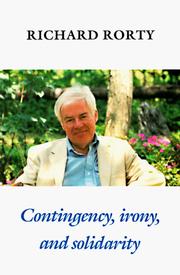
偶然、反讽与团结:一个实用主义者的政治想像 (1989)
- 作者
- 理查德·罗蒂
- 首版
- 1989 年
- 国家/地区
- 美国
- Open Library
- 4 个版本
百科
这个词条暂时没有中文维基百科条目,下面是英文维基百科的内容(英文原文):
Contingency, Irony, and Solidarity is a 1989 book by the American philosopher Richard Rorty, based on two sets of lectures he gave at University College, London, and at Trinity College, Cambridge. In contrast to his earlier work, Philosophy and the Mirror of Nature (1979), Rorty mostly abandons attempts to explain his theories in analytical terms and instead creates an alternate vocabulary to that of the "Platonists" he rejects. In this vocabulary, "truth" (as the term is used conventionally) is considered unintelligible and meaningless.
The book is divided into three parts: "Contingency", "Ironism and Theory", and "Cruelty and Solidarity".
Part I: Contingency
1) The contingency of language
Here, Rorty argues that all language is contingent. This is because "only descriptions of the world can be true or false", and descriptions are made by humans who must also make truth or falsity: truth or falsity is thus not determined by any intrinsic property of the world being described. Instead, they purely belong to the human realm of description and language. For example, a factual case of green grass is neither true nor false, in and by itself, but that grass is green may be true. One could say that that grass is green and another person could agree with the statement (which for Rorty makes the statement true), but the use of the words to describe grass is distinct and independent of the grass itself.
Apart from human expression in language, notions of truth or falsity are simply irrelevant, or maybe inexistent or nonsensical. Rorty consequently argues that all discussion of language in relation to reality should be abandoned and that one should instead discuss vocabularies in relation to other vocabularies. In coherence with this view, he thus states that he will not exactly be making "arguments" in this book, because arguments, as expression mostly within the domain of a given vocabulary, preclude novelty.
2) The contingency of selfhood
Rorty proposes that each of us has a set of beliefs whose contingency we more or less ignore, which he dubs our "final vocabulary". One of the strong poet's greatest fears, according to Rorty, is that he will discover that he has been operating within someone else's final vocabulary all along; that he has not "self-created". It is his goal, therefore, to recontextualize the past that led to his historically contingent self, so that the past that defines him will be created by him, rather than creating him.
3) The contingency of a liberal community
Rorty begins this chapter by addressing critics who accuse him of irrationality and moral relativism. He asserts that accusations of irrationality are merely affirmations of vernacular "otherness". We use the term "irrational" when we come across a vocabulary that cannot be synthesized with our own, as when a father calls his son irrational for being scared of the dark, or when a son calls his father irrational for not checking under the bed for monsters. The vocabulary of "real monsters" is not shared between father and son, and so accusations of irrationality fly. As for moral relativism, for Rorty, this accusation can only be considered a criticism if one believes in a metaphysically salient and salutary moral, which Rorty firmly does not.
Rorty then discusses his liberal utopia. He gives no argument for liberalism and believes that there have been and will be many ironists who are not liberal, but he does propose that we as members of a democratic society are becoming more and more liberal. In his utopia, people would never discuss restrictive metaphysical generalities such as good, "moral", or "human nature", but would be allowed to communicate freely with each other on entirely subjective terms.
Rorty sees most cruelty as stemming from metaphysical questions like, "what is it to be human?", because questions such as these allow us to rationalize that some people are to be considered less than human, thus justifying cruelty to those people. In other words, we can only call someone "less than human" if we have a metaphysical "yardstick" with which to measure their prototypical human-ness. If we deprive ourselves of this yardstick (by depriving ourselves of metaphysics altogether), we have no means with which to dehumanize anyone.
Part II: Ironism and Theory
4) Private irony and liberal hope
Rorty introduces a term that he believes effectively describes the status of a person holding the "axioms" set out in the first three chapters. This person is an ironist. An "ironist", according to Rorty, is someone who fulfils three conditions: (1) She has radical and continuing doubts about the final vocabulary she currently uses because she has been impressed by other vocabularies, vocabularies taken as final by people or books she has encountered; (2) she realizes that arguments phrased in her present vocabulary can neither underwrite nor dissolve these doubts; (3) insofar as she philosophizes about her situation, she does not think that her vocabulary is closer to reality than others, that it is in touch with a power, not herself.
5) Self-creation and affiliation: Proust, Nietzsche, and Heidegger
Rorty views Proust, Nietzsche, and Heidegger each as different types of ironists. In Remembrance of Things Past, Proust almost perfectly exemplifies ironism by constantly recontextualizing and redefining the characters he meets along the way, thus preventing any particular final vocabulary from becoming especially salient. Nietzsche is an ironist because he believes all truths to be contingent, but he tends to slip back into metaphysics, especially when discussing his superman. Heidegger is an ironist because he has mostly rejected metaphysics and its conception of language as a means to an end, but his discussion of elementary words forces him to propose a "universal litany" (or "universal poem"), that does not exist, because every great ironic "poet-thinker" (such as Nietzsche, Proust and Heidegger) has a very particular, subjective and contingent one.
以上文字摘自英文维基百科「Contingency, Irony, and Solidarity」(有删节,去掉了参考文献等尾部小节),按 CC BY-SA 4.0 使用,作者为维基百科的各位编者。
资料卡
- 原题
- "Contingency, Irony, and Solidarity"
- 原作语言
- 英语
- 首次出版
- 1989 年
- 首版出版社
- 剑桥大学出版社
- 主题
- 哲学
资料卡来自 Wikidata Q5165349(CC0),众包数据,个别字段可能不全。