书单
百科
这个词条暂时没有中文维基百科条目,下面是英文维基百科的内容(英文原文):
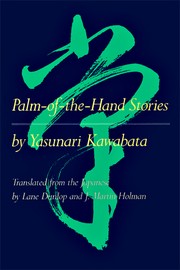
Palm-of-the-Hand Stories (掌の小説, Tenohira no shōsetsu or Tanagokoro no shōsetsu) is the name Japanese author Yasunari Kawabata gave to the type of short stories he wrote during his long career. The earliest of these stories were published in the early 1920s, with the last appearing posthumously in 1972.
The first Japanese collection under this title appeared in 1952 and contained 100 stories in two volumes. In 1971, an expanded edition was published with 111 stories, and in 1989 there was a further expansion with 122 stories (based on the 1981 publication of Kawabata's complete works). Some scholars have classified as many as 146 such stories in total. The name refers to the brevity of the stories – many of which are only two to three pages long – which would "virtually fit into the palm of the hand".
Style and themes
For Susan J. Napier in the Monumenta Nipponica, Kawabata's brief stories express the facets of his novels, while at the same time "providing an intensity of focus that is the essence of Kawabata's celebrated 'haiku-esque' style", working with "evocations and suggestions". Often, the stories focus "on feelings rather than understanding", presenting "the chaos of the human heart", and depict "epiphanies, transformations and revelations". Reviewers also pointed out a "delicate lyricism" and "warmth and fragility" as well as a "cool formalism" and "sharp experimental intention and edge". Kawabata reportedly claimed to feel most at ease with the short-story form and explained that, while other writers tended to write poetry in their early years, he wrote his "palm-of-the-hand stories".
English translations
In 1988, North Point Press published the first substantial volume of English translations as Palm-of-the-Hand Stories (scattered individual stories had previously appeared in English). It contained a total of 70 stories drawn from the early 1920s until Kawabata's death in 1972, translated by Lane Dunlop and J. Martin Holman.
The stories Japanese Anna and The Sea, which appeared in the 1920s, had not been included in Dunlop's and Holman's anthology and were translated by Steve Bradbury for the Winter 1994 edition of the journal Mānoa.
In 1998, Holman's translations of another 18 stories, which had been published originally in Japanese before 1930, appeared in the anthology The Dancing Girl of Izu and Other Stories, published by Counterpoint Press.
Adaptations
The story Thank You was adapted for the film Mr. Thank You by director Hiroshi Shimizu in 1936.
Four stories from Palm-of-the-Hand Stories were adapted for an anthology film of the same title that premiered in October 2009 at the Tokyo International Film Festival and was officially released on 27 March 2010. The film contained the stories The Man Who Did Not Smile, Thank You, Japanese Anna and Immortality, with each episode directed by a different director (Kishimoto Tsukasa, Miyake Nobuyuki, Tsubokawa Takushi, and Takahashi Yuya).
Love Suicides was adapted into a 2009 short film of the same title by Malaysian filmmaker Edmund Yeo. Later in the same year, Yeo adapted Canaries into a short film Kingyo (replacing canaries with goldfish), which premiered at the Venice Film Festival.
以上文字摘自英文维基百科「Palm-of-the-Hand Stories」(去掉了参考文献等尾部小节),按 CC BY-SA 4.0 使用,作者为维基百科的各位编者。
资料卡
- 插图
- 平山郁夫
- 原作语言
- 日语
- 首次出版
- 1971 年 3 月 15 日
- 作品形式
- 短篇小说
- 首版出版社
- 新潮社
- 页数
- 644
- 故事发生地
- 日本
资料卡来自 Wikidata Q3296810(CC0),众包数据,个别字段可能不全。
改编作品
电影1
名单来自 Wikidata(CC0):只列条目里写明「改编自 / 取材于」这本书的作品,不按名字猜;众包数据,可能不全。