书单
百科
这个词条暂时没有中文维基百科条目,下面是英文维基百科的内容(英文原文):
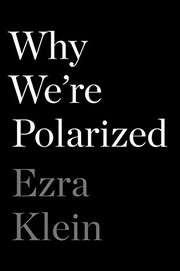
Why We're Polarized is a 2020 non-fiction book by American journalist Ezra Klein, in which he analyzes political polarization in the United States. Focusing in particular on the growing polarization between the major political parties in the United States (the Democratic Party and the Republican Party), Klein argues that a combination of good intentions gone wrong, such as dealing with an arguably more unjust political consensus maintained at the expense of minorities, and inherent glitches in the institutional design of the country's federal government have caused widespread social problems.
Opinions on the book are polarized, with positive reviews in The New York Times and Foreign Affairs, mostly positive but somewhat critical reviews in The Washington Post, Publishers Weekly, and Kirkus Reviews, mixed reviews in The New Yorker, The New Republic, Dissent, and Jacobin, and mostly negative reviews in The Wall Street Journal, Commentary, and The Outline.
Background and contents
The author delves into the history of the United States and finds that the country's politics after the end of the civil war constituted an artificial peace in which popular passions didn't adequately get represented by the actions of mainstream political parties. Furthermore, this peace was at the expense of the nation's various minorities whose unjust treatment was to be ignored, especially African Americans – as Congressional supporters of Jim Crow laws demanded these laws be unchallenged in exchange for cooperation, not even by powerful politicians like President Franklin D. Roosevelt. He reminds readers that commentators in both the 1950s and the 1960s criticized the set-up of pitting the Democratic Party against the Republican Party, with the two organizations getting labeled as being too similar. The prominent status of ideological conservatives and liberals in both parties, Klein writes, created a complicated situation for voters. The author particularly cites American racial debates as having warped political organization, writing that prejudicial policies "kept the Democratic party less liberal than it otherwise would’ve been, the Republican Party Congressionally weaker than it otherwise would’ve been, and stopped the parties from sorting themselves around the deepest political cleavage of the age."
The passage of the Civil Rights Act of 1964 resulted in widespread re-sorting along different lines both inside of and in between the two major parties. Furthermore, the decline of mass media and the rise of niche-based consumption of various socio-political material has exacerbated this trend, according to Klein. Eventually, Klein argues, the polarization has resulted in a country where large numbers of people fear a kind of coming apocalypse at the hands of those with whom they disagree.
"The parties are dividing over fundamental identities that tend to generate intolerance and hostility," Klein writes. Human beings form groups and set up collective identities as part of their inherent nature due to their psychological identities, he states, yet the dynamics in American politics have caused multiple methods of categorization from ethnicity to gender to religion and more to merge into "mega-identities". Thus, in Klein's eyes, the two parties represent fundamentally different types of people to which, due to this identity fusion, frustrating conflict becomes inevitable. "What if our loyalties and prejudices are governed by instinct and merely rationalized as calculation?" he asks.
Klein particularly criticizes his own profession, describing the process behind how exactly journalists decide what stories to cover. He argues that modern journalism has fed into a deleterious feedback loop, with attempts to actually persuade individuals generating far less interest than material meant to feed partisanship. In profession-based terms, he also remarks upon what he sees as an inherent instability of a republic headed by modern-style president.
Reception
The book has received polarized reviews, with praise and criticism coming from both the political left and right.
It received positive reviews in Foreign Affairs and The New York Times. In Foreign Affairs, Amy Chua, a professor of law at Yale Law School, called Klein one of "the country's keenest political observers" and recognized the book as "a cut above the slew of other [books] on the United States' divisions". She notes that Klein marshals an "impressive body of evidence" to bolster his view that partisan identity has become central to "psychological self-expression", and praises how he "takes into account a multitude of factors" underlying political polarization, including "institutional, cultural, and psychological" factors, faulting him only for his "surprisingly dismissive" consideration of class. In The New York Times, political scientist Norman J. Ornstein was similarly positive. Ornstein states that Klein provides a "thoughtful, clear and persuasive analysis", and praises Klein for identifying "a logic to our polarization".
以上文字摘自英文维基百科「Why We're Polarized」(有删节,去掉了参考文献等尾部小节),按 CC BY-SA 4.0 使用,作者为维基百科的各位编者。
资料卡
- 原题
- Why We're Polarized
- 原作语言
- 英语
- 首次出版
- 2020 年 1 月 28 日
- 主题
- 民主党、共和党
资料卡来自 Wikidata Q96414832(CC0),众包数据,个别字段可能不全。