书单
百科
这个词条暂时没有中文维基百科条目,下面是英文维基百科的内容(英文原文):
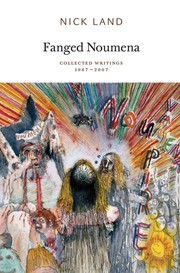
Fanged Noumena: Collected Writings 1987–2007 is a 2011 anthology of writings by English philosopher Nick Land, edited by Maya B. Kronic (formerly Robin Mackay) and Ray Brassier. It was first published by Urbanomic—founded by Kronic prior—with Sequence Press and later republished by the MIT Press.
The anthology collects essays and texts, initially published and previously unpublished, spanning various philosophical and aesthetic interests—as well as unorthodox writing styles that have been dubbed "theory-fictions"—explored and utilized by Land over the titular time period. The book has obtained a cult following and has subsequently been credited with influencing the rise in popularity of accelerationism.
Summary
As an anthology primarily aiming to cohere Nick Land's conjunctional reinterpretation of continental philosophy and modernist poetry in the 1990s—what British writer Kodwo Eshun described as a dramatization of "theory as a geopolitico-historical epic"—and his subsequent "theory-fictions" which explored cyberpunk media, Gothic themes and esoteric systems while utilizing unorthodox and disordered experimental writing styles, Fanged Noumena consists of essays and prose texts written by Land during multiple periods, compiled by Michael Carr, Mark Fisher, David Rylance and Reza Negarestani, with their sequence being edited by Kronic and Brassier.
The sequence begins during his time as a lecturer for the Department of Philosophy of the University of Warwick, England from 1987 until his resignation from his academic post in 1998, progressing onto his contributions to the mythopoeia of "hyperstitions" of the Cybernetic Culture Research Unit (CCRU) as it was maintained within the university, and concluding with blog posts written between 2004 and 2007 in his residency in Shanghai, China.
The progression displayed in Land's work, according to Kronic and Brassier, is essential to the presentation of the book as a response to "an incapacity to believe that Land actually meant what he said—[his] writing was indeed nothing but a machine for intensification", and that rhetorically, "if this volume infects a new generation, already enlivened by a new wave of thinkers who are partly engaging the re-emerging legacy of Nick Land's work—it will have fulfilled its purpose."
Kronic and Brassier noted that the emergence of accelerationism in Land's work is marked by the idea that philosophically, "it is no longer a matter of 'thinking about', but rather of observing an effective, alien intelligence in the process of making itself real, [and is] a matter of participating in such a way as to continually intensify and accelerate this process." In a lecture for a conference on accelerationism given in 2010, Brassier referred to Land's philosophical project as "mad black Deleuzianism", referencing a criticism given by French philosopher Vincent Descombes of the work of Deleuze and Guattari and Jean-François Lyotard as "mad black Hegelianism".
The term denotes the anti-vitalism of Land's reinterpretation of Deleuze's philosophy, distinguished by its "unsavory" orientation towards the paradox of "will[ing] the impossibility of willing" and an active materialist interest ("no longer a pretext for critique but a vector of exploration") in, according to Kronic and Brassier, "the impersonal and anonymous chaos of absolute time".
These themes are consistent in the writings featured in Fanged Noumena, with a turn in the 1990s towards "the 'inconceivable alienations' outputted by the monstrous machine-organism built by capital" according to Kronic and Armen Avanessian, and a further turn into the 2000s towards "ever more abstract planes of an alien Outside's absolute deterritorialisation of reason and sense", according to Vincent Le.
Late 1980s—early 1990s
The sequence of Fanged Noumena begins with "Kant, Capital, and the Prohibition of Incest: A Polemical Introduction to the Configuration of Philosophy and Modernity", initially published for Third Text in 1988. Land has since retroactively dismissed the essay for its inaccuracies. "Narcissism and Dispersion in Heidegger's 1953 Trakl Interpretation", initially published in 1990, analyzes what Land identifies as Heidegger's suppression of the effectivity of the Dionysian tropes in Trakl's poetry, which Kronic and Brassier identified as Land's "mounting impatience" with Heideggerian philosophy, leading to a resolution of the "exit problem" where "the manner in which the (failed) insurrectionary attempts at 'escape' made by artists each open up the prospect of [a] heterogeneous space that subverts order"
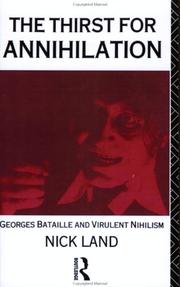
This concept is explored further in the subsequent literary criticism essays "Art as Insurrection: the Question of Aesthetics in Kant, Schopenhauer, and Nietzsche", "Spirit and Teeth" and "Shamanic Nietzsche", which were published prior to and following the 1992 publication of The Thirst for Annihilation: Georges Bataille and Virulent Nihilism (An Essay in Atheistic Religion), Land's student thesis for the University of Warwick.
Prior to these, "Delighted to Death" extends from his research conducted for The Thirst for Annihilation, identifying regulatory and repressive principles of Christian morality in Kant's ethical system, and elements of martyrdom in the experience of the sublime. On the contrary, Land also focuses on the history of the concept of genius as an "a contingent, impersonal creative force" according to Kronic and Brassier, a theme which reappears in the aforementioned essays. McKenzie Wark characterizes this essay as focusing on the appearance of "a priori forms as constants for novel experiences" in Land's topics. The 1993 essay "After the Law" also extends from Land's then-present philosophical research, analyzing the Apology of Socrates and Bataille's political anti-philosophy to focus on exceptions to the moral law that similarly creatively escape judgment.
以上文字摘自英文维基百科「Fanged Noumena」(有删节,去掉了参考文献等尾部小节),按 CC BY-SA 4.0 使用,作者为维基百科的各位编者。
资料卡
- 原题
- Fanged Noumena: Collected Writings 1987–2007
- 原作语言
- 英语
- 首次出版
- 2011 年 3 月
- 作品形式
- 选集
资料卡来自 Wikidata Q120176659(CC0),众包数据,个别字段可能不全。