 书单
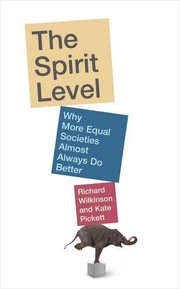
The Spirit Level (2009)
- 作者
- Richard & Kate Pickett Wilkinson、Illustrated
- 首版
- 2009 年
- 国家/地区
- 英国
- Open Library
- 1 个版本
百科
这个词条暂时没有中文维基百科条目,下面是英文维基百科的内容(英文原文):
The Spirit Level: Why More Equal Societies Almost Always Do Better is a book by Richard G. Wilkinson and Kate Pickett, published in 2009 by Allen Lane. The book is published in the US by Bloomsbury Press (December, 2009) with the new sub-title: Why Greater Equality Makes Societies Stronger. It was then published in a paperback second edition (United Kingdom) in November 2010 by Penguin Books with the subtitle, Why Equality is Better for Everyone.
The book argues that there are "pernicious effects that inequality has on societies: eroding trust, increasing anxiety and illness, (and) encouraging excessive consumption". It claims that for each of eleven different health and social problems: physical health, mental health, drug abuse, education, imprisonment, obesity, social mobility, trust and community life, violence, teenage pregnancies, and child well-being, outcomes are significantly worse in more unequal countries, whether rich or poor.
The book contains diagrams (scatter plots) that are available online.
In 2010, the authors published responses to questions about their analysis on the Equality Trust website. As of September 2012, the book had sold more than 150,000 copies in English. It is available in 23 foreign editions.
In July 2024, Wilson and Pickett produced an updated version of the book called The Spirit Level at 15: The Enduring Impact of Inequality, noting that inequality had worsened since their 2009 original.
Contents
Part I. Material Success, Social Failure
The end of an era
Poverty or Economic inequality?
How inequality gets under the skin
Part II. The Costs of Inequality
Community life and social relations
Mental health and drug use
Physical health and life expectancy
Obesity: wider income gaps, wider waists
Educational performance
Teenage births: recycling deprivation
Violence: gaining respect
Imprisonment and punishment
Social mobility unequal opportunities
Part III. A Better Society
Dysfunctional societies
Our social inheritance
Equality and sustainability
Building the future
Reception
Positive reviews
In a review for Nature, Michael Sargent said that "In their new book, epidemiologists Richard Wilkinson and Kate Pickett extend this idea" (of the harm caused by status differences) "with a far-reaching analysis of the social consequences of income inequality. Using statistics from reputable independent sources, they compare indices of health and social development in 23 of the world's richest nations and in the individual US states. Their striking conclusion is that the societies that do best for their citizens are those with the narrowest income differentials—such as Japan and the Nordic countries and the US state of New Hampshire. The most unequal—the United States as a whole, the United Kingdom and Portugal—do worst."
In the London Review of Books University of Cambridge lecturer David Runciman said that the book fudged the issue of its subtitle thesis of its UK first edition, and asked whether it is that "in more equal societies almost everyone does better, or is it simply that everyone does better on average?" Later in the review he stated that, "More equality is a good thing and it’s an idea that’s worth defending." Richard Wilkinson responded to the review in a letter, claiming that "while pointing out that we do not have evidence on the fraction of one percent who are very rich, we show that people at all other levels of the social hierarchy do better in more equal societies".
Boyd Tonkin, writing in The Independent, described it as "an intellectual flagship of post-crisis compassion, this reader-friendly fusion of number-crunching and moral uplift has helped steer a debate about the route to a kinder, fairer nation. Will Hutton in The Observer described it as "A remarkable new book ...the implications are profound." Roy Hattersley in the New Statesman called it "a crucial contribution to the ideological argument", and the New Statesman listed it as one of their top ten books of the decade.
Critical response
John Kay wrote in the Financial Times that the book "is a powerful counter to any simple equation of social progress and the advance of GDP", but he warned that the causal relationships are complex, and said that other studies, such as the World Values Survey, could also explain high performance of societies such as Sweden and Japan. He said that "the evidence presented in the book is mostly a series of scatter diagrams, with a regression line drawn through them. No data is provided on the estimated equations, or on relevant statistical tests". The significance tests and correlation coefficients were included in the November 2010 revised paperback edition of the book, and also appear on the Equality Trust website, where source data is also available and there is an explanation for the omission that "the book's intended readership was not confined to those with statistical training".
Richard Reeves in The Guardian called the book "a thorough-going attempt to demonstrate scientifically the benefits of a smaller gap between rich and poor", but said there were problems with the book's approach. "Drawing a line through a series of data points signals nothing concrete about statistical significance ... since they do not provide any statistical analyses, this can't be verified." He later noted that, "The Spirit Level is strongest on Wilkinson's home turf: health. The links between average health outcomes and income inequality do appear strong, and disturbing". The Guardian ranked The Spirit Level #79 in its list of 100 Best Books of the 21st Century.
In the European Sociological Review, sociologist John Goldthorpe argued that the book relied too heavily on income inequality over other forms of inequality (including broader economic inequality), and demonstrated a one-dimensional understanding of social stratification, with social class being in effect treated as merely a marker for income. He concluded that much more research was needed to support either the Wilkinson and Pickett "account of the psychosocial generation of the contextual effects of inequality on health or the rival neo-materialist account".
以上文字摘自英文维基百科「The Spirit Level (Wilkinson and Pickett book)」(有删节,去掉了参考文献等尾部小节),按 CC BY-SA 4.0 使用,作者为维基百科的各位编者。
资料卡
- 原题
- The Spirit Level
- 原作语言
- 英语
- 首次出版
- 2009 年 3 月 5 日
- 体裁
- 专著
- 主题
- 社会经济学
资料卡来自 Wikidata Q3137490(CC0),众包数据,个别字段可能不全。