书单
百科
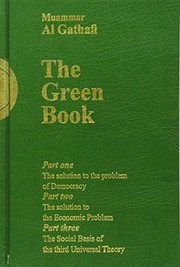
《绿皮书》(阿拉伯语:الكتاب الأخضر,罗马化:al-Kitāb al-Aḫḍar),又称《绿宝书》,是利比亚前领导人穆阿迈尔·卡扎菲为叙述自己的政治哲学而撰写的书籍,在1975年首次出版,日后亦有相关增订并由官方翻译成英文、俄文版、意大利文版、中文版等,共有3卷。这本书的目的是要给“所有的利比亚人民阅读”,因此篇幅不长且内容较为简单易懂。
外界普遍认为本书的出版动机是受到《毛主席语录》的影响 。在2011年利比亚内战中,有示威者烧毁《绿皮书》来表示抗议。
内容
《绿皮书》由3个部分组成,全书约有110页,平均每页最多200字。
民主问题的解决方案:人民的监督(1975年年底出版)
经济问题的解决方案:社会主义(1977年年初出版)
第三国际理论的社会基础(1981年9月出版)
《绿皮书》亦提到反对现代自由民主制、新闻自由和资本主义的理念。利比亚是在直接民主制的基础上建立普选委员会。但这一制度在事实上只能有限度的实现,因为领导人卡扎菲自行任命内阁部长和各部门首长,并影响整个人民大会在不用选举的前提下产生政府。
推广
根据英国作家及前大伦敦议会议员乔治·特雷姆利特的说法,利比亚的学童每周花2小时的上课时间来阅读本书。电视台和电台也会每天播放本书内容,相关内容也以图画或招牌的形式在一些利比亚建筑上出现;1993年时还在法国、东欧、哥伦比亚和委内瑞拉等地的大学和学院举办有关《绿皮书》的讲座及研讨会。
争议
这本书的广泛推广在1987年引起了一场争议,因为利比亚当局花费90万美元赞助当时西德的冰球俱乐部ECD Iserlohn来宣传《绿皮书》,造成各界的舆论。
以上文字摘自维基百科「綠皮書 (利比亞)」(去掉了参考文献等尾部小节),按 CC BY-SA 4.0 使用,作者为维基百科的各位编者。
中文维基百科的条目比较短,下面附上英文维基百科的内容(英文原文):
The Green Book (Arabic: الكتاب الأخضر al-Kitāb al-Aḫḍar) is a short book setting out the political philosophy of Libyan leader Muammar Gaddafi. The book was first published in 1975. It is said to have been inspired in part by The Little Red Book (Quotations from Chairman Mao Tse-tung). Both were widely distributed both inside and outside Libya, and "written in a simple, understandable style with many memorable slogans".
An English translation was issued by the People's Establishment for Publication, Distribution, and Advertising, an organ of the Libyan People's Committee, and a bilingual English-Arabic edition was issued in London by Martin, Brian & O'Keeffe in 1976.
During the First Libyan Civil War in 2011, during which Gaddafi himself was killed, copies of the book were burned by anti-Gaddafi demonstrators, and monuments to The Green Book demolished.
Influence
In Libya
According to British author and former Greater London Council member George Tremlett, Libyan children spent two hours a week studying the book as part of their curriculum. Extracts were broadcast every day on television and radio. Its slogans were also found on billboards and painted on buildings in Libya.
International
By 1993, lectures and seminars on The Green Book had been held at universities and colleges in France, Eastern Europe, Colombia, and Venezuela.
On a state visit to Libya in 2008, socialist Bolivian President Evo Morales cited the Green Book as a major influence on his political beliefs and policies.
Contents
The Green Book consists of three parts and has 110 pages:
The Solution of the Problem of Democracy: The Authority of the People (published in late 1975)
The Solution of the Economic Problem: Socialism (published in early 1977)
The Social Basis of the Third International Theory (published in September 1981)
Views
The Green Book rejects both capitalism and communism, as well as representative democracy. Instead, it proposes a type of direct democracy overseen by the General People's Committee which allows direct political participation for all adult citizens.
The book states that "Freedom of expression is the natural right of every person, even if they choose to behave irrationally, to express his or her insanity." The Green Book states that freedom of speech is based upon public ownership of book publishers, newspapers, television, and radio stations, on the grounds that private ownership would be undemocratic.
A paragraph in the book about abolishing money is similar to a paragraph in Friedrich Engels' Principles of Communism. Gaddafi wrote: "The final step is when the new socialist society reaches the stage where profit and money disappear. It is through transforming society into a fully productive society, and through reaching in production a level where the material needs of the members of society are satisfied. On that final stage, profit will automatically disappear and there will be no need for money."
Summary
The following table gives a chapter-by-chapter summary of the book.
Reception
George Tremlett has called the resulting media dull and lacking in a clash of ideas. Dartmouth College Professor Dirk Vandewalle describes the book as more a collection of aphorisms than a systematic argument. U.S. Ambassador David Mack called the book quite jumbled, with various ideas including "a fair amount of xenophobia" wrapped up in "strange mixture".
Writing for the British Broadcasting Corporation, the journalist Martin Asser described the book as follows: "The theory claims to solve the contradictions inherent in capitalism and communism... In fact, it is little more than a series of fatuous diatribes, and it is bitterly ironic that a text whose professed objective is to break the shackles... has been used instead to subjugate an entire population."
The book caused a scandal in 1987, when West German ice hockey club ECD Iserlohn, led by Heinz Weifenbach, signed a US$900,000 advertising deal for the book.
以上文字摘自英文维基百科「The Green Book (Gaddafi)」(有删节,去掉了参考文献等尾部小节),按 CC BY-SA 4.0 使用,作者为维基百科的各位编者。
资料卡
- 原题
- الكتاب الأخضر
- 原作语言
- 阿拉伯语
- 首次出版
- 1975 年
- 体裁
- 政治文学
- 页数
- 110
- 主题
- 卡扎菲主义
资料卡来自 Wikidata Q107790(CC0),众包数据,个别字段可能不全。