 书单
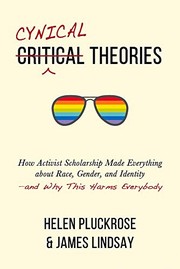
左胶是如何炼成的:左派理论如何让一切都成了问题?危害社会民主价值 (2020)
- 作者
- James A. Lindsay、Helen Pluckrose
- 首版
- 2020 年
- Open Library
- 6 个版本
百科
这个词条暂时没有中文维基百科条目,下面是英文维基百科的内容(英文原文):
Cynical Theories: How Activist Scholarship Made Everything About Race, Gender, and Identity—and Why This Harms Everybody is a nonfiction book by Helen Pluckrose and James Lindsay, published in August 2020. The book was listed on the bestsellers lists of Publishers Weekly, USA Today, and the Calgary Herald.
The book was released in Australia as Cynical Theories: How Universities Made Everything about Race, Gender, and Identity – and Why This Harms Everybody.
Summary
Cynical Theories contrasts the academic approaches of liberalism and postmodernism, then argues that "applied postmodernism" (which focuses on ought rather than is) has displaced other approaches to activism and scholarship. The authors present several academic fields and schools—postcolonial theory, queer theory, critical race theory, intersectionality, fourth-wave feminism, gender studies, fat studies, and ableism—and describe how the "applied postmodernism" approach has developed in each field. The authors use capitalization to distinguish between the liberal concept of "social justice" and the ideological movement of "Social Justice" that they state has reified postmodernism.
Sales and rankings
Shortly after its release the book became a Wall Street Journal, USA Today, and Publishers Weekly bestseller and a number-one bestseller in philosophy on Amazon. Cynical Theories was named in the Financial Times' Best Books of the Year 2020 and in The Times' Best Political and Current Affairs Books of the Year 2020.
Critical reception
Positive
Harvard University's Steven Pinker, a psychologist and public intellectual, praised the book, saying that it "exposes the surprisingly shallow intellectual roots of the movements that appear to be engulfing our culture".
Douglas Murray wrote an admiring review of Cynical Theories for The Times, saying "I have rarely read such a good summary of how postmodernism evolved from the 1960s onwards." Murray concluded, "Yet as I put down the book and turned on the news I couldn't help thinking that this deconstruction of the deconstructionists may have arrived just a moment too late."
Joanna Williams, writing from her post as a commentator on Spiked, said that the authors provide "a huge service in translating the language of today’s activists and explaining to readers not steeped in critical theory or postmodernism how the world looks from the perspective of those who are," and that it "successfully draws out how, over the course of six decades, the burgeoning popularity of critical theory within university humanities and social-science faculties shifted postmodernism from a minority academic pursuit to an all-encompassing political framework." But Williams also noted that "[w]hile Cynical Theories offers an excellent account of how postmodern scholarship morphed into social-justice activism, it is less persuasive when it comes to why this happened." Williams stated, "What's largely missing from Cynical Theories is a broader political contextualisation of social-justice activism."
Ryan Whittaker wrote on The Manchester Review that "Despite its flaws, Cynical Theories is an important, interesting, accessible, and extensively cited work of non-fiction. It avoids the pitfalls of texts caught up in 'culture war' subjects; it intentionally avoids screeds of left- and right-wing punditry and the reader is likely to come away feeling that it has been academic and fair towards its opponents. Peter Gregory Boghossian who had also published bogus articles in the Grievance studies affair with Lindsay and Pluckrose stated that the book "is a tactical nuclear strike on the heart of the moral architecture that is sustaining Culture war 2.0" and "will take the culture war to the next level".
Writing in The Times Literary Supplement, Simon Jenkins wrote that within half an hour of starting he thought he had "had enough of this book. Helen Pluckrose and James Lindsay seemed obsessed by a straw man, a fake foe. Their opponents, I felt, were surely well-intentioned and did not really believe what they were accused of believing." He went on, however, "I read on and now think differently." He cited the conclusion "refreshing" in that they offered no "counter-revolutionary strategy" or "demand that Theory be suppressed," but rather only call for the support of "reason, debate, tolerance, democracy and the rule of law." He wrote that the book illuminates "one of those sidetracks in Western ideology that led to both Salem and Weimar."
Mixed
Nigel Warburton, writing for The Spectator, praises the early chapters on postmodernism and calls the first part of the book "a plausible and interesting story about the origins of the phenomena they describe. Like Roger Scruton in his book Fools, Frauds, and Firebrands, they have done their homework, and can't fairly be accused of a superficial understanding of the thinkers they engage with, though they probably underestimate the seriousness and depth of Foucault's analysis of power." He says "the book then becomes a gloves-off polemic against specific manifestations of Theory in areas such as postcolonialism, queer theory, critical race theory, gender, and disability studies. Here they are far less charitable to their targets, and they take cheap shots in passing, a strategy likely to prevent anyone who has caught Theory from being cured by reading this."
Nick Fouriezos of OZY magazine described Cynical Theories as the first cohesive attempt to tie together the intellectual strands of the intellectual dark web. He notes that [w]hile crediting liberalism for leading to the gains of the modern feminist movement, LGBT rights and the civil rights movement, [the book] suggests almost total victory was reached in those fields by the end of the 1980s while ignoring significant issues that have persisted since then.
Reviewing the book for Philosophy Now, Stephen Anderson noted a "major weakness" in the book yet recommended a reading.
以上文字摘自英文维基百科「Cynical Theories」(有删节,去掉了参考文献等尾部小节),按 CC BY-SA 4.0 使用,作者为维基百科的各位编者。
资料卡
- 原题
- Cynical Theories: How Activist Scholarship Made Everything about Race, Gender, and Identity — and Why This Harms Everybody 等 2 项
- 原作语言
- 英语、西班牙语
- 首版出版社
- Pitchstone Publishing、Alianza Editorial
资料卡来自 Wikidata Q102079197(CC0),众包数据,个别字段可能不全。