书单
百科
这个词条暂时没有中文维基百科条目,下面是英文维基百科的内容(英文原文):
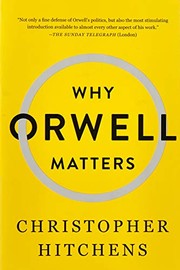
Why Orwell Matters, released in the UK as Orwell's Victory, is a book-length biographical essay by Christopher Hitchens. In it, the author relates George Orwell's thoughts on and actions in relation to: The British Empire, the Left, the Right, the United States, English conventions, feminism, and his controversial list for the British Foreign Office.
Summary
The British Empire
Orwell spoke for his radio magazine 'Voice' on the BBC of India where he spoke about literature and ideas. Orwell agreed to broadcast to India under his own name on one condition; that he could express his anti-imperialist opinions without diluting them. He criticized the British government's lack of principles regarding Indian self-government and never failed to argue for India's independence. Orwell's experience working with the BBC correlated with some of the concepts in his novel Nineteen Eighty-Four. Such as his concept doublethink, in relation to the sometimes extreme daily changes in political propaganda that was being broadcast. Orwell's thoughts and writings on colonialism are a permanent part of his lifelong commitment to the subjects of power, cruelty, force, and the relationship between the dominator and the dominated. Orwell can be read as a teaching in Britain's transition from an imperial society to a multicultural and multi-ethnic one. Since this was a great development in his time, and continues to be, this is one reason Hitchens argues that Orwell matters.
The Left
Orwell contributed to the socialist press in England for many years. He considered himself to be on the left and advocated for democracy, decolonization, egalitarian ideals and heavily criticized totalitarianism. Orwell had lived under a Stalinist police regime in Spain when he fought against fascism in the Spanish Civil War. His time in Spain never left him; he continuously helped vindicate those he had known that survived the Stalinist regime. He did this by publicizing their cases, helping their families, getting them out of prison and saving them from being condemned. He witnessed how the government could distort the truth and how political enemies could suddenly disappear. Orwell returned home after he was shot in the throat. This may have saved him in a way as he was "guilty" of Trotskyism and served with the POUM militia, which was more than enough to land him in prison. Orwell's friends, such as his brigade commander Georges Kopp, were imprisoned under horrendous conditions. Kopp was subject to torture of close confinement with rats; this, and some of Orwell's other experiences in Spain, initiated some of the subject matter for Nineteen Eight-Four. His socialist peers had a great appreciation for the Soviet Union. Since Orwell had witnessed its cruelty first hand, he did not. He argued that it was not socialism, but a viscous form of state-capitalism. Many of them never forgave him about his criticisms towards the Soviet Union and being right about Spain. Despite being a leftist himself, many of Orwell's harshest critics were on the left and came about after his death. In the 1960s and 1970s the New Left despised Orwell, partly because his writings were right about the issues in society and they were not. 'Orwell put it best: the sin of most leftists is that they wanted to be anti-totalitarian without being anti-communist.'
The Right
Orwell spent his entire adult life renouncing his upbringing in the Conservative Party. It is true that he was one of the founders of anti-communism and held some beliefs that are associated with the right. Such as individualism, patriotism, his strong sense of right and wrong, and his dislike for bureaucracy and government. Liberty and equality were two of the things Orwell valued the most, as told in his writings, 'A society of free and equal human beings.' As such, they were generally not allies in Britain's laissez-faire culture at the time. Orwell was aware of this paradox and symbolizes it in Nineteen Eighty-Four; his point being that there should be no utilitarian trade-off between freedom and security. Nineteen Eighty-Four was accused of attacking the Labour Party Government. Orwell responded that he supported the Labour Party and his novel was not meant to attack it nor socialism. 'It exposes the corruptions that a centralized economy is prone to, as witnessed with communism and fascism. The novel takes place in Britain to emphasize that English-speaking races are not innately better and that totalitarianism can triumph everywhere, if not fought against.' Orwell was invited by the Duchess of Atholl in November 1945 to speak on behalf of the right-wing and anti-communist group, League for European Freedom. Orwell thought that their arguing against communist brutality was inconsistent with them claiming to support democracy, yet not supporting the end of British rule in India. Therefore, Orwell did not want to associate himself with them. In Orwell's words, 'I belong to the Left and must work inside it, as much as I hate totalitarianism and its poisonous influence.' It is true that Orwell held many conservative instincts, not prejudices. Such as his somewhat traditional moral and sexual values. Also his dislike of abortions and homosexuals, as well as sharing some anti-semitic comments in his writings. Hitchens argues that Orwell spent his life trying to reason himself out of them. Although there were times that his upbringing and pessimism succeeded his efforts, oftentimes when he was ill or depressed. Hitchens writes, 'Orwell was conservative about many things, but not about politics.'
以上文字摘自英文维基百科「Why Orwell Matters」(有删节,去掉了参考文献等尾部小节),按 CC BY-SA 4.0 使用,作者为维基百科的各位编者。
资料卡
- 原题
- Why Orwell Matters
- 原作语言
- 英语
- 首次出版
- 2002 年
- 体裁
- 随笔
- 首版出版社
- 基础书籍出版社
- 主题
- 乔治·奥威尔
- 主要人物
- 乔治·奥威尔
资料卡来自 Wikidata Q3400596(CC0),众包数据,个别字段可能不全。