书单
百科
这个词条暂时没有中文维基百科条目,下面是英文维基百科的内容(英文原文):
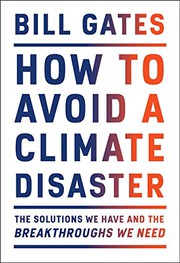
How to Avoid a Climate Disaster: The Solutions We Have and the Breakthroughs We Need is a 2021 book by Bill Gates. In it, Gates presents what he learned in over a decade of studying climate change and investing in innovations to address global warming and recommends technological strategies to tackle it.
Description
When it comes to climate change, I know innovation isn’t the only thing we need. But we cannot keep the earth livable without it. Techno-fixes are not sufficient, but they are necessary.
– Bill Gates, from page 14 of his book, How to Avoid a Climate Disaster (2021).
The book's five parts
The book is organized into five parts. In part one (chapter 1), Gates explains why the world must completely eliminate greenhouse gas emissions ("getting to zero"), rather than simply reducing them. In part two (chapter 2) he discusses the challenges that will make achieving this goal very difficult. In part three (chapter 3) he outlines five pragmatic questions a reader can ask to evaluate any conversation they have about climate change. Part four (the longest part of the book, or chapters 4 through 9) analyzes currently-available technologies that can be utilized now to adapt to and mitigate climate change ("the solutions we have") and those areas where innovation is needed to make climate-friendly technologies cost competitive with their fossil fuel counterparts ("the breakthroughs we need"). In the final part (chapters 10 through 12) Gates suggests specific steps that can be taken by government leaders, market participants and individuals to collectively avoid a climate disaster.
Electricity generation
Gates thinks that decarbonizing electricity should be a priority, because it would not only reduce emissions from coal and gas used to produce electricity, but also allow an accelerated shift to zero emission transportation like electric cars. He advocates increased innovation and investment in nuclear energy, and warns against overly focusing on wind and solar generation, due to their intermittent nature.
Roles for government and business
Gates argues that both governments and businesses have parts to play in fighting global warming. While he acknowledges that there is a tension between economic development and sustainability, he posits that accelerated innovation in green technology, particularly sustainable energy, would resolve it. He calls on governments to increase investment in climate research, but at the same time to incentivize firms to invest in green energy and decarbonization. Gates also urges governments to institute a carbon pricing regime that would account for all externalities involved in producing and using carbon-emitting energy.
Get to zero rather than simply reducing emissions
The book describes strategies for achieving net zero greenhouse gas emissions by 2050, and emphasizes that many efforts to reduce emissions are actually counter-productive. For example, one can reduce CO2 emissions in 2030 by replacing a coal-fired electrical power plant with a new natural gas power plant (since coal combustion emits twice as much CO2 as natural gas, per unit of electricity). However, the natural gas plant will still be emitting CO2 in 2050. Alternatively, Gates prefers we spend money on infrastructure that does not emit CO2 in 2050. Gates warns, "Making reductions by 2030 the wrong way might actually prevent us from ever getting to zero."
Gates' plan to get to net zero emissions
Gates introduces a plan for getting to net zero greenhouse gas emissions in Chapters 11 and 12 with several key points:
The world needs to get to zero emissions, not just reduce.
The world needs to accelerate the development of technology that helps to resolve the climate change problem.
The world needs to reduce the additional cost of green energy, which he refers to as the "green premium".
Federal, state and local governments can play a role to reduce emissions; in addition to private citizens.
Publication
How to Avoid a Climate Disaster was published in hardcover by Alfred A. Knopf on February 16, 2021. An audiobook narrated by Gates and Wil Wheaton was released the same day. A large-print paperback edition was published on February 23, 2021.
The book debuted at number one on The New York Times nonfiction best-seller list for the week ending February 20, 2021.
Reception
The ideas in How to Avoid a Climate Disaster generated discussions and commentary on both sides of the Atlantic. Most reviewers found that the book did not adequately address the political obstacles that must be overcome to transition away from fossil fuels, but many appreciated its assertion that technological progress and innovation will be critically necessary for the worldwide energy transition. Additionally, many commentators disagreed with Gates' emphasis on the intermittency problem associated with both solar power and wind power, and some took issue with his conclusion that nuclear fission power might be an acceptable way of mitigating climate change.
Gordon Brown
Writing in The Guardian, former UK prime minister Gordon Brown made generally positive comments on the book, but warned that it only touches briefly on the political obstacles the international community must navigate before a cataclysm is averted:
Gates [has a] touching, admirable faith in science and reason, [but he also] knows that the solution he seeks is inextricably tied up in political decisions. ... [T]o operationalise the Paris [COP21] agreement – to limit warming to 1.5 degrees – requires countries to halve their CO2 emissions by 2030. So vested interests like big oil will have to be enlisted for change. The ... rhetoric of irresponsible demagogues will have to be taken head on. And supporters of a stronger set of commitments will have to show why sharing sovereignty is in every nation’s self-interest.
以上文字摘自英文维基百科「How to Avoid a Climate Disaster」(有删节,去掉了参考文献等尾部小节),按 CC BY-SA 4.0 使用,作者为维基百科的各位编者。
资料卡
- 原题
- How to Avoid a Climate Disaster
- 原作语言
- 英语
- 首次出版
- 2021 年 2 月 16 日
- 体裁
- 非虚构作品
- 首版出版社
- 阿尔佛雷德·A·克诺夫
- 主题
- 全球变暖
资料卡来自 Wikidata Q105697082(CC0),众包数据,个别字段可能不全。