书单
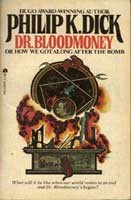
血钱博士 (1965)
百科
这个词条暂时没有中文维基百科条目,下面是英文维基百科的内容(英文原文):
Dr. Bloodmoney, or How We Got Along After the Bomb is a 1965 science fiction novel by American writer Philip K. Dick. It was nominated for the Nebula Award for Best Novel in 1965.
Dick wrote the novel in 1963 with working titles In Earth's Diurnal Course and A Terran Odyssey. Ace editor Donald Wollheim, however, suggested the final title which references the film Dr. Strangelove or: How I Learned to Stop Worrying and Love the Bomb (1964).
Plot summary
Dr. Bloodmoney is set in a post-apocalyptic future. In 1972, before the start of the narrative, Dr. Bruno Bluthgeld (German for "Blood-Money") had led a project testing nuclear weapons as a protectionary measure against Communist China and the Soviet Union. However, a miscalculation caused an atmospheric nuclear accident leading to widespread fallout and mutations. More recently the United States has been involved in a prolonged period of hostilities with China and the Soviet Union erupting in a war in Cuba.
In 1981, the now universally hated Bluthgeld seeks psychotherapy with Dr. Stockstill for his paranoia and guilt. Meanwhile, Stuart McConchie, Hoppy Harrington and Jim Fergesson, employees at Modern TV Sales and Service in Berkeley, California, go through a fairly typical day, pausing to watch Walt and Lydia Dangerfield being launched into orbit in the first stage of a colonization mission to Mars. This ordinary day, however, is disrupted by a massive nuclear strike. Orbiting overhead, Walt Dangerfield witnesses the tragic events as they unfold, while other characters are reduced to desperate measures in their struggle for survival. Fergesson is killed as his shop collapses. Meanwhile, Bluthgeld is convinced that he caused the strike in response to a universal conspiracy against him. Believing that he has shown the world his power, he sets out to heal and restore order through his imagined magical powers.
The narrative jumps to 1988, when many communities have begun to rebuild a sort of order. A military government has arisen in Cheyenne, Wyoming, while in California government is by local community councils that view one another with varying degrees of hostility. Most pre-war technologies and amenities have been lost. Oil shortages result in disabled cars being pulled by horses or fitted with wood-burning (steam) engines. Former California ranch territory has been converted into agricultural land for corn and other crops. Human mutants have become more common, such as phocomeli, as well as conjoined symbiotes. At the same time, former domestic animals like dogs and cats have undergone mutations that have greatly enhanced their intelligence. Many of these former pets and zoo specimens have allied themselves into ferocious tribal units of their own. Bruno Bluthgeld's dog Terry is capable of imitating simple human speech, while some species of felines may have developed their own evolved languages.
Walt Dangerfield, equipped with enough rations to last for several more years, along with an extensive collection of books and musical recordings, has become an orbiting disc jockey. His broadcasts offer a semblance of continuity with pre-war civilization to the isolated settlements of the postwar world. His wife, Lydia, committed suicide during the intervening period. Now, Dangerfield is showing symptoms of an unknown medical condition, causing concern among some of his listeners.
In Marin County survivors including Bonny Keller, Dr. Stockstill, June Raub and Hoppy Harrington have organized into a self-governing community. Harrington, a Thalidomide baby missing all four of his limbs, harbors a quietly smoldering resentment of the patronizing and condescending attitudes he endured before the war. He has now become a successful mechanic thanks to electronic servo-mechanism technology as well as his gradually increasing abilities of psychokinesis or mind-over-matter. As such, he becomes a genuinely respected and absolutely indispensable member of the community. His ultimate goal, however, is to dominate and humiliate the people within his community through intimidation via his increasingly capricious and violent misuse of his ever-strengthening powers. He has been using his talents to gradually weaken Walt Dangerfield in order to take over Dangerfield's much-beloved satellite transmissions. Meanwhile, Bluthgeld, under the assumed name of Jack Tree, lives as a sheep farmer outside the community. One outsider searching for the infamous Bluthgeld was exposed by Bonny Keller and summarily executed for his troubles.
Stuart McConchie has become a travelling entrepreneur in the post-apocalyptic world, selling "smart" robotic rat traps for a company based in post-war Berkeley. Still holding onto his ambitious pre-war salesman's mentality, McConchie travels to Marin County to meet Andrew Gill, a cigarette and alcohol entrepreneur, to discuss the re-introduction of automation within his factory as an agent of Berkeley-based business interests. His appearance in West Marin startles Hoppy Harrington and Bruno Bluthgeld, both of whom had last seen McConchie on the day of the "Emergency".
以上文字摘自英文维基百科「Dr. Bloodmoney」(有删节,去掉了参考文献等尾部小节),按 CC BY-SA 4.0 使用,作者为维基百科的各位编者。
资料卡
- 原题
- Dr. Bloodmoney, or How We Got Along After the Bomb
- 原作语言
- 美国英语
- 首次出版
- 1965 年
- 作品形式
- 长篇小说
- 体裁
- 科学幻想、末日后幻想
- 首版出版社
- 爱司图书公司
- 故事发生地
- 加利福尼亚州
资料卡来自 Wikidata Q1317915(CC0),众包数据,个别字段可能不全。
更多资料与书评
在哪读
菲利普·迪克 的其他作品
作者页 ›相似的书

 豆瓣 #38
 豆瓣 #82