 书单
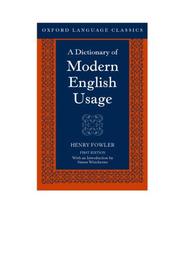
现代英语用法词典 (1926)
百科
这个词条暂时没有中文维基百科条目,下面是英文维基百科的内容(英文原文):
A Dictionary of Modern English Usage (1926), by H. W. Fowler (1858–1933), is a dictionary of usage of modern English. It details the usage of selected words, morphemes, phrases, word classes, punctuation, and various other rules and word features. The 1926 first edition remains in print along with the 1965 second edition, which was edited by Sir Ernest Gowers and reprinted in 1983 and 1987. The 1996 third edition, titled The New Fowler's Modern English Usage, and revised in 2004, was mostly rewritten by Robert W. Burchfield and incorporated corpus linguistics data. The 2015 fourth edition, titled Fowler's Dictionary of Modern English Usage, was edited by Jeremy Butterfield. Informally readers may refer to the style guide and dictionary as Fowler's Modern English Usage, Fowler or Fowler's.
Fowler's linguistic approach
On illogicalities in usage
In the entry on only, Fowler says that "illogicalities and inaccuracies of expression tend to be eliminated as the language grows older". However, he argues that this tendency can have "its bad as well as its good effects", and that "pedants" who try to accelerate this process "when the illogicality is only apparent or the inaccuracy of no importance are turning English into an exact science or an automatic machine".
As an example, he compares the position of the adverb only in "He died only a week ago" versus "he only died a week ago". He labels the former the "orthodox placing", and, in defense of the (heterodox) latter, argues that "it is the order that most people have always used and still use, and that, the risk of misunderstanding being chimerical, it is not worthwhile to depart from the natural". He then offers an example in which the case against heterodox placing is stronger: "Mackenzie only seems to go wrong when he lets in yellow; and yellow seems to be still the standing difficulty of the colour printer." Here, because of the ambiguity as to whether only is modifying "seems" or "when he lets in yellow", it should be placed immediately before "when" if that is the intended meaning. Fowler offers the following advice:
There is an orthodox position for the adverb, easily determined in case of need; to choose another position that may spoil or obscure the meaning is bad; but a change of position that has no such effect except technically is not only justified by historical and colloquial usage but often demanded by rhetorical needs.
On preposition stranding
In the preface to the second edition of Modern English Usage, Ernest Gowers wrote of Fowler as a grammarian: "In one respect he was an iconoclast. There was nothing he enjoyed debunking more than the 'superstitions' and 'fetishes', as he called them, invented by pedagogues for no other apparent purpose than to make writing harder."
Here is Fowler on the "once cherished superstition that prepositions must be kept true to their name and be placed before the word they govern" and not at the end of a sentence:Those who lay down the universal principle that final prepositions are "inelegant" are unconsciously trying to deprive the English language of a valuable idiomatic resource, which has been used freely by all our greatest writers except those whose instinct for English idiom has been overpowered by notions of correctness derived from Latin standards. The legitimacy of the prepositional ending in literary English must be uncompromisingly maintained; in respect of elegance or inelegance, every example must be judged not by any arbitrary rule, but on its own merits, according to the impression it makes on the feeling of educated English readers.
Fowler believed that, "what grammarians say should be has perhaps less influence on what shall be than even the more modest of them realize; usage evolves itself little disturbed by their likes and dislikes."
Editions
20th century
Before writing A Dictionary of Modern English Usage, Henry W. Fowler and his younger brother, Francis George Fowler (1871–1918), wrote and revised The King's English (1906), a grammar and usage guide. Assisted in the research by Francis, who died in 1918 of tuberculosis contracted (1915–16) whilst serving with the British Expeditionary Force in the First World War (1914–1918), Henry dedicated the first edition of the Dictionary to his late brother:
I think of it as it should have been, with its prolixities docked, its dullnesses enlivened, its fads eliminated, its truths multiplied. He had a nimbler wit, a better sense of proportion, and a more open mind, than his twelve-year-older partner; and it is a matter of regret that we had not, at a certain point, arranged our undertakings otherwise than we did. ... This present book accordingly contains none of his actual writing; but, having been designed in consultation with him, it is the last fruit of a partnership that began in 1903 with our translation of Lucian.
The first edition of the dictionary was published in 1926, and then was reprinted with corrections in 1930, 1937, 1954, and in 2009 with an introduction and commentary by the linguist David Crystal. The second edition, titled Fowler's Modern English Usage, was published in 1965, revised and edited by Ernest Gowers. Gowers largely preserved the original, citing Randolph Quirk's comment on the first edition: "Modern English Usage is personal: it is Fowler".
The third edition, The New Fowler's Modern English Usage, was published in 1996, edited by Robert Burchfield. While Fowler had focused only on British English, Burchfield broadened the dictionary to include American English and English spoken in Australia, Canada, New Zealand, South Africa, and elsewhere.
The Pocket Fowler's Modern English Usage (1999), edited by the lexicographer Robert Allen, is an abridgement of Burchfield's 1996 edition. It was produced by omitting about half the entries and reducing the length of others. A second edition of Allen's Pocket Fowler was published in 2008, the content of which the publisher said "harks back to the original 1926 edition".
以上文字摘自英文维基百科「A Dictionary of Modern English Usage」(有删节,去掉了参考文献等尾部小节),按 CC BY-SA 4.0 使用,作者为维基百科的各位编者。
资料卡
- 原题
- A Dictionary of Modern English Usage
- 原作语言
- 英语
- 首次出版
- 1926 年
- 首版出版社
- 牛津大学出版社
资料卡来自 Wikidata Q4656430(CC0),众包数据,个别字段可能不全。