书单
百科
这个词条暂时没有中文维基百科条目,下面是英文维基百科的内容(英文原文):
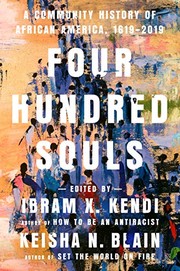
Four Hundred Souls: A Community History of African America, 1619–2019 is a 2021 anthology of essays, commentaries, personal reflections, short stories, and poetry, compiled and edited by Ibram X. Kendi and Keisha N. Blain. Conceived and created to commemorate the four hundred years that had passed since the arrival of the first Africans in Virginia, the book concerns African-American history and collects works written by ninety Black writers. A winner or finalist of multiple awards in its print and audiobook editions, Four Hundred Souls has been widely praised by reviewers for its prose and historical content.
Background
From 1841 to 2019, the vast majority of books telling a history of African America were written by individuals, also almost always male. As the 400th anniversary of Black Africans' arrival in British North America approached, Ibram X. Kendi contemplated how to commemorate the "symbolic birthday of Black America" and the whole 400-year period. Kendi resolved to invert the trend by "bringing together a community of writers" and encouraging them to both write history and make history, creating an artifact capturing what Black Americans were thinking during that anniversary year.
Kendi and Keisha N. Blain collaborated to compile and edit the book project, titled Four Hundred Souls: A Community History of African America, 1619–2019, and together they invited ten poets and eighty writers from a diverse range of professions—including historians, anthropologists, journalists, novelists, economists, theologians, educators, and more—to contribute. Reviewer Don Polite called the resulting contributor list a "who's who of African America" and "a remarkable cross section of the Black community". Many contributors are "huge names", but Four Hundred Souls also features numerous "up-and-coming writers". Most of the authors wrote their chapters in 2019.
Blain remembered the process being a "moving experience". The COVID-19 pandemic began while Kendi and Blain were in the process of assembling the book; feeling that she was at work on something historically significant comforted Blain during a time of intense loss and loneliness. The book is dedicated "to Black lives lost to COVID-19".
While contrasting with past single-author histories of Black America, Four Hundred Souls also emerges in a tradition of Black-written anthologies "of historical observations, poetry, scholarship, and vignettes" in the vein of Abraham Chapman's Black Voices: An Anthology of Afro-American Literature and Maya Angelou's I Know Why the Caged Bird Sings.
During a later stage of producing the book, Kendi and Blain decided that for the audiobook version, they wanted to "actualize what [Kendi] wrote about" in his introductory description of the book's "community of writers [being] like a choir". To evoke this effect, they chose to pursue a full-cast audiobook. The cast features eighty-seven narrators, some of whom are contributors to the book who narrate their own chapters. Others feature only as narrators in the audiobook; this cast includes actress Danai Gurira, broadcast journalist Soledad O'Brien, and singer Phylicia Rashad, among many others. In the interest of enabling each narrator to give a passionate performance, the producers did not assign chapters to narrators and instead allowed cast members to choose which contributions they were interested in narrating. Narration was recorded in December 2020 and January 2021. Because of the COVID-19 pandemic, most narrators recorded at home studio setups.
Summary
Four Hundred Souls features essays, biographical sketches, short stories, and poems by ninety Black writers. It chronologically spans the 400-year length of African-American history, beginning in 1619 with the arrival of the first Africans in Virginia and ending in 2019. The book is divided into ten sections, each of which examine a period of 40 years. Each section concludes with a poem. There are eighty essays featured in the book, each of which chronicle a five-year period. Kendi and Blain invited some contributors to write about specific topics, such as asking Barbara Smith to write about the Combahee River Collective. With other writers, they worked together to find subjects that were good fits. In every case, the choice was up to the contributor. This "democratising approach" makes Four Hundred Souls a "people's history" told by and about African Americans themselves.
Following an introduction by Ibram X. Kendi, the anthology begins with an essay by Nikole Hannah-Jones, who developed The New York Times' 1619 Project. Chapter subjects include policy, political events, elements of culture, revised historical narratives, and biographies. Some chapters offer fresh insight on well-known subjects, such as the essays on Phyllis Wheatley, Booker T. Washington, and Black Power; while others spotlight little-known history, such as the life of Black New Yorker James McCune Smith. Each essay can function and be read individually, but together they highlight the "entangled histories" of African America. The book's final essay is written by Alicia Garza, who co-founded the Black Lives Matter movement.
以上文字摘自英文维基百科「Four Hundred Souls」(有删节,去掉了参考文献等尾部小节),按 CC BY-SA 4.0 使用,作者为维基百科的各位编者。
资料卡
- 原题
- Four Hundred Souls
- 原作语言
- 英语
- 首次出版
- 2021 年 2 月 2 日
- 作品形式
- 选集
- 体裁
- 诗歌、随笔
- 主题
- 非裔美国历史
资料卡来自 Wikidata Q109655068(CC0),众包数据,个别字段可能不全。