 书单
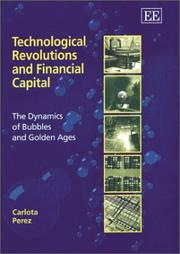
Technological Revolutions and Financial Capital (2003)
- 作者
- Carlota Perez
- 首版
- 2003 年
- 国家/地区
- 美国
- Open Library
- 2 个版本
百科
这个词条暂时没有中文维基百科条目,下面是英文维基百科的内容(英文原文):
Technological Revolutions and Financial Capital: The Dynamics of Bubbles and Golden Ages is an academic book by Carlota Perez that seeks to describe the connection between technological development and financial bubbles as seen in the emergence of long term technology trends. The model described by Carlota Perez shows repeated surges of technological development over the past three centuries with examples such as: the age of steam and railways, the age of steel and electricity, mass production and the automobile and the current information/knowledge society.
Five Technological Revolutions
The book identifies five bursts of technological innovation that have occurred in industrial history.
Technological Revolutions
Perez defines Technological Revolutions as the emergence of a cluster of interrelated technologies as well as respective products and industries. These technological innovations are different from the current technological landscape, they are dynamic and have a long-lasting and profound effect on the working of the economy. Their aggregated deployment typically leads to a long-term surge of economic development and improvements in living standards. Their launch and acceleration is usually driven by an all-pervasive low-cost input, for instance, an important material, source of energy or technical component. Perez clearly distinguishes the term Technological Revolution from the term Revolutionary Technology, as the latter only describes a single innovative technology, but not its interrelation with other emerging innovations.
Perez derives the revolutionary nature of these technologies from their ability to shape behaviour beyond their industries of origin and reach widespread diffusion. These new general purpose technologies and their associated organizational principles influence and spread into most areas of economic activity. Their deployment enables an increase in efficiency and modernization across all sectors. The amalgamation of new dynamic industries, propelled by new cheap inputs, products and processes, forms a new engine of growth for the whole economy, according to Perez.
Techno-Economic Paradigms
In the book, a Techno-Economic Paradigm refers to the gradually resulting best-practice framework characterized by the attributes of the Technological Revolution and corresponding organizational set-ups. These principles embody the most efficient methods for conducting business in the context of the particular technological innovations and leveraging them to modernize the broader economy. Once widely adopted, these principles form the foundational "common sense" for organizing activities and structuring institutions across diverse sectors. The emergence of a cluster of new technologies not only rejuvenates the industries of the previous paradigm, but also leads to new industries, products and infrastructure. This new “common sense” guides investors, consumers, entrepreneurs and other economic actors.
According to Perez, a new Techno-Economic Paradigm is the result of a Technological Revolution and is divided into an installation and a deployment phase. Between the two phases is a period of upheaval, as institutions still operate according to the old paradigm and must first adapt to achieve social progress.
Role of capital
The role and behaviour of capital, investments, and the adjacent institutional framework play a central role in Perez's model and are presented as the driving forces of the diffusion cycles. Perez adapts the dichotomy of production and financial capital, which are distinct from each other.
Production capital encompasses the industries, businesses, and infrastructure that adopt and implement new technologies, transforming them into tangible economic output, particularly during the deployment phase.
Financial capital plays a critical role during the installation phase, funding innovation and experimentation through investments. Perez argues that decoupled speculative activity during this phase results in financial bubbles, which ultimately burst. This financial activity, despite its initial disruptive nature, helps finance the infrastructure and systems required for the new technologies to mature.
Perez underscores the importance of a balanced relationship between these two forms of capital, with financial capital enabling early-stage innovation and production capital ensuring sustained, widespread economic and potential social progress in the later stages of a techno-economic paradigm.
Financial cycles
Perez found that these cycles of technological revolutions are coupled with financial cycles. Each cycle, which may take 50–60 years, consists of the following four phases:
Irruption phase: There is an intense funding of innovation in new technologies. Clusters of new revolutionary inventions appear. New industries are established, and the construction of new infrastructure begins.
Frenzy phase: Increased speculation and financialization leads to a decoupling between financial capital and production capital. Capital is invested more in financial innovations than in technological innovations. Asset bubbles are inflated.
Synergy phase: Growing inequality and political unrest. A need for political regulation of the financial sector is acknowledged. Asset bubbles may burst. The link between financial capital and production capital is repaired.
Maturity phase: The market for the new technology begins to become saturated. Social structure and infrastructure have adapted to the new technologies. Opportunities for investment are decreasing. The idle financial capital is moving to new sectors and new regions where it may lay the foundation of the next great surge.
Critical reviews
A Foreign Affairs review said "A broad-sweep 'think piece' in the Schumpeterian spirit, this book discusses the relationship between major technological innovations and financial booms and busts."
以上文字摘自英文维基百科「Technological Revolutions and Financial Capital」(有删节,去掉了参考文献等尾部小节),按 CC BY-SA 4.0 使用,作者为维基百科的各位编者。
资料卡
- 首次出版
- 2003 年 4 月
- 体裁
- 非虚构作品
资料卡来自 Wikidata Q17126550(CC0),众包数据,个别字段可能不全。