书单
百科
这个词条暂时没有中文维基百科条目,下面是英文维基百科的内容(英文原文):
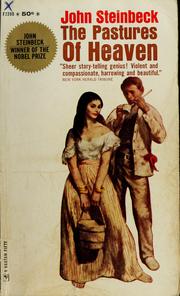
The Pastures of Heaven is a short story cycle by John Steinbeck published by Brewer, Warren and Putnam in 1932.
This episodic collection is composed of ten self-contained but related stories set in the Corral de Tierra of the Salinas Valley of California.
The Pastures of Heaven was said by one critic "to rival The Long Valley (1938) as Steinbeck's major achievement in short fiction".
Short story cycle: Chapters I-XII
The stories are presented here as per literary critics Richard. S. Hughes and Warren French. For clarity, the focal character is listed with the numerical section, as per Hughes.
Chapter I (Prologue)
Chapter II ("George Battle")
Chapter III ("Shark Wicks")
Chapter IV ("Tularecito")
Chapter V ("Helen Van Deventer")
Chapter VI ("Junius Maltby")
Chapter VII ("The Lopez Sisters")
Chapter VIII ("Molly Morgan")
Chapter IX ("Raymond Banks")
Chapter X ("Pat Humbert")
Chapter XI ("The Whitesides")
Chapter XII (Epilogue)
Reception
Characterizing The Pastures of Heaven as a collection of short stories rather than a novella, Saturday Review (November 26, 1932), praises Steinbeck for an aptitude that promises "richly human fiction" limited by merely "journalistic talent rather than of a creative imagination".
Critic Anita Moffet in The New York Times Book Review, November 20, 1932, reports Steinbeck conveys "deep feeling for the tragedy implicit in each situation…his writing is noteworthy for originality of phrase and image and a strongly poetic feeling".
The Nation in its "Shorter Notices" section (December 7, 1932) remarks on the dichotomous structure of the book - "Not really a novel, nor yet a book of short stories", - and classifies the stories as "sketches". Praising the collection's "excellent analytical narratives, written in supple prose", the review closes with this caveat: "If Steinbeck could add social insight to his present equipment he would be a first-rate novelist". Literary critic Joseph R. McElrath Jr. reports that the book "received a majority of positive reviews acknowledging the young writer's promise".
Background
As early as May, 1931 Steinbeck reported that he was at work on a "series of related stories". In a letter to his agent Mavis McIntosh at McIntosh & Otis, Steinbeck wrote: "The manuscript is made up of stories, each one complete in itself, having its rise, climax and ending. Each story deals with a family or an individual."
The stories are based largely on a local Salinas Valley family, the Morans, whose history and character Steinbeck knew well. The Morans appear as the 'Munroes" in The Pastures of Heaven cycle and provide a "connecting link" for the narratives.
Steinbeck completed the manuscript in December 1931. The publication of the book was complicated by a number of publisher bankruptcies. and was finally released by Brewer, Warren and Putnam in late 1932.
Form and structure
The organization of the book's narrative into ten "chapters" has elicited commentary among critics. Biographer Warren French writes: "Argument still continues as to whether The Pastures of Heaven is a 'novel' at all or simply a loosely related collection of short stories."
As a series of "autonomous stories" The Pastures of Heaven may be classified with "short-story cycles" comparable to Sherwood Anderson's Winesburg, Ohio (1919) or William Faulkner's The Unvanquished (1938). As such, the tales which are simply presented numerically by Roman numerals, "can stand by themselves" as works of short fiction.
Steinbeck's fiction includes "short story cycles" in which the stories may be "highly unified" as in his novel-like Tortilla Flat (1935), or only loosely associated, as in The Red Pony (1933) comprising only three stories.
The Pastures of Heaven was conceived by Steinbeck as a short story cycle. The unifying device is the presence of a single family residing in the valley, the Munroes, who appear, often as a physical link, in all the tales.
Literary critic Robert S. Hughes Jr. emphasizes that the Munroe family exerts a passive, but often decisive influence, serving as "the catalyst but not the true cause of the downfall of several of their unsuspecting neighbors".
The collection is also marked by an adamant irony that appears in the title itself, as well as the prologue and epilogue. Hughes writes:
The title's irony stems from the word heaven, which suggests a celestial realm where the righteous dwell in perfect harmony. Ironically, Steinbeck's earthly "heaven" hosts nearly every conceivable human imperfection; consequently, discord spreads among the inhabitants.
Theme
Biographer Warren French locates the key thematic element in "the heavy use of the kind of irony" that was encouraged by "New Critics" of the 1930s. The narratives place emphasis on the disparity between the aspirations of Steinbeck's protagonists and their "frustrating fulfillments".
In a May, 1931 letter to literary agent Mavis McIntosh, Steinbeck explained how devise the setting and thematic material for his story cycle:
There is, about twelve miles from Monterey, a valley in the hills called Corral de Tierra [earthen corridor]. Because I am using its people I have named it Las Paturas del Cielo. The valley was for years known as a happy valley because of the unique harmony which existed among its twenty families. About ten years ago a new family moved in on one of the ranches. They were ordinary people, ill-educated but honest and as kindly as any. In fact in there whole history I cannot find that they have committed a really malicious act...but about the Morans ['Munroes' in Pastures] there was a flavor of evil. Everyone they came in contact with was injured. Every place they went dissension sprang up…
Plot summaries and analysis
Chapter I
During the early pastoral period of California colonial occupation in 1776, a Spanish corporal and his mounted troopers pursue and capture a group of Indians - fugitive slaves from the
以上文字摘自英文维基百科「The Pastures of Heaven」(有删节,去掉了参考文献等尾部小节),按 CC BY-SA 4.0 使用,作者为维基百科的各位编者。
资料卡
- 原题
- The Pastures of Heaven
- 原作语言
- 美国英语、英语
- 首次出版
- 1932 年
- 作品形式
- 短篇小说集、长篇小说
- 续作
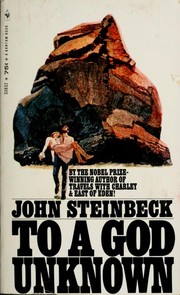
- To a God Unknown
- 故事发生地
- 加利福尼亚州
资料卡来自 Wikidata Q257144(CC0),众包数据,个别字段可能不全。