书单
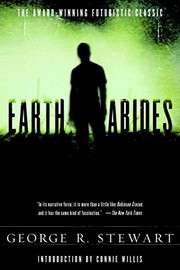
Earth Abides (1949)
百科
这个词条暂时没有中文维基百科条目,下面是英文维基百科的内容(英文原文):
Earth Abides is a 1949 American post-apocalyptic science fiction novel by George R. Stewart. It tells the story of the fall of civilization from deadly disease and the emergence of a new culture with simpler tools. Set in the 1940s in Berkeley, California, the story is told by Isherwood Williams, who emerges from isolation in the mountains only to discover that almost everyone has died.
Earth Abides won the inaugural International Fantasy Award in 1951. It was included in Locus magazine's list of best All Time Science Fiction in 1987 and 1998 and was a nominee to be entered into the Prometheus Hall of Fame some time before 2002.
Plot
"Part I: World Without End"
While working on his graduate thesis in geography in the Sierra Nevada, Ish is bitten by a rattlesnake. As he heals from the bite in a cabin, he gets sick with a disease similar to measles, and he lapses in and out of consciousness. He eventually recovers and makes his way back to civilization, only to discover that it has collapsed after most people have died from the same disease. He decides to go to his home in Berkeley, California. In the city near his home, Ish meets a few survivors and also encounters a friendly and eager dog, which he names Princess, who swiftly adopts Ish as her new master. He sets out on a cross-country tour, traveling all the way to New York City and back, scavenging for food and fuel as he goes. As he travels, he finds small groups of survivors, but has doubts about humanity's ability to survive the loss of civilization.
Ish returns to his home in California. After reading Ecclesiastes, he realizes that he had been throwing his life away. He finds an African American woman named Emma living nearby, and they agree to consider themselves married and have children. Other survivors gradually join them. Over time, the electricity (which had been provided by an automated hydro power station) fails, and the comforts of civilization recede. As the children grow, Ish tries to instill basic academic skills by teaching reading, writing, arithmetic, and geography, but he is unsuccessful mainly due to the others' lack of interest.
Many children are born in these years, including Joey, Ish's youngest and favorite son. Joey is very similar in nature to Ish, as he demonstrates innate intelligence and a curiosity about the world before the epidemic. This leads Ish to believe that Joey is the key to the future.
"Part II: The Year 22"
22 years after the collapse, the community is flourishing, with the young adapting easily to the de-modernised world. They come to have a better grasp of the natural world than the adults, and when running water fails, the younger generation comes to the rescue, knowing where flowing streams may be found. Ish turns his attention from ecology to his newly forming society, and he notices that the children are becoming very superstitious. One day, Ish asks for his hammer, which he habitually carries around, and finds the children are afraid to touch it as it is a symbol to them of the old times; the long-dead "Americans" of the old world are now viewed like gods, including Ish. Only Joey is willing to touch the hammer, confirming in Ish's mind that he is the future of civilization.
Two of the older boys return from a cross-country trip with a stranger named Charlie, whom Ish and the other adults immediately distrust. When it is discovered that Charlie carries multiple dangerous diseases, Ish and the other survivors vote to execute him to prevent transmission. Shortly after Charlie's arrival, the tribe experiences an outbreak of typhoid fever, which kills many, including Joey. Through his despair, Ish is compelled to confront the future with a new set of expectations and hopes. His ambition to restore civilization to its original state is replaced by a more modest, practical one: to convey a few basic survival skills, such as making bows and arrows, which the children find to be excellent playthings.
As the years go by, the community begins to grow corn. Ish presides at meetings, his hammer being a symbol of his status. Though he is respected, many of his ideas are ignored by the younger men. Decades pass, and every original member of the tribe dies except Ish, leaving him as "the Last American".
"Part III: The Last American"
Ish spends most of his elderly life in a mental "fog", unaware of the world. Occasionally, the fog in his mind lifts. During one such time, he finds himself aware of his great-grandson, Jack, who stands before him. Jack tells him that the bow and arrow have become more reliable than the gun, whose cartridges do not always work. Jack also mentions that the differently colored arrowheads that he has made (unbeknownst to him, from several coin denominations) are suitable for hunting different game. Ish finds this belief superstitious, but decides it would be futile to challenge it. Ish realizes that the former civilization is now completely gone and will not be rebuilt anytime soon. He becomes reconciled to the way things have changed. After a fire destroys Ish's house and the surrounding city, Jack and some other men carry him and the hammer to safety. Ish collapses while crossing the San Francisco–Oakland Bay Bridge, and as he is dying the younger men insist that his hammer be passed on to one of them. Ish chooses Jack, then dies while recalling a passage from Ecclesiastes: "Men go and come, but Earth abides."
Characters
Isherwood Williams (Ish) is a graduate student at Berkeley, studying the geography of an area in the mountains, somewhere in California. He is sometimes referred to in the book as "The Last American". Ish—due, he believes, to his intellect—becomes the leader of the community, or "the tribe".
以上文字摘自英文维基百科「Earth Abides」(有删节,去掉了参考文献等尾部小节),按 CC BY-SA 4.0 使用,作者为维基百科的各位编者。
资料卡
- 原题
- Earth Abides
- 原作语言
- 英语
- 首次出版
- 1949 年
- 作品形式
- 长篇小说
- 体裁
- 末日后幻想、科学幻想
- 首版出版社
- 兰登书屋
- 故事发生地
- 旧金山
资料卡来自 Wikidata Q3213115(CC0),众包数据,个别字段可能不全。
改编作品
电视剧 / 剧集1
名单来自 Wikidata(CC0):只列条目里写明「改编自 / 取材于」这本书的作品,不按名字猜;众包数据,可能不全。
更多资料与书评
在哪读
George R. Stewart 的其他作品
作者页 ›
相似的书
 豆瓣 #38
 豆瓣 #82