 书单
百科
这个词条暂时没有中文维基百科条目,下面是英文维基百科的内容(英文原文):
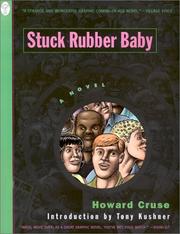
Stuck Rubber Baby is a 1995 graphic novel by American cartoonist Howard Cruse. He created his debut graphic novel after a decades-long career as an underground cartoonist. It deals with homosexuality and racism in the 1960s in the southern United States, in the midst of the civil rights movement. While the book is not autobiographical, it draws upon Cruse's experience of growing up in the South during this time period, including his accidental fathering of a child, as referred to in the title.
Background
Howard Cruse was born in 1940s Alabama to a Baptist preacher and his wife. He earned a degree in drama and worked in television before turning to a cartooning career. From 1971 he published a strip called Barefootz, which appeared in a number of underground comix publications, including three issues under its own title. Cruse's contemporaries gave it little regard, deeming it too cute and gentle compared to the countercultural works alongside which it ran. In 1976, Cruse introduced a gay character into the strip, committing to the gay liberation movement.
In 1979 Denis Kitchen of Kitchen Sink Press invited Cruse to edit the comic-book anthology Gay Comix; the first issue appeared in 1980. From 1983 to 1989 Cruse produced Wendel, an ongoing humorous comic strip for the LGBTQ magazine The Advocate.
Publication history
Piranha Press, an imprint of DC Comics for alternative comics, contracted with Cruse for a graphic novel. It gave him an advance against royalties to cover expenses for the two years projected to finish the book; it ultimately took four years. When his finances became tight, Cruse took time away from the book to raise funds by applying for grants and selling original art pages from the book before they were drawn. Piranha Press was discontinued in 1994, before Cruse finished the book. It was instead published by DC's Paradox Press imprint in 1995 in hardcover, and in paperback in 1996 by HarperCollins. In 2010, DC published a new edition under its Vertigo imprint. Cruse's agents Denis Kitchen and John Lind moved the book to First Second Books, which published a 25th Anniversary edition in 2020, incorporating unpublished material from Cruse's archives; the book was released a few months after his death.
Playwright Tony Kushner wrote an introduction to the first edition. Cartoonist Alison Bechdel contributed an introduction to the 2010 reprint edition. Translations have been published in French, German, Italian, Polish, and Spanish.
Plot summary
Decades after the book's events, the forty-something Toland Polk narrates his youth in the fictional town of Clayfield, in the American South in the 1950s and 1960s. After his parents die in a car accident, he finds he has no direction. He chooses to work for a gas station rather than go to college.
Polk becomes involved with the black community and the civil rights movement. At the same time, he courts a folk singer named Ginger in the hopes of "curing" his homosexuality. Together they have a child they give up for adoption. Polk finds the black community more accepting of his homosexuality than his own white community. The bombing of a black community center, the lynching of a gay friend, and other such events push him to social activism.
Style and analysis
The dense black-and-white artwork is more restrained and less cartoony than that of Cruse's earlier work. Cruse abandons his trademark stippling for heavily crosshatching. He gives particular attention to buildings and other background details, and to rendering characters with individuality. Ben Bolling likens the rounded rendering of the figures to those in the paintings of American artist Paul Cadmus. The pages are dense with dialogue balloons.
The frame story, set off with rounded panel borders, takes place in the late 1980s or early 1990s, as the adult Toland narrates with his male partner by his side. The narration appears to occur over a substantial span of time, as the pair's clothing and background reflect seasonal changes from summer to winter.
Overview
The story is not autobiographical, but Cruse draws from his experiences growing up in Birmingham, Alabama. He also includes such historical events as the 1955 murder of Emmett Till in Mississippi and the 16th Street Baptist Church bombing in Birmingham in 1963.
In an interview with Comic Book Resources, Cruse said that he based the novel on his own experiences in the 1960s and his "anger at the degree to which the ideals of the Civil Rights Era were being abandoned".
In another interview, Cruse stated: "My goal was to create the kind of novel that is too full of incident for someone to simply summarize in their mind in one sentence. I wanted it to be like life, where you spend a year of your life and you can't just remember everything that happened, but it's all part of a process".
Character list
Toland Polk, the main character/protagonists
Melanie, Toland's sister
Orley, Melanie's husband
Stetson, an elderly handyman/gardener who worked for the Toland family
Ben, Stetson's son
Ginger Raines, Toland's old girlfriend
Riley Wheeler, Toland's friend
Mavis Greene, Riley's girlfriend
Sammy Noone, a longtime gay friend of Mavis & Riley
Lester Pepper, the gay son of preacher Harland Pepper
Reverend Harland Pepper, a preacher and nonviolent social activist
Anna Dellyne Pepper, a former New York singer and the preacher's wife
Shiloh Reed, a singer who suffers from brain damage following an accident
Lottie, Shiloh's wife, who has cancer
Sledge Rankin, a black person who is murdered by the KKK
Robert Samson, a friend and bisexual lover
Esmo "Esmereldus", a drag queen
Mabel Older, a piano player and Effie's sister
Cindy Neuworth, Mabel's younger, "butchy" girlfriend
Marge, a lesbian, Effie's partner and co-owner of Alleysax
Effie, Marge's partner and co-owner of Alleysax and Mabel's sister
Father Edgar Morris, another preacher in town
Reception and legacy
Stuck Rubber Baby was published with high expectations, given the success of Art Spiegelman's graphic novel Maus (1991). Stuck Rubber Baby won a favorable critical reception, but its sales were modest.
以上文字摘自英文维基百科「Stuck Rubber Baby」(有删节,去掉了参考文献等尾部小节),按 CC BY-SA 4.0 使用,作者为维基百科的各位编者。
资料卡
- 插图
- 霍华德·克鲁斯
- 原作语言
- 英语
- 作品形式
- 漫画小说
- 体裁
- 历史漫画
资料卡来自 Wikidata Q451403(CC0),众包数据,个别字段可能不全。