书单
百科
这个词条暂时没有中文维基百科条目,下面是英文维基百科的内容(英文原文):
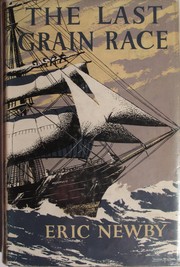
The Last Grain Race is a 1956 book by Eric Newby, a travel writer, about his time spent on the four-masted steel barque Moshulu during the vessel's last voyage in the Australian grain trade.
Background to the book
In 1938 the 18-year-old Newby shipped aboard the four-masted barque Moshulu as an apprentice. His outbound passage from Europe to Australia was via the Cape of Good Hope. His return was around Cape Horn. The Moshulu was at the time one of the largest sailing ships still transporting grain.
While 1939 was arguably the last Grain race worthy of the name, as it was followed by World War II and the consequent near-total interruption of commercial shipping, commercial sailing ships still sailed the route after the war for two more years in 1948 and 1949.
Summary of content
Newby finds out that his advertising agency, the Wurzel Agency, has lost a lucrative cereal account and he decides to write to Gustav Erikson of Mariehamn for a place on one of his grain ships, having been inspired with tales of the sea by an old family friend, Mr Mountstewart. Much to his surprise, he is accepted by 'Ploddy Gustav', the owner of the largest fleet of square-rigged deep-water sailing vessels in the world at that time.
After fitting himself out with heavy-weather gear, Newby makes his way to Belfast where Moshulu is discharging her cargo in York Dock. He meets some of the crew and they take him out on a drinking binge, but not before the second mate has ordered him "op the rigging". As the ship waits in port, he spends his time chipping away at the rust on the ship's hull but also befriends John Sömmarström, the ship's sailmaker, 58 years old, 43 of which have been at sea, who explains all the technicalities of a square rig to the young greenhorn.
The ship has a rough passage through the Irish Sea and ten days out they are passing Gibraltar. The ship's forecastle where the crew sleeps is overrun by bugs, including their beds, so they string hammocks (with practical jokers cutting the ropes they hang from). 24 days out, the ship picks up the Trade Wind and Moshulu is hit by a tornado. By now the crew is getting desperate for any food different from their staple menu and Newby shares his last can of peaches with another crewman, Kroner.
On the 34th day, Moshulu crosses the Equator and, along with a bottle of Akvavit from the captain, the new crewmen undergo the initiation ceremony – their heads are covered in tar and red lead. It is at this stage that Newby almost kills himself by not attaching his bosun's chair correctly. He also must undertake horrific jobs like cleaning the heads (the lavatories) and doing backstern—washing up for the 20 occupants of the three forecastles. Tension rises as weather conditions worsen, and Newby finally fights Hermansonn, whom Newby is able to smash after ten minutes.
Moshulu finally reaches port and the ship is loaded with 60,000 sacks (about 5000 tons) of grain—"wheat" in America, "corn" elsewhere—at Port Lincoln in South Australia. All the crew go on a bender, having at last received their measly pay. The ship sails on to Port Victoria and the crew have to offload the ballast on the outer-ballast grounds, working amidst the stench of two dead dog carcasses that the Belfast stevedores had kindly included. The ship finally leaves Australia on 11 March 1939 and Newby's new job, given to him by the First Mate who dislikes him, is to muck out the pigsties of four large pigs—"dose brodders of yours". Moshulu is prepared to meet the Southern Ocean and Newby at last experiences some real storms as the sea washes over the deck and the crew have to deal with flapping sails perched high up in the rigging. Newby manages to fall off the yard backwards, knocked off by 40 feet (12 m) of canvas, but fortunately becomes entangled in the weather rigging 5 feet (1.5 m) below the yard.
The storm finally abates but not before it enters its most impressive phase.
We were cold and wet, and yet too excited to sleep ... watching the seas rearing up astern as high as a three-storeyed house. It was not only their height that was impressive but their length. Between the greatest of them there was a distance that could only be estimated in relation to the ship, as much as four times her entire length, or nearly a quarter of a mile.
Newby goes aloft into the fore rigging:
At this height, 130 feet up, in a wind blowing 70 miles an hour, the noise was an unearthly scream. Above me was the naked topgallant yard and above that again the royal to which I presently climbed ... the high whistle of the wind through the halliards sheaf, and above all the pale blue illimitable sky, cold and serene, made me deeply afraid and conscious of my insignificance.
As they round Cape Horn, the crew have become bored by the desolation around them and engage in a tug-of-war competition from which Newby emerges victorious. They also kill a pig to celebrate Good Friday and they also spot another four-master—the Passat—whom they pass which makes Captain Sjögren happy. Having passed Cape Horn and the Falkland Islands, the crew start to realize they are making a record-breaking passage. The crew are now becoming famished, having to eat 'Buffelo' (boiled salt beef) the whole time cooked by the 'Kock'. However, life becomes easier with the return of the Trades but then Moshulu becomes becalmed. They finally cross the Line and are given a huge rum ration which they find difficult to get through, and spirits are lifted when they think they have caught a shark but it bends the hook. The last pig, Filamon, is slaughtered and the crew eat so much pork that it wreaks havoc with their stomachs.
以上文字摘自英文维基百科「The Last Grain Race」(有删节,去掉了参考文献等尾部小节),按 CC BY-SA 4.0 使用,作者为维基百科的各位编者。
资料卡
- 原作语言
- 英语
- 体裁
- 航行
- 首版出版社
- 塞克尔和沃伯格出版社
资料卡来自 Wikidata Q7745796(CC0),众包数据,个别字段可能不全。