 书单
百科
这个词条暂时没有中文维基百科条目,下面是英文维基百科的内容(英文原文):
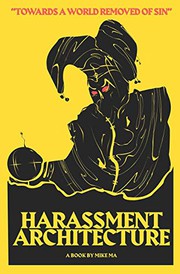
Harassment Architecture is a 2019 novella that was self-published and written by writer Mike Ma. A sequel, Gothic Violence, was published in 2021. It follows an unnamed protagonist, a racist insomniac with violent tendencies, who embarks on a campaign to destroy the world. Some sections are narrative, while others are more ranting or political discourse. It is popular among the online far-right.
The book contains ecofascist, white nationalist, and militant accelerationist themes and content. It contains scenes of extreme violence, as well as extreme misogyny and racism; it criticizes modernity and progressivism, promoting violence as the only solution, and has gained popularity among right-wing accelerationists.
Background and publication history
Harassment Architecture was self-published by Mike Ma in 2019. Mike Ma is the pen name of far-right internet influencer Mike Mahoney, a former Breitbart writer for Glittering Steel and former associate of Milo Yiannopoulos. Ma is also the founder of the Pine Tree Party accelerationist movement, founded in 2017, which had previously brought him prominence among ecofascists. He is a militant accelerationist, and has been outspoken in his praise for the Unabomber Ted Kaczynski.
Harassment Architecture was advertised in Raw Egg Nationalist's magazine Man's World, as was its sequel. Ma described Harassment Architecture as "more of a mental breakdown than a story". In 2021, Ma published a sequel, Gothic Violence; the plot of that book centers on a group of terrorist surfers taking over Florida.
Summary
The book begins with an author's note declaring that "if you came here expecting coherent plot or structure, you bought or stole the wrong book." The novella's protagonist is an unnamed white man in his early 20s. He works at an unspecified job and regularly goes without sleeping for days on end due to insomnia; as a result, he frequently loses track of time and his own train of thought. He is a self-avowed racist and accelerationist who despises the state of the world (what he calls the "lowerworld"), particularly technological advancement and progressivism, and is prone to violent fantasies. His self descriptions are inconsistent and he is often unclear about how much of what he is experiencing is real. The narrative, largely made up of various isolated incidents, is interrupted by the narrator's constant daydreams, hallucinations, and commentary on various political and cultural topics.
The book begins with him playing Richard Wagner's music loudly in his car, "with the windows down, mostly because I want the people at this red light to think I'm a cultured guy". He harasses a woman and then gets into a car accident. The narrative shifts to a concert he must attend with his friends; he says they are not his real friends because he cannot be "racist, sexist, or myself around them". While at the concert, he begins fantasizing about murdering everyone there, before his fantasy is interrupted by a girl who flirts with him; broken out of his fantasy, he leaves and decides to abandon all of his friends for good. Another day, he has a pleasant discussion with a leftist woman who does not know his political views, and imagines the results if she knew what he was actually like.
The protagonist narrates the life of a depressed woman whom he stalks, who accidentally kills herself when the narrator breaks into her apartment. He kills one of his friends by tipping a bookcase onto her; he claims it was self-defense, and there are no apparent consequences. His sleep deprivation and hallucinations worsen to the point where he is no longer sure if he is dreaming or awake. He gets into another car accident and almost dies, resulting in delirium as he heals. He leaves America under unclear circumstances and returns with several thousand dollars.
At the end of the narrative, the following events are clearly real: the narrator decides that he will attempt to cause as much harm to the world as he can. He first kills several people by throwing rocks through their windshields, leading to a pileup car accident. His campaign escalates to mass murder and widespread terrorism and attracts followers, declaring war on the world; to a real but unclear extent, the narrator succeeds in severely disrupting the government and status quo. He is arrested and briefly concludes the experience was a daydream, hallucinating further that he sees Lucifer speaking to him, before his followers break him out of jail and he gives a speech advocating accelerationism. The book ends with the narrator proclaiming all the things he has seen both God and demons in, concluding that "I saw God and he told me to burn it all down".
Themes and ideology
Harassment Architecture espouses ecofascist, white nationalist and identitarian views. The novel contains militant accelerationist themes, and promotes the targeting of infrastructure in order to destabilize society. It, as well as its sequel, espouses several conspiracy theories, including that of the Great Replacement, as well as antisemitism and anti-vaccination ideas. The book includes scenes where the protagonist suggests that he has shot up a gay nightclub, as well as attacks on ethnic minorities, the poor, and transgender people. It also focuses substantially on diet and physical fitness, which are part of the "transformation" the protagonist undergoes.
以上文字摘自英文维基百科「Harassment Architecture」(有删节,去掉了参考文献等尾部小节),按 CC BY-SA 4.0 使用,作者为维基百科的各位编者。
资料卡
- 原题
- Harassment Architecture
- 原作语言
- 英语
- 首次出版
- 2019 年 4 月 27 日
- 作品形式
- 中篇小说
资料卡来自 Wikidata Q130285610(CC0),众包数据,个别字段可能不全。