书单
百科
这个词条暂时没有中文维基百科条目,下面是英文维基百科的内容(英文原文):
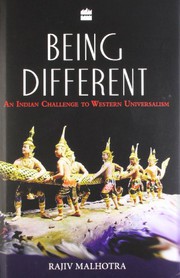
Being Different: An Indian Challenge to Western Universalism is a 2011 book by Rajiv Malhotra, an Indian-American author, philanthropist and public speaker, published by HarperCollins. The book attempts to study Western cultures from the vantage point of Indian philosophy, specifically through what he refers to as “traditional dharmic approach.”
The primary objective of this book is to challenge the postulations of Western societies on the Indic civilization.
About the book
Malhotra intends to give a critique of western culture, by comparing it with Indian culture, as seen from a 'Dharmic point of view.' To accomplish this goal, he postulates a set of characteristics of western culture, and a set of characteristics of Indian culture and religion, characterised as "Dharmic." Malhotra explains that in Being Different,
'Dharma' is used to indicate a family of spiritual traditions originating in India which today are manifested as Hinduism, Buddhism, Jainism and Sikhism. I explain that the variety of perspectives and practices of dharma display an underlying integral unity at the metaphysical level.
Malhotra summarizes his rationale for treating Dharmic traditions as a family, contrasting the family of Dharmic traditions with Abrahamic religions. He constructs their differences from this 'Dharmic perspective,' thereby 'reversing the gaze.' Malhotra clarifies that he is not replacing a West-centric view with a Dharma-centric view by proposing the reversal of gaze. Malhotra explains that he seeks a dialogue, where the world civilizations are not merely seen from the viewpoint of the West, but the west is also seen from a non-western, c.q. 'dharmic' point of view.
Malhotra calls for mutual respect as a higher standard for pluralism than tolerance. Mutual respect does not call for acceptance of beliefs held by others, only to have genuine respect for difference, because, beliefs are not facts. Malhotra explains why this gaze from the other side benefits the West, explaining that he
... hopes to set the terms for a deeper and more informed engagement between dharmic and Western civilizations."
Overview
Malhotra identifies "six distinct and fundamental points of divergence between the dharmic traditions and the West." Malhotra argues that understanding these six points of divergence is crucial to recognizing the fallacy of facile sameness arguments and to understanding senselessness of inculturation efforts. These points of divergence are:
Approaches to difference
History-centrism versus inner sciences
Integral versus synthetic unity
The nature of chaos and uncertainty
Translatability vs. Sanskrit
Western universalism challenged
Divergence 1: Approaches to difference
According to Malhotra, there is a pervasive anxiety in the west over personal and cultural differences. Therefore, the west tries to assimilate and convert "all that does not fit its fundamental paradigms." According to Malhotra, this anxiety is grounded in schisms which are inherent in the western worldview. In contrast, "Dharmic traditions [...] are historically more comfortable with differences."
Divergence 2: History Centrism versus inner sciences
According to Malhotra, Dharmic traditions rely on adhyatma-vidya, while the Abrahamic religions rely on God's interventions in human history. For followers of history-centric (Abrahamic) religions, truth-claims based on history are more significant than the scriptural message itself. History-centric dogma such as original sin and resurrection become critical beliefs and no compromise can be made on their acceptance. This explains the centrality of Nicene creed to all major Christian denominations. Followers of history-centric religions believe that the God revealed His message through a special prophet and that the message is secured in scriptures. This special access to God is available only to these intermediaries or prophets and not to any other human beings.
Dharma traditions do not hold history central to their faith. Gautama Buddha emphasized that his enlightenment was merely a discovery of a reality that is always there. He was not bringing any new covenants from any God. The history of the Buddha is not necessary for Buddhist principles to work. In fact, Buddha stated that he was neither the first nor the last person to have achieved the state of enlightenment. He also asserted that he was not God nor sent by any God as a prophet, and whatever he discovered was available to every human to discover for himself. This makes Buddhism not History-Centric.
Malhotra explains how history-centrism or lack of it has implications for religious absolutist exclusivity vs. flexible pluralism: Abrahamic religions claim that we can resolve the human condition only by following the lineage of prophets arising from the Middle East. All other teachings and practices are required to be reconciled with this special and peculiar history. By contrast, the dharmic traditions – Hinduism, Buddhism, Jainism and Sikhism -- do not rely on history in the same absolutist and exclusive way. This dharmic flexibility has made fundamental pluralism possible which cannot occur within the constraints of history centrism, at least as understood so far.
Divergence 3: Integral versus synthetic unity
Both Western and Dharmic civilizations have cherished unity as an ideal, but with a different emphasis. Here, Malhotra posits a crucial distinction between what he considers a "synthetic unity" that gave rise to a static intellectualistic Worldview in the West positioning itself as the Universal and an "integrative unity" that gave rise to a dynamically oriented Worldview based on Dharma. While the former is characterized by a "top-down" essentialism embracing everything a priori, the latter is a "bottom-up" approach acknowledging the dependent co-origination of alternative views of the human and the divine, the body and the mind, and the self and society.
以上文字摘自英文维基百科「Being Different」(有删节,去掉了参考文献等尾部小节),按 CC BY-SA 4.0 使用,作者为维基百科的各位编者。
资料卡
- 原作语言
- 英语
- 首次出版
- 2011 年
资料卡来自 Wikidata Q15915028(CC0),众包数据,个别字段可能不全。