书单
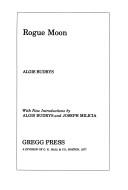
Rogue Moon (1960)
百科
这个词条暂时没有中文维基百科条目,下面是英文维基百科的内容(英文原文):
Rogue Moon (1960) is a short science fiction novel by Lithuanian-American writer Algis Budrys (1931-2008). It was a 1961 Hugo Award nominee. A substantially shortened version of the novel was originally published in F&SF; this novella-length story was included in The Science Fiction Hall of Fame, Volume Two, edited by Ben Bova. It was adapted into a radio drama by Yuri Rasovsky in 1979.
Rogue Moon is largely about the discovery and investigation of a large alien artifact found on the surface of the Moon. The object eventually kills its explorers in various ways—more specifically, investigators "die in their effort to penetrate an alien-built labyrinth where one wrong turn means instant death", but their deaths slowly reveal the funhouse-like course humans must take in moving through it.
Synopsis
Dr. Edward Hawks runs a top-secret project for the United States Navy investigating a large alien artifact found on the Moon. Hawks has created a matter transmitter which scans a person or object to make a copy at receivers on the Moon. The earthbound person is placed in a state of sensory deprivation which allows him to share the experiences of his doppelgänger. The copies enter and explore the alien labyrinth, but are killed for violating the unknown rules in force within the structure. Each explorer gets a little further and learns a bit more about what they can and cannot do. However, none of the participants have been able to remain sane after experiencing death second-hand.
Vincent "Connie" Connington, Continental's head of personnel, tells Hawks that he has found the perfect candidate for the next mission. He takes Hawks to see Al Barker, an adventurer and thrill-seeker. Hawks also meets Barker's girlfriend, Claire Pack, a sociopath of a different kind. Where Connington covets power, and Barker seems to love death, Claire enjoys using sex, or the prospect of sex, to manipulate men. Connington wants her, but she stays with Barker because he has no weaknesses in her eyes. Hawks has to appeal to Barker's dark side to persuade him to join the project. Claire tries to get under Hawks' skin while simultaneously playing Connington off against Barker.
Barker is the first to retain his sanity after dying in the artifact, but even he is deeply affected, exclaiming, "...it didn't care! I was nothing to it!" He returns again and again, advancing a little farther each time. His relationship with Claire deteriorates, even as Connington continues his disastrous attempts to win her, at one point receiving a severe beating from Barker. Eventually, Connington announces he is quitting, and Claire leaves with him.
Meanwhile, Hawks starts a relationship with a young artist, Elizabeth Cummings, and expresses his torment over the project to her.
Finally, Barker announces that he is almost finished. Hawks takes Elizabeth to a romantic location and declares his love for her, then transmits himself to the Moon, where his duplicate joins Barker's on the final run. Together, the two weave their way through a series of bizarre landscapes containing death traps, before emerging out the other side.
Hawks tells Barker that they cannot return to Earth. The equipment on the Moon is too crude to transmit a man back safely, and even if it were possible, there are already people living their lives. All the men working on the Moon are duplicates, mostly Navy men, all volunteers. Hawks elects to remain outside until his air runs out. Barker returns to try to be transmitted back anyway. Back on Earth, Hawks removes his isolation suit and finds a note in his hand, which he knew would be there. It reads simply, "Remember me to her."
Themes
Science fiction scholar Jeff King wrote that the novel's major themes are "the meaning of life and humanity's yearning to transcend death. Algis Budrys uses the trip through the alien labyrinth as a metaphor for life." Therefore, "Barker's discovery when he makes it completely through the alien structure" is that "a person must create himself or herself." King adds that a secondary theme is: "Human beings are possessed of more than the ability to reason and to function in the physical universe. They also feel, and development of that quality is as important as development of any other."
A reviewer for SFF World disagreed with Jeff King, considering the novel to be about death or dying; he referred to Arthur C. Clarke when he opined, "Rogue Moon seems to be initially a great exploration puzzle, about a large alien artefact found on the surface of the Moon. All attempts to explore it leads to the intrepid explorers being killed or going insane in various ways, but their deaths slowly reveal that the process of dying is the point: that and by dying in various ways by moving through it humans learn something about themselves, as presumably would the aliens, should they still exist. It is a Clarkean test, an ordeal that humans must pass in order to evolve and develop beyond their present state. As this shows, Rogue Moon is a deeper and more complex novel than we expect at first."
Reception
The novel was chosen in 2012 for the SF Masterworks series by publisher Victor Gollancz Ltd.
David Pringle included the novel in his book Science Fiction: The 100 Best Novels (Xanadu, 1985, ISBN 978-0-947761-10-3). Nick Rennison and Stephen E. Andrews, similarly, included it in their 100 Must-Read Science Fiction Novels.
以上文字摘自英文维基百科「Rogue Moon」(有删节,去掉了参考文献等尾部小节),按 CC BY-SA 4.0 使用,作者为维基百科的各位编者。
资料卡
- 原题
- Rogue Moon
- 原作语言
- 英语
- 首次出版
- 1960 年
- 作品形式
- 长篇小说
- 体裁
- 推想虚构作品、科学幻想
- 首版出版社
- 金牌书籍
资料卡来自 Wikidata Q3305686(CC0),众包数据,个别字段可能不全。
改编作品
取材于它的书1
名单来自 Wikidata(CC0):只列条目里写明「改编自 / 取材于」这本书的作品,不按名字猜;众包数据,可能不全。
更多资料与书评
在哪读
Algis Budrys 的其他作品
作者页 ›相似的书
 豆瓣 #38
 豆瓣 #82