书单
百科
这个词条暂时没有中文维基百科条目,下面是英文维基百科的内容(英文原文):
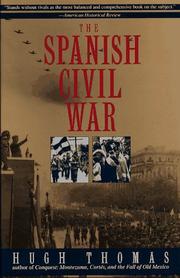
The Spanish Civil War is a book by Hugh Thomas. It provides a scholarly historiographic account of the Spanish Civil War. Begun in 1957, it was first published in 1961 simultaneously in the United Kingdom by Eyre & Spottiswoode and in the United States by Harpers'. It won the Somerset Maugham Prize in 1962 and during the following few years was translated and published in Portugal, France, Germany, Denmark and Italy. Despite initial approving reviews, in Francoist Spain the book received unfavorable treatment and was never published.
The work was revised and enlarged in 1965, 1977 and 2001. It was re-issued many times, the last edition during the lifetime of the author in 2012 and the last known edition in 2022. Over the decades it remained the most popular monograph on the war and was translated into at least 13 languages, reportedly selling over a million copies around the globe. It continues to be quoted in scholarly works on the war. It is usually acclaimed for its unbiased perspective, high level of detail and lively narrative. Detractors claim that it emphasizes storytelling at the expense of historical analysis, that some interpretations advanced are doubtful, and that it relies too heavily on some sources while neglecting others.
Background
Previous historiography
The first serious works on the Spanish civil war appeared when the conflict was still ongoing (Rudolf Rocker 1937, Frantisek Jellinek 1938). Numerous books went to print in Francoist Spain, but they were largely propagandistic; the best and the most detailed one was also plagued by censorship limitations (Joaquín Arrarás, 1940–1943). The analysis by Gerald Brennan covered causes rather than the war itself (1943). Beyond Spain there were personal accounts (e.g. Julió Álvarez del Vayo 1940), partisan narratives (e.g. Herbert Matthews 1958) or works which focused on particular dimensions of the war (e.g. Patricia van der Esch 1951, David Cattell 1954). In 1953 Brennan declined a proposal to write a broader work and suggested that Raymond Carr, who got interested in Spain only in the early 1950s, write it instead, a suggestion that would not bear fruit until much later. Herbert Southworth would not start writing his most famous work until 1963. Pierre Broué and Émile Témime were about to commence work on their book, to be published in 1961, but it reflected their Trotskyist leanings. Burnett Bolloten was merely collecting data, gathered in his later book (also 1961). Gabriel Jackson was a young college teacher and had not begun his account, which appeared in the mid-1960s.
Author
In the late 1950s Thomas was in his mid-20s. A Cambridge graduate, former employee of the Foreign Office and member of the British delegation to the UN Disarmament Commission, he was released at his own request due to unease with policies he was asked to promote. In 1956 he published a barely noticed novel on diplomatic life, The World Game. In 1957 he co-authored a Fabian Society brochure titled Disarmament – The Way Ahead. Disarmament remained "one of his main areas of interest". Together with Philip Noel-Baker he considered setting up a National Disarmament League. As director of the Disarmament Campaign of the United Nations he took part in various conferences as well as a meeting of the British-Soviet Friendship Society. He admitted left-wing sympathies, possibly bordering socialism. He was the Labour Party parliamentary candidate 1957-1958 for Ruislip and Northwood. At the time, he was a lecturer at the Royal Military College at Sandhurst. Some sources claim that in 1955 Thomas visited Spain for the first time and began his research on the civil war, though the introduction to his book mentions no such visit. At the time Thomas did not know any Spanish and, though a historian by education, had not published a single historiographic work. According to a contemporary, "in the late 1950s Thomas was casting around for the best use of his talents".
In the making
Origins
James MacGibbon, a wartime Soviet spy (later a suspect under the MI5 surveillance, which was all unknown to Thomas) and literary agent of the Curtis Brown literary agency, approached the 25-year-old Thomas some time halfway through 1957. MacGibbon claimed having liked The World Game and its acid portrait of British diplomatic circles. He hinted to Thomas that an American firm Coward McCann wanted to commission a book about the Spanish civil war; he asked whether Thomas would be interested. Thomas confirmed and in August he provided an outline to Cass Canfield Jr., at the time the representative of Coward McCann. Canfield liked it and commissioned Thomas for Harper's, which he had by then joined. Thomas shared the outline also with his agent at Eyre and Spottiswoode (the British company which published The World Game), Douglas Jerrold, an active supporter of Franco 20 years before. By the autumn Thomas cashed in the $300 advance from Harper Brothers and £250 from Eyre and Spottiswoode, both considerable amounts (in 1957 average annual earnings in the UK were some £390, the Ford Anglia model cost £571). Further details are unknown; many years later, when approached by an Australian historian who was writing about impact of the Cold War on Anglo-American representations of Spanish civil war, Thomas denied him access to the correspondence between himself and his publisher.
以上文字摘自英文维基百科「The Spanish Civil War (book)」(有删节,去掉了参考文献等尾部小节),按 CC BY-SA 4.0 使用,作者为维基百科的各位编者。
资料卡
- 原作语言
- 英语
- 首次出版
- 1961 年
- 首版出版社
- Eyre & Spottiswoode、哈珀与罗出版公司
- 主题
- 西班牙内战
资料卡来自 Wikidata Q85808518(CC0),众包数据,个别字段可能不全。