书单
百科
这个词条暂时没有中文维基百科条目,下面是英文维基百科的内容(英文原文):
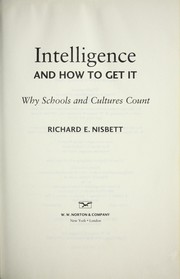
Intelligence and How to Get It: Why Schools and Cultures Count is a 2009 book about human intelligence by Richard Nisbett, a professor of social psychology at the University of Michigan. The book challenges the hereditarians' argument that IQ is entirely or almost entirely heritable, and argues that nonhereditary factors play a more significant role than hereditarians assert. It also recommends how to tutor children so as to maximize their intelligence. The book also argues that IQ scores are a valid, though imperfect, indicator of general intelligence, while criticizing some of the assertions made about such scores in the 1994 book The Bell Curve. The book's appendix argues that racial differences in IQ are entirely due to environmental factors.
Reviews
Writing for The New York Times, philosopher Jim Holt described the book as "a meticulous and eye-opening critique of hereditarianism." Psychologist Earl B. Hunt reviewed the book in the journal Intelligence, stating that "Nisbett is a very good writer, but he is a combative writer", and while "Nisbett is writing for a general audience" and "does so very well", Hunt argues that "Nisbett...goes too far in attacking discussions of the genetics of intelligence". In Gifted Child Quarterly, Wendy Johnson described the book as "a fascinating example of a scholarly exercise in wishful thinking", and criticized Nisbett for ignoring studies with results different from those that he cites, disregarding the importance of replication, and forgetting the limitations and caveats raised by the authors that he cites.
以上文字摘自英文维基百科「Intelligence and How to Get It」(去掉了参考文献等尾部小节),按 CC BY-SA 4.0 使用,作者为维基百科的各位编者。
资料卡
- 原题
- Intelligence and How to Get It
- 原作语言
- 英语
- 首次出版
- 2009 年
- 首版出版社
- 威廉·沃德尔·诺顿公司
- 前作
- 思维的彊域
- 主题
- 智力
资料卡来自 Wikidata Q40890606(CC0),众包数据,个别字段可能不全。