 书单
百科
这个词条暂时没有中文维基百科条目,下面是英文维基百科的内容(英文原文):
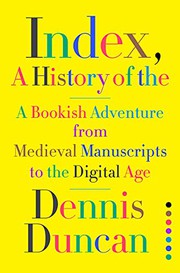
Index, A History of the: A Bookish Adventure from Medieval Manuscripts to the Digital Age is a 2022 book by Dennis Duncan that examines the history of indexes. Indexes, argues Duncan—paraphrasing Jonathan Swift's Mechanical Operation of the Spirit—allow the reader a legitimate means of starting a book from the back, a practice he compares to "travellers entering a palace through the privy".
Background
In books, indexes are usually placed near the end (this is commonly known as "BoB" or back-of-book indexing). They complement the table of contents by enabling access to information by specific subject, whereas contents listings enable access through broad divisions of the text arranged in the order they occur. It has been remarked that, while "[a]t first glance the driest part of the book, on closer inspection the index may provide both interest and amusement from time to time."
Book, title and author of
Dennis Duncan is a lecturer in English at University College London. The book's title has been described as particularly clever in how it "encapsulates both the subject and tone of Duncan's animated and amusing work". Steven Moore, for The Washington Post, argues that the title's distinct punctuation ensures that the book immediately stands out from being a "dry account of a small cogwheel in the publishing machine". Jennifer Szalai, for The New York Times, argues that while the book may sound as if it was a history of information science alone, it touches on far broader, more catholic, themes. These include, most obviously, the study of reading and writing, but also include "communication, learning and imagination, as well as competition, anxiety and no small amount of mischief".
Index, pejorative uses of a
Kurkowski argues that a particularly surprising aspect of the index, as Duncan devotes a chapter to how it can become "a passive-aggressive vehicle for lambasting one's enemies". He begins by noting how indexes can be used against an author as well as in the reader. This he calls "the rogue index ... [that is] weaponized against its primary text". For example, he recalls the mock index drawn up by several students of the 17th-century philologist and King's Librarian, Richard Bentley, of Christ Church, Oxford, which referenced Bentley's supposed "egregious dullness" and an assumed familiarity with works he never saw yet claimed to have used. Other insulting references were to his pedantry and "collection of asinine proverbs".
The children's author and mathematician Lewis Carroll, in the index to his Sylvie and Bruno contains an entry for "Sobriety, extreme inconvenience of". A similar technique was later used by the historian Hugh Trevor-Roper, who—while master of Peterhouse, Cambridge, a position he detested—"revenged himself on his detested colleagues" in the index of his latest piece pointed his readers, under the entry to his college, "Peterhouse: high-table conversation not very agreeable, 46; main source of perverts, 113". The "ultimate index compiled in bad faith", comments Douglas, is that of John Oldmixon, who was commissioned in 1718 to compose the index to Laurence Echard's A History of England. Echard was very much a High Tory, and his great man view of history reflected his conservative beliefs. Oldmixon, on the other hand, was a polemicist for the Whigs, and soundly at odds with Echard's views; he had already issued a "virulent barrage of pamphlets". Douglas comments that Oldmixon's commission gave him the opportunity for mischief: "As Duncan shows, his index undercuts Echard's intended meanings with sarcastic and deliberate misrepresentations, rewriting history from the safety of the back pages". Oldmixon's trolling of Echard had repercussions a century later, when another Whig historian, Thomas Macaulay, also the author of a The History of England, instructed his publisher to "let no damned Tory index my history". Sometimes targets were more general, such as this entry to a Tatler anthology: "Dull Fellows, who, 43 / Naturally turn their Heads to Politics or Poetry, ibid". On one occasion, William F. Buckley Jr. sent a copy of his latest book to Norman Mailer, and, knowing that Mailer's—who had a reputation for vanity—first act upon receiving it would be to look himself up in the index, wrote "hi!" by hand next to Mailer's entry.
Index, structure of
Duncan analyses how indexes can weigh the readers' perspective. By their nature, they are the somewhat arbitrary and possibly subjective opinions of one person as to what to include and exclude. This makes it easier for certain points of view to pushed on the reader whether they realise it or not. Likewise, they are almost always arranged chronologically, which, Duncan says, shifts the quality of what the prose says to a formulaic entry alongside so many others; it is, the author puts it, a "great leveller". Duncan also considers the question of whether fictional works should have indexes, citing John Updike's comment that "most biographies are just novels with indexes". This became a particular source of argument in the 18th century, although ultimately a failed proposal. Alexander Pope, for example, attempted to index Shakespeare's plays. While basic facts were indexable, notes Duncan, problems arose for Pope when he attempted to organise the characters' "manners, passions and their external effects".
以上文字摘自英文维基百科「Index, A History of the」(有删节,去掉了参考文献等尾部小节),按 CC BY-SA 4.0 使用,作者为维基百科的各位编者。
资料卡
- 原题
- Index, A History of the
- 原作语言
- 英语
- 首次出版
- 2022 年
- 首版出版社
- 威廉·沃德尔·诺顿公司
- 主题
- 索引
资料卡来自 Wikidata Q111912772(CC0),众包数据,个别字段可能不全。