 书单
百科
这个词条暂时没有中文维基百科条目,下面是英文维基百科的内容(英文原文):
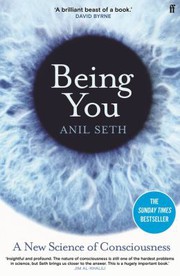
Being You: A New Science of Consciousness is a 2021 non-fiction book by neuroscientist Anil Seth, published by Faber and Faber. The book explores the author's theory of consciousness and the self. Seth also looks at the relationship between humans, animals, and the potential for machines to have consciousness.
The writing process took Seth three years, with support from the Wellcome Trust. The ideas in the book come from Seth's long-standing interest in understanding the mind, combined with research and discussions with his team in Sussex.
The book was well-received by major publications and was awarded Best Book of 2021 from Bloomberg and The Economist and Best Science Book of 2021 by The Guardian and the Financial Times. Critics praised the book for being rigorous and meticulous in its research, and Seth's writing style. However, some reviewers pointed out concerns with the language and approach towards solving consciousness used in the book.
Context
Anil Seth is a neuroscientist based in Sussex, England. Having been interested in consciousness since childhood, and after finding Tononi's 1998 paper compelling, he developed his theory of "causal density" with a different mathematical foundation.
In an interview with The Guardian, Seth stated he wanted to understand himself and others. His multidisciplinary team in Sussex helped in writing the book, all wanting to develop a "satisfying scientific explanation of conscious experience." He described Being You as a means to weave multiple threads of ideas together.
The book took three years to write. Seth said the process was difficult due to other commitments, but the Wellcome Trust provided him with an Engagement Fellowship which helped him find time to write.
Summary
The book is split into six parts and various chapters, each giving a broad overview of various philosophical and scientific positions that Seth relates to his own conclusions. Personal stories are also used to illustrate his points. Seth's theory of consciousness consists of three parts: conscious level, conscious content, and conscious self.
Conscious level is Seth's measurement of how conscious a being is. He defines it as a multilayered increase or decrease of brain activity, ranging between brain death, being comatose, being awake, and non-ordinary mental states caused by psychedelics. Conscious content is what a being is conscious of, be it their senses, emotions, thoughts, or beliefs. Conscious self is the pure awareness of the self, consisting of multiple facets Seth defines by their core focus: bodily self, perspectival self, volitional self, narrative self, and social self. These facets usually exist simultaneously, and all can exist at the same time.
Seth argues the brain uses Bayesian inference and predictive modelling to produce a "controlled hallucination" which is a subjective rendering of the inside and outside world. The brain makes predictions, sensory signals keep the predictions tied to their causes, and subjective experiences are created via "top-down" predictions rather than "bottom-up."
He proposes a new problem of consciousness that differs from David Chalmer's hard problem of consciousness. Instead of asking why or how beings experience qualia, Seth states we should focus on asking why a particular brain pattern of activity maps to a particular kind of conscious experience. His solution, as a physicalist and as a scientist, is through understanding the underlying biological processes of the brain through explaining, predicting, and controlling them.
Reception
General
Gaia Vince in her review for The Observer describes the book as a "meticulously researched" scientific exploration of people's souls. She identifies key themes throughout the book, such as consciousness, in Seth's view, being any and all subjective experiences as a key component to human identity. Disagreements between "perceptual expectations" and "conscious experience", she states, is how we bypass William Blake's so-called "doors of perceptions". These "doors", she writes, are seen in the dress phenomena and through the usage of hallucinogenics and virtual reality, which Seth discusses in the book. These altered states of mind influencing personal characteristics was shown to Vince through her grandfather's transition from a "funny, gentle man" into a stranger who "spoke inappropriately and unkindly" due to dementia. Despite this, she finds the book exhilarating and thinks it would "become a seminal text."
Writing in The Business Standard, the journalist Sams Wahid Shahat describes Seth's real problem of consciousness as a way to "dissolve" the hard problem. He details this being done through the various thought experiments which Seth presents throughout the book, which demystifies the hard problem by looking at the underlying biological processes in the mind. Shahat states that Seth borrowed the prediction machine concept from Hermann von Helmholtz, and controlled hallucinations are a part of these predictive processes. He describes the five facets of the conscious self as "theoretically distinct and can be understood independently" but we are able to perceive either multiple or all of these processes at the same time. Shahat praises the book as an "intriguing and accessible journey into the realm of consciousness" and "compelling" if one ignores "the book's emphasis on idea judgments [over] idea generation."
The science journalist Maddie Bender, writing for Scientific American, describes the book as "logically rigorous" to the point of almost being tedious, and observes Seth's likeliness to both discuss Kant as well as recent studies in detailing his theory of consciousness. She praises his vivid descriptions of scientific experiments, preferring them to the "philosophical hypotheticals of false selves and teleportation" also present in the book.
以上文字摘自英文维基百科「Being You: A New Science of Consciousness」(有删节,去掉了参考文献等尾部小节),按 CC BY-SA 4.0 使用,作者为维基百科的各位编者。
资料卡
- 原题
- Being You
- 原作语言
- 英语
- 首次出版
- 2021 年 9 月 2 日
- 首版出版社
- 法伯尔和法伯尔
- 主题
- 神经科学、心理学
资料卡来自 Wikidata Q120721350(CC0),众包数据,个别字段可能不全。