 书单
百科
这个词条暂时没有中文维基百科条目,下面是英文维基百科的内容(英文原文):
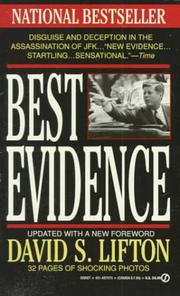
Best Evidence: Disguise and Deception in the Assassination of John F. Kennedy is a 1980 book by David S. Lifton. It details the author's long quest to solve what he considered a fundamental mystery in the JFK assassination: why the president's gunshot wounds, as described on the afternoon of November 22, 1963 by doctors and nurses at Parkland Hospital in Dallas, differed sharply from the autopsy findings later that night at Bethesda Naval Hospital in Maryland. The Dallas medical staff who first examined JFK reported seeing evidence that he was shot from the front, whereas the Bethesda autopsy doctors concluded that all entrance wounds were in his back and the rear of his skull. The thesis put forth by Lifton to resolve this contradiction is that during the hours between Dallas and Bethesda, conspiracy participants secretly altered the president's body so that it would fit the government's assassination narrative, i.e., that he was killed by a lone gunman firing from behind.
Best Evidence was criticized in the mainstream press as "bizarre". It nevertheless rose to No. 4 on The New York Times nonfiction bestseller list in March 1981. Macmillan distributed 100,000 copies in hardback. There were seven paperback reprintings by Dell Publishing, totaling over 200,000 copies. In 1988, Carroll & Graf released an expanded second edition, including graphic autopsy photos that Lifton had recently obtained, which led to another surge in book sales.
Background
In the mid-1960s, Lifton was pursuing a master's degree in engineering from UCLA when he dropped out of graduate school to focus his energies on researching the JFK assassination. For the next ten years, he collected notes, memos, and file material but had not yet converted his accumulated research into a book. In the summer of 1975, with encouragement from a friend, he began writing a manuscript that would become Best Evidence.
His work was rejected by over twenty publishers before Macmillan accepted it in 1978, giving the author a $10,000 advance. He continued to revise the manuscript, which delayed the hardcover publication date until the end of 1980 (he was still recording interviews with witnesses as late as October 1980). Due to the book's controversial contents, Macmillan went to unusual lengths in the fact-checking process. Best Evidence was "examined for potential factual errors by in-house counsel, an outside law firm, a forensic pathologist, and a neurosurgeon."
Lifton shepherded the book through all of its final pre-publication stages, and became "a fixture at Macmillan's New York offices". A Macmillan president joked that Lifton would probably still be making corrections at the bookstores.
Description
Best Evidence is written as a first-person narrative of the author's 15-year search for the truth about the JFK assassination. More than simply another conspiracy theorist's view of what happened on November 22, 1963, the book recounts a personal quest to resolve factual conflicts in the record.
The central thesis of the book is that JFK's body was altered between the Dallas hospital where he was immediately taken after the shooting, and the Bethesda hospital where the autopsy was performed that evening. Lifton argues that the alteration was done for the purpose of creating erroneous conclusions about the number and direction of the shots. He details evidence—using both Warren Commission documents and his own research and interviews with those present at Dallas and Bethesda—of a marked change in the description of JFK's wounds. For instance, Dallas medical personnel and others who saw the deceased President said the fatal head wound indicated a bullet had entered the right temple and exited through a posterior skull cavity. The autopsy, on the contrary, showed a massive exit wound (about 4x the size of the reports of the Dallas staff) in the right front of the president's head, which would signify a shot originating from behind.
It was these sorts of discrepancies that drove Lifton's quest. The Warren Commission relied on what is normally considered a murder investigation's best evidence—the official autopsy report, X-rays and photos. In a chapter titled "Redefining the Problem: The Autopsy as 'Best Evidence'", Lifton recalls his interactions in 1966 with former Warren Commission counsel Wesley Liebeler. Lifton sat in on Liebeler's UCLA Law School lectures and had several one-on-one conversations with the attorney. Liebeler pointedly asked Lifton that if there were multiple assassins firing at JFK, as Lifton was alleging, where were the other bullets? Why were they not found during the autopsy?
以上文字摘自英文维基百科「Best Evidence (book)」(有删节,去掉了参考文献等尾部小节),按 CC BY-SA 4.0 使用,作者为维基百科的各位编者。
资料卡
- 原作语言
- 英语
资料卡来自 Wikidata Q138005596(CC0),众包数据,个别字段可能不全。