 书单
百科
这个词条暂时没有中文维基百科条目,下面是英文维基百科的内容(英文原文):
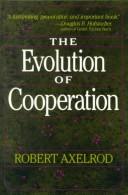
The Evolution of Cooperation is a 1984 book written by political scientist Robert Axelrod that expands upon a paper of the same name written by Axelrod and evolutionary biologist W.D. Hamilton. The article's summary addresses the issue in terms of "cooperation in organisms, whether bacteria or primates".
The book details a theory on the emergence of cooperation between individuals, drawing from game theory and evolutionary biology. Since 2006, reprints of the book have included a foreword by Richard Dawkins and have been marketed as a revised edition.
The book provides an investigation into how cooperation can emerge and persist as explained by the application of game theory. The book provides a detailed explanation of the evolution of cooperation, beyond traditional game theory. Academic literature regarding forms of cooperation that are not easily explained in traditional game theory, especially when considering evolutionary biology, largely took its modern form as a result of Axelrod's and Hamilton's influential 1981 paper and the subsequent book.
Background: Axelrod's tournaments
Axelrod initially solicited strategies from other game theorists to compete in the first tournament. Each strategy was paired with each other strategy for 200 iterations of a Prisoner's Dilemma game and scored on the total points accumulated through the tournament. The winner was a very simple strategy submitted by Anatol Rapoport called "tit for tat" (TFT) that cooperates on the first move, and subsequently echoes (reciprocates) what the other player did on the previous move. The results of the first tournament were analyzed and published, and a second tournament was held to see if anyone could find a better strategy. TFT won again. Axelrod analyzed the results and made some interesting discoveries about the nature of cooperation, which he describes in his book.
In both actual tournaments and various replays, the best-performing strategies were nice: that is, they were never the first to defect. Many of the competitors went to great lengths to gain an advantage over the "nice" (and usually simpler) strategies, but to no avail: tricky strategies fighting for a few points generally could not do as well as nice strategies working together. TFT (and other "nice" strategies generally) "won, not by doing better than the other player, but by eliciting cooperation [and] by promoting the mutual interest rather than by exploiting the other's weakness."
Being "nice" can be beneficial, but it can also lead to being suckered. To obtain the benefit – or avoid exploitation – it is necessary to be provocable and forgiving. When the other player defects, a nice strategy must immediately be provoked into retaliatory defection. The same goes for forgiveness: return to cooperation as soon as the other player does. Overdoing the punishment risks escalation, and can lead to an "unending echo of alternating defections" that depresses the scores of both players.
Most of the games that game theory had heretofore investigated are "zero-sum" – that is, the total rewards are fixed, and a player does well only at the expense of other players. But real life is not zero-sum. Our best prospects are usually in cooperative efforts. In fact, TFT cannot score higher than its partner; at best it can only do "as good as". Yet it won the tournaments by consistently scoring a strong second-place with a variety of partners. Axelrod summarizes this as "don't be envious"; in other words, don't strive for a payoff greater than the other player's.
In any IPD game, there is a certain maximum score each player can get by always cooperating. But some strategies try to find ways of getting a little more with an occasional defection (exploitation). This can work against some strategies that are less provocable or more forgiving than TFT, but generally, they do poorly. "A common problem with these rules is that they used complex methods of making inferences about the other player [strategy] – and these inferences were wrong." Against TFT one can do no better than to simply cooperate. Axelrod calls this "clarity". Or: "don't be too clever".
The success of any strategy depends on the nature of the particular strategies it encounters, which depends on the composition of the overall population. To better model the effects of reproductive success Axelrod also did an "ecological" tournament, where the prevalence of each type of strategy in each round was determined by that strategy's success in the previous round. The competition in each round becomes stronger as weaker performers are reduced and eliminated. The results were amazing: a handful of strategies – all "nice" – came to dominate the field. In a sea of non-nice strategies the "nice" strategies – provided they were also provocable – did well enough with each other to offset the occasional exploitation. As cooperation became general the non-provocable strategies were exploited and eventually eliminated, whereupon the exploitive (non-cooperating) strategies were out-performed by the cooperative strategies.
In summary, success in an evolutionary "game" correlated with the following characteristics:
Be nice: cooperate, never be the first to defect.
Be provocable: return defection for defection, cooperation for cooperation.
Don't be envious: focus on maximizing your own 'score', as opposed to ensuring your score is higher than your 'partner's'.
Don't be too clever: or, don't try to be tricky. Clarity is essential for others to cooperate with you.
以上文字摘自英文维基百科「The Evolution of Cooperation」(有删节,去掉了参考文献等尾部小节),按 CC BY-SA 4.0 使用,作者为维基百科的各位编者。
资料卡
- 原题
- The Evolution of Cooperation
- 原作语言
- 英语
- 首次出版
- 1984 年
- 体裁
- 哲学
- 主题
- 囚徒困境、合作、进化生物学
资料卡来自 Wikidata Q915809(CC0),众包数据,个别字段可能不全。