 书单
百科
这个词条暂时没有中文维基百科条目,下面是英文维基百科的内容(英文原文):
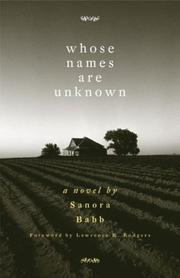
Whose Names Are Unknown is an American novel by Sanora Babb, written in the 1930s but not published until 2004. It centers on members of a High Plains farm family during the Great Depression as they endure the poverty inflicted by drought and the Dust Bowl; they ultimately flee to California in hopes of building a better life but encounter a new set of hardships.
Although accepted by a major publisher, the book was shelved after a similar novel by a celebrated author, The Grapes of Wrath by John Steinbeck, was published first. After Whose Names Are Unknown finally reached print, some scholars and critics noted that Steinbeck had had access to Babb's notes and appeared to have borrowed from her work in crafting his own novel.
Plot and summary
The first section of the novel, "Oklahoma Panhandle," introduces Julia and Milt Dunne, farmers in western Oklahoma during the 1930s. They live in a dugout basement with Milt's father ("the old man" or "Konkie") and their daughters Myra and Lonnie. After another year of barely making ends meet with his usual broomcorn crop, Milt persuades his father to try planting winter wheat and purchases seed using money that was set aside for clothing for the family. The wheat harvest goes well and the family finds itself financially secure for a brief time, but then a summer drought arrives, and with it billowing clouds of dust that suffocate the crops and sicken the children. Other farmers are similarly beleaguered, beset with failing crops, abundant debt, and little hope.
With the few resources they have left, the Dunnes (minus the old man) decide to follow in the footsteps of other "Okies" and head to California, lured by the promise of plentiful resources and abundant jobs. In the second section of the novel, "California," the reality turns out to be less idyllic. The flood of refugees from the east means low pay for menial jobs, mostly picking crops. The Dunnes are forced to live in tents and move from camp to camp in a desperate attempt to earn enough to survive. They are hampered by a company store system that substitutes store scrip for wages and holds workers financially hostage to their bosses. The Dunnes' desperation, and that of the other farmworkers, grows as they find that no matter how hard they work, they are unable even to feed their children. An attempt to organize in protest of working and living conditions results in Milt's beating and arrest and leaves the workers jobless and homeless, as the company is easily able to find replacement laborers.
The novel closes with Milt's realization that workers on company farms are no more than "a lot of parts that can't stand alone because we haven't got an acre of our own to keep our feet on...[T]hese bosses of ours...[are] looking out for the Almighty Dollar, and if they have to starve us to get more'n they can count, they can do it because there's more where we come from. They can do it because they never have to look a poor man or woman in the eye. We ain't human, we're figures on the books." In the final paragraphs, the workers reach a shared resolve to persevere despite the hardships, to organize, and to "stand together as one man. They would rise and fall and, in their falling, rise again."
Development
As a native Oklahoman and a former journalist whose family had experienced crop failures and poverty – and who herself had been homeless for a time after the Wall Street crash of 1929 – Sanora Babb was perhaps uniquely suited to write about the diaspora that was occurring in the American West during the Great Depression.
In 1938, having had her stories published in some small activist magazines, Babb went to California and volunteered to work for the Farm Security Administration (FSA), assisting migrant farmers to improve their living conditions while taking notes for a planned novel about the migrant experience. Her supervisor was Tom Collins, a migrant camp manager, who had also become acquainted with another writer researching his own book about the plight of California farmworkers: John Steinbeck.
"How brave they all are," Babb wrote in her notes of the farmworkers she had met. "They aren't broken and docile but they don't complain...They all want work and hate to have help."
Babb set about composing her novel and in early 1939 sent several sample chapters to Random House, the prestigious New York publishing firm, whose co-founder and editor, Bennett Cerf, responded enthusiastically and offered her a publishing contract. At the same time, however, Steinbeck was writing The Grapes of Wrath, which competitor Viking Press published in April 1939. After Steinbeck's novel appeared, to critical acclaim, Cerf shelved Babb's novel, telling her "Obviously, another book at this time about exactly the same subject would be a sad anticlimax!" Babb attempted to interest other publishers in Whose Names Are Unknown but ultimately put her manuscript in a drawer. She turned to writing poetry, short stories, and non-fiction, and would not publish another novel for almost 20 years.
Although Babb's novel was known to historians and literary scholars, and acclaimed by those who had a chance to read it, Whose Names Are Unknown remained unpublished. In the mid-1990s, after several of Babb's novels had been returned to print, the author showed her friend and literary agent Joanne Dearcropp a copy of the manuscript for Whose Names Are Unknown; Dearcropp was able to attract the interest of the University of Oklahoma Press, which focuses on books about the Dust Bowl experience.
As Babb explains in an author's note, the title of the novel comes from the legal notices used by company town owners to evict resident workers who had broken rules or otherwise caused trouble. Often the owners had no knowledge or record of the identities of the workers. One such notice, bearing the heading "To John Doe and Mary Doe, whose true names are unknown...", appears on page 220 of the novel.
以上文字摘自英文维基百科「Whose Names Are Unknown」(有删节,去掉了参考文献等尾部小节),按 CC BY-SA 4.0 使用,作者为维基百科的各位编者。
资料卡
- 原题
- Whose Names Are Unknown
- 原作语言
- 英语
- 作品形式
- 长篇小说
资料卡来自 Wikidata Q85815473(CC0),众包数据,个别字段可能不全。