书单
百科
这个词条暂时没有中文维基百科条目,下面是英文维基百科的内容(英文原文):
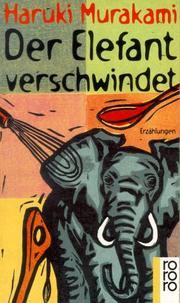
The Elephant Vanishes (象の消滅, Zō no shōmetsu) is a collection of 17 short stories by Japanese author Haruki Murakami. The stories were written between 1980 and 1991, and published in Japan in various magazines, then collections. The contents of this compilation were selected by Gary Fisketjon (Murakami's editor at Knopf) and first published in an English translation in 1993 (its Japanese counterpart was released later in 2005). Several of the stories had already appeared (often with alternate translations) in the magazines The New Yorker, Playboy, and The Magazine (Mobil Corp.) before this compilation was published.
Stylistically and thematically, the collection aligns with Murakami's previous work. The stories mesh normality with surrealism, and focus on painful issues involving loss, destruction, confusion and loneliness. The title for the book is derived from the final story in the collection.
Synopsis
"The Wind-up Bird and Tuesday's Women"
Note: This story was subsequently updated as the first chapter of The Wind-Up Bird Chronicle.
After being disturbed by a strange phone-call from an unknown woman demanding ten minutes of his time, a man goes in search of his wife's missing cat and meets a girl in a neighbor's garden.
"The Second Bakery Attack"
A recently married couple in their late twenties lie in bed, famished; they have little in their refrigerator: a six-pack of beer and some cookies. After drinking and eating all of it, the man recounts to his wife a time he and his friend “robbed” a bakery ten years ago. The two intended to take all the bread they could from a bakery by force. The man who ran the bakery offers a counterproposal before the two men can act: since he is a Richard Wagner fanatic, if they listen to Tannhäuser and The Flying Dutchman with him in the bakery, he will give them all the bread they can carry. They agree, and the bread is enough to feed the two men for a few days. After hearing of that story, the woman suggests that they do the same thing, despite it being 2:30 A.M.
They drive around Tokyo looking for a bakery but all of them are closed; they “compromise” to “rob” a McDonald's instead. With ski-masks and a Remington automatic shotgun, they enter the restaurant and demand thirty Big Macs. The three employees working there fulfill the peculiar request. The couple then leave the restaurant and drive until they find an empty parking lot; they then eat four to six Big Macs each until they are full. The man feels calm after this experience.
"The Kangaroo Communiqué"
A man working in the product-control section of a department store received a letter from a woman who wrote to complain that she had mistakenly bought Mahler instead of Brahms. The man is captivated by the woman's letter of complaint and so decides to make personal contact with her after seeing Kangaroos at a zoo; he decides to call this letter to her "The Kangaroo Communiqué."
"On Seeing the 100% Perfect Girl One Beautiful April Morning"
A Tokyo man tells of passing the "100% perfect girl" for him in a Harajuku neighborhood. He imagines a scenario where an eighteen-year-old boy and a sixteen-year-old girl meet and agree that they are 100% perfect for each other. To prove their hypothesis, they agree to go their separate ways and let fate bring them back together. Years go by and one winter, they both get terrible influenza which causes them to forget much of their respective young adult years. They run into each other in Harajuku when he is thirty-two and she is thirty, but they do not stop for each other. The man says that this is what he should have said to the "100% perfect girl."
"Sleep"
A woman has not slept for 17 days but does not feel the need for sleep. She conceals her condition from her husband and children but spends the nights eating chocolate, drinking Rémy Martin brandy, reading Anna Karenina and going for drives through the city in her Civic. Ultimately, her insomnia takes her to a nearly deserted parking lot, where danger awaits.
"The Fall of the Roman Empire, the 1881 Indian Uprising, Hitler's Invasion of Poland, and the Realm of Raging Winds"
A man writes his diary, prompted by unique phrases to remind him of the day's events.
"Lederhosen"
A woman tells of her mother's divorce, prompted by a trip to buy some lederhosen in Germany as a souvenir for her husband who has remained at home in Tokyo. The shop refuses to sell her any as her husband is not there to be fitted, so she finds a stranger of the same size.
"Barn Burning"
A 31-year-old married man and a 20-year-old woman begin a casual and unclear relationship. The woman, an amateur mime, decides to leave Japan for Algiers. Three months later, she returns with a Japanese boyfriend. One day, the woman and her boyfriend ask if they can visit the man's home; because his wife is away visiting relatives, he agrees to the gathering. The three drink carelessly and smoke marijuana in the man's living room; the woman needs to be helped to bed after smoking one joint.
Back in the living room, the boyfriend tells him about his idiosyncratic need to burn a barn about every two months. Interested, the man asks why and how he does this. The boyfriend replies that he feels morally obligated to do so and that he picks the barns that he will burn based on their condition. After the woman wakes up, she and the boyfriend leave the man's place, leaving the man very curious about barn burning. He plans his next few days around scouting possible barns nearby that the boyfriend might burn. He narrows it down to five barns, and passes by all of them on his morning run for a month, but there are no signs of arson.
The man sees the boyfriend again during Christmas and they share coffee. He asks if the boyfriend has burned a barn recently; he says he did about ten days after he visited the man's house. Before leaving, the boyfriend asks if the man has seen the woman lately; he says no, and the boyfriend says that he has not either, and she does not answer her phone or door. The man checks her apartment and sees that her mailbox is filled with fliers. When he checks again later, he sees a new name on the door and realizes that she has disappeared. Continuing his daily routine, he sometimes thinks about barns burning.
以上文字摘自英文维基百科「The Elephant Vanishes」(有删节,去掉了参考文献等尾部小节),按 CC BY-SA 4.0 使用,作者为维基百科的各位编者。
资料卡
- 原题
- 象の消滅
- 译者
- Alfred Birnbaum
- 原作语言
- 日语
- 首次出版
- 1993 年
- 作品形式
- 短篇小说集
- 首版出版社
- 阿尔佛雷德·A·克诺夫
- 页数
- 432
资料卡来自 Wikidata Q2456858(CC0),众包数据,个别字段可能不全。