 书单
百科
这个词条暂时没有中文维基百科条目,下面是英文维基百科的内容(英文原文):
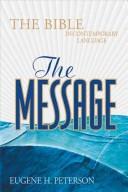
The Message: The Bible in Contemporary Language (MSG) is a paraphrase of the Bible in contemporary English. It was authored by Eugene H. Peterson, and was published in segments from 1993 to 2002. The initial press run for the 2002 publication was 500,000, with 320,000 of those copies sold in advance.
A Catholic version, The Message – Catholic / Ecumenical Edition, was published in 2013.
Features
According to the Introduction to the New Testament of The Message, its "contemporary idiom keeps the language of the Message (Bible) current and fresh and understandable". Peterson notes that in the course of the project, he realized this was exactly what he had been doing in his thirty-five years as a pastor, "always looking for an English way to make the biblical text relevant to the conditions of the people".
Translation consultants
The publisher states: "Peterson's work has been thoroughly reviewed by a team of recognized Old and New Testament scholars to ensure that it is accurate and faithful to the original languages."
Old Testament team:
Robert L. Hubbard Jr., North Park Theological Seminary (chair)
Richard E. Averbeck, Trinity Evangelical Divinity School
Bryan E. Beyer, Columbia International University
Lamar E. Cooper Sr., Criswell College
Peter E. Enns, Eastern University
Duane A. Garrett, The Southern Baptist Theological Seminary
Donald R. Glenn, Dallas Theological Seminary
Paul R. House, Beeson Divinity School, Samford University
V. Philips Long, Regent College
Tremper Longman, Westmont College
John N. Oswalt, Asbury Theological Seminary
Richard L. Pratt Jr., Reformed Theological Seminary, Third Mill Ministries
John H. Walton, Wheaton College
Prescott H. Williams Jr., Austin Presbyterian Theological Seminary
Marvin R. Wilson, Gordon College
New Testament team:
William W. Klein, Denver Seminary (chair)
Darrell L. Bock, Dallas Theological Seminary
Donald A. Hagner, Fuller Theological Seminary
Moises Silva, Gordon-Conwell Theological Seminary
Rodney A. Whitacre, Trinity School of Ministry
Catholic version
Deuterocanonical book translator:
William Griffin, St. Lawrence Seminary
Comparison to other translations
The Message was translated by Peterson from the original languages. It is a highly idiomatic translation, using contemporary slang from the US rather than a more neutral International English, and it falls on the extreme dynamic end of the dynamic and formal equivalence spectrum. Some scholars, like Michael J. Gorman, consider some of Peterson's idiomatic renderings unconventional. The work was awarded the Evangelical Christian Publishers Association Gold Medallion in 2003 for being the title retailers prized.
Psalm 23:1-4
New International Version:
King James Version:
The Living Bible:
The Message:
Lord's Prayer (Matthew 6:9-13)
New International Version:
King James Version:
The Living Bible:
The Message:
Editions
Old Testament:
The Pentateuch: ISBN 1-57683-196-5
The Books of History: ISBN 1-57683-194-9
The Wisdom Books: ISBN 1-57683-126-4
The Prophets: ISBN 1-57683-195-7
New Testament:
Youth Edition: ISBN 0-89109-793-7
Text Edition: ISBN 0-89109-728-7
Entire Bible:
With verse markings (The Message Remix): ISBN 1-57683-434-4
Without verse markings: ISBN 1-57683-289-9
With verse markings (The Message: The Numbered Edition): ISBN 1-57683-673-8; this edition was recognized as an ECPA Christian Book Award winner.
Catholic/Ecumenical Edition: 2013, ISBN 978-0879464943
Criticisms
The Message has faced criticism regarding its faithfulness to original Hebrew and Greek Bible manuscripts and its perceived incorporation of terminology and themes associated with the New Age movement.
New Age undertones
Critics argue that The Message exhibits New Age undertones, drawing parallels to concepts influenced by Hermeticism and other metaphysical philosophies propagated by figures like Helena Blavatsky and the early Theosophical Society, which significantly shaped New Age spirituality.
One notable point of contention is Peterson's inclusion of the Hermetic phrase "As above, so below" within the Lord's Prayer in Matthew 6:9–13. Warren Smith, a former New Age follower, highlights that this phrase, widely used in New Age circles with metaphysical connotations, replaces the traditional "heaven and earth" in The Message.
Furthermore, The Message consistently translates the Greek word Kyrios as "Master Jesus" instead of "Lord Jesus" throughout the New Testament. In Theosophical and New Age thought, "Master Jesus" is frequently understood as one of many "ascended masters"—enlightened beings believed to offer guidance to humanity.
The phrase "the One" is also used approximately one hundred times in The Message to refer to Jesus and God. In various New Age belief systems, "the One" commonly denotes a pantheistic concept of God, where divinity permeates all things, implying a single interconnected unity.
Several passages in The Message have been identified as potentially reflecting a New Age pantheistic view of God. For instance, its rendering of Ephesians 4:6 states:
While traditional Christian interpretations of Ephesians 4:6 typically refer to God's presence in Christian believers through the Holy Spirit, The Message's addition of "Everything you are and think and do is permeated with Oneness" is seen by Smith (2019) as aligning with a pantheistic understanding of God's presence in all things. "Oneness" itself is a term frequently used in New Age contexts to describe a pantheistic view of God.
Inaccuracies
Critics also point to instances where The Message significantly deviates from original biblical texts, leading to what they consider inaccuracies.
An example is its interpretation of Galatians 5:22–23:
The Message's addition of "a conviction that a basic holiness permeates things and people" is argued to contradict the biblical perspective on human sinfulness.
Another example is Romans 15:13, where The Message uses phrases like "the God of green hope" and "life-giving energy":
These phrases have been suggested to reflect New Age beliefs in nature deities, such as Gaia, often associated with the color green and believed to provide 'life-giving energy.'
以上文字摘自英文维基百科「The Message (Bible)」(有删节,去掉了参考文献等尾部小节),按 CC BY-SA 4.0 使用,作者为维基百科的各位编者。
资料卡
- 译者
- 尤金·毕德生
- 首次出版
- 2002 年
资料卡来自 Wikidata Q7751124(CC0),众包数据,个别字段可能不全。