 书单
百科
这个词条暂时没有中文维基百科条目,下面是英文维基百科的内容(英文原文):
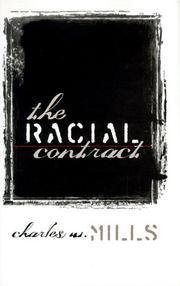
The Racial Contract is a book by the Jamaican philosopher Charles W. Mills in which he argues that, although it is conventional to represent the social contract moral and political theories of Thomas Hobbes, John Locke, Jean-Jacques Rousseau, and Immanuel Kant as neutral with respect to race and ethnicity, these social contracts only regulated relations between whites. The book demonstrates the ways in which social contract theorists helped to create a "racial contract," which formally and informally permits whites to oppress and exploit people of color and validate their own moral ideals in dealing with non-whites. Because in contemporary political philosophy, white philosophers take their own white privilege for granted, they don't recognize that white supremacy is a political system, and so in their developments of ideal, moral and political theory never consider actual practice. Mills proposes to develop a non-ideal theory "to explain and expose the inequities of the actual nonideal policy and to help us see through the theories and moral justifications offered in defense of them." Using it as a central concept, "the notion of a Racial Contract might be more revealing of the real character of the world we are living in, and the corresponding historical deficiencies of its normative theories and practices, than the raceless notions currently dominant in political theory."
The Racial Contract has sold over 50,000 copies and been adopted in hundreds of courses in the United States in philosophy as well as "political science, sociology, anthropology, literature, education, African American, American Studies, and other subjects." The book has been translated into Korean, Turkish, and French.
In 2022, Cornell University Press issued a 25th-anniversary edition with a new introduction by Mills and a foreword by Tommie Shelby, Caldwell Titcomb Professor of African and African American Studies and of Philosophy at Harvard University.
The book won a Gustavus Myers Outstanding Book Award for the study of bigotry and human rights in America.
The American Political Science Association chose Mills as the recipient of its biennial Benjamin E. Lippincott Award, which "honors exceptional work by a living political theorist that is still considered significant after a time span of at least 15 years since the original publication."
Synopsis
Mills argues that racism is at the core of the "social contract", rather than racism being an unintended result attributed to the failings of imperfect men. Specifically, the racial contract is a tacit (and at times explicit) agreement among members of the tribes of Europe to assert, promote, and maintain the ideal of white supremacy as against all other tribes of the world. This intention is deliberate and an integral characteristic of the social contract, a characteristic which persists to the present day. In Mills's words, "...what has usually been taken...as the racist 'exception' has really been the rule; what has been taken as the 'rule'...[racial equality]...has really been the exception."
Mills argues that these ideals of the social contract are at worst pure fiction or at best were intended only to apply to a specific group of people, namely members of the tribes of Europe and their genetic descendants. "...when white people say 'Justice,' they mean 'Just Us'."
Rather than viewing white supremacy as an ideology or a set of beliefs that renders the rest of the nonwhite world inferior, the book presents white supremacy as a political system of domination. Mills writes that “racism (or, as I will argue, global white supremacy), is itself a political system, a particular power structure of formal or informal rule, socioeconomic privilege and norms for the differential distribution of material wealth and opportunities, benefits and burdens, rights and duties.” Mills extends white domination to the cultural, cognitive-moral, and metaphysical spheres. The racial contract is a social contract that begins with the idea “we the white people…” and the global society that ensues is marked by domination in all aspects of life. The racial contract also breaks from typical social contract theory, which is a normative tool for determining the ideals of justice (see John Rawls for more contemporary social contract theory), in that it actually attempts to explain how actual society came to be.
Reception
The scholarly reception (in the fields of philosophy and political philosophy) to Mills The Racial Contract has been largely positive with some criticism.
以上文字摘自英文维基百科「The Racial Contract」(有删节,去掉了参考文献等尾部小节),按 CC BY-SA 4.0 使用,作者为维基百科的各位编者。
资料卡
- 原题
- The Racial Contract
- 原作语言
- 英语
- 首次出版
- 1997 年
- 主题
- 政治哲学
资料卡来自 Wikidata Q7759193(CC0),众包数据,个别字段可能不全。