书单
百科
这个词条暂时没有中文维基百科条目,下面是英文维基百科的内容(英文原文):
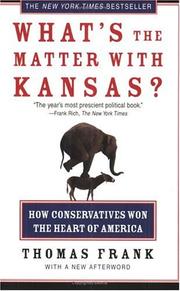
What's the Matter with Kansas? How Conservatives Won the Heart of America (2004) is a book by American journalist and historian Thomas Frank, which explores the rise of populist and anti-elitist conservatism in the United States, centering on the experience of Kansas, Frank's native state. In the late 19th century, says Frank, Kansas was known as a hotbed of the left-wing populist movement, but in recent decades, it has become overwhelmingly conservative. The book was published in Britain and Australia as What's the Matter with America?
What's the Matter with Kansas? spent 18 weeks on the New York Times Bestseller List.
Overview
According to the book, the political discourse of recent decades has dramatically shifted from social and economic equality to the use of "explosive" cultural issues, such as abortion and gay marriage, which are used to redirect anger toward "liberal elites."
Against this backdrop, Frank describes the rise of political conservatism in the social and political landscape of Kansas, which he says espouses economic policies that do not benefit the majority of people in the state.
Frank also claims a bitter divide between "moderate" and "conservative" Kansas Republicans (whom he labels "Mods" and "Cons") as an archetype for the future of politics in America, in which fiscal conservatism becomes the universal norm and political war is waged over a handful of hot-button cultural issues.
Not long ago, Kansas would have responded to the current situation by making the bastards pay. This would have been a political certainty, as predictable as what happens when you touch a match to a puddle of gasoline. When business screwed the farmers and the workers – when it implemented monopoly strategies invasive beyond the Populists' furthest imaginings – when it ripped off shareholders and casually tossed thousands out of work – you could be damned sure about what would follow.
Not these days. Out here the gravity of discontent pulls in only one direction: to the right, to the right, further to the right. Strip today's Kansans of their job security, and they head out to become registered Republicans. Push them off their land, and next thing you know they're protesting in front of abortion clinics. Squander their life savings on manicures for the CEO, and there's a good chance they'll join the John Birch Society. But ask them about the remedies their ancestors proposed (unions, antitrust, public ownership), and you might as well be referring to the days when knighthood was in flower.
Frank argues that instead of fighting for working class interests, the Democratic party, under the direction of the Democratic Leadership Council (DLC), effectively abandoned them by adopting economically conservative policies. To differentiate themselves from Republicans at the national level, Democrats focused on socio-cultural wedge issues:
The Democratic Leadership Council, the organization that produced such figures as Bill Clinton, Al Gore, Joe Lieberman and Terry McAuliffe, has long been pushing the party to forget blue-collar voters and concentrate instead on recruiting affluent, white-collar professionals who are liberal on social issues. The larger interests that the DLC wants desperately to court are corporations, capable of generating campaign contributions far outweighing anything raised by organized labor. The way to collect the votes and -- more important -- the money of these coveted constituencies, "New Democrats" think, is to stand rock-solid on, say, the pro-choice position while making endless concessions on economic issues, on welfare, NAFTA, Social Security, labor law, privatization, deregulation and the rest of it.
The book also details how Kathleen Sebelius, a Democrat, was elected governor in conservative Kansas. By emphasizing issues such as health care and school funding and avoiding hot-button social issues, Sebelius successfully fractured the Kansas GOP and won a clear majority.
Frank says that the conservative coalition is the dominant coalition in American politics. There are two sides to this coalition, according to the author: Economic conservatives want business tax cuts and deregulation, while social conservatives focus on culture. Frank says that since the coalition formed in the late 1960s, the coalition has been "fantastically rewarding" for the economic conservatives. The policies of the Republicans in power have been exclusively economic, but the coalition has caused the social conservatives to be worse off economically, due to these pro-corporate policies. Meanwhile, Frank says, the social issues that the "Cons" faction pushes never go anywhere after the election. According to the book, "abortion is never outlawed, school prayer never returns, the culture industry is never forced to clean up its act." He attributes this partly to conservatives "waging cultural battles where victory is impossible," such as a constitutional amendment banning gay marriage. He also argues that the very capitalist system the economic conservatives strive to strengthen and deregulate promotes and commercially markets the perceived assault on traditional values.
Frank also discusses Kansas' history on slavery and civil rights, experiencing violent conflict before entering as a free state, as well as being the location of Brown v. Board of Education (1954) that outlawed racial segregation. He argues that conservative backlash in Kansas cannot be ascribed to racism.
The state may be 88 percent white, but it cannot be easily dismissed as a nest of bigots. Kansas does not have Trent Lott's disease. It is not Alabama in the sixties. It was not tempted to go for George Wallace in 1968. Few here get sentimental about the Confederate flag. Kansas may burn to restore the gold standard; it may shriek for concealed carry and gasp at imagined liberal conspiracies; but one thing it doesn't do is racism.
以上文字摘自英文维基百科「What's the Matter with Kansas? (book)」(有删节,去掉了参考文献等尾部小节),按 CC BY-SA 4.0 使用,作者为维基百科的各位编者。
资料卡
- 原题
- What's the Matter with Kansas?
- 原作语言
- 英语
- 首次出版
- 2004 年 6 月 1 日
- 首版出版社
- 亨利·霍尔特出版公司
- 主题
- 历史
资料卡来自 Wikidata Q7990900(CC0),众包数据,个别字段可能不全。