书单
百科
这个词条暂时没有中文维基百科条目,下面是英文维基百科的内容(英文原文):
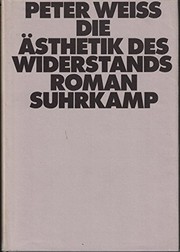
The Aesthetics of Resistance (German: Die Ästhetik des Widerstands, 1975–1981) is a three-volume novel by the German-born playwright, novelist, filmmaker, and painter Peter Weiss which was written over a ten-year period between 1971 and 1981. Spanning from the late 1930s into World War II, this historical novel dramatizes anti-fascist resistance and the rise and fall of proletarian political parties in Europe. It represents an attempt to bring to life and pass on the historical and social experiences and the aesthetic and political insights of the workers' movement in the years of resistance against fascism.
Living in Berlin in 1937, the unnamed narrator and his peers, sixteen and seventeen-year-old working-class students, seek ways to express their hatred for the Nazi regime. They meet in art museums and galleries, and in their discussions they explore the affinity between political resistance and art, the connection at the heart of Weiss's novel. Weiss suggests that meaning lies in the refusal to renounce resistance, no matter how intense the oppression, and that it is in art that new models of political action and social understanding are to be found. The novel includes extended meditations on paintings, sculpture, and literature. Moving from the Berlin underground to the front lines of the Spanish Civil War and on to other parts of Europe, the story teems with characters, almost all of whom are based on historical figures.
The three volumes of the novel were originally published in 1975, 1978 and 1981. English translations of the three volumes have been published by Duke University Press, in 2005, 2020 and 2025.
Plot
Weiss's complex multi-layered 1000 page novel has been called a "book of the century [Jahrhundertbuch]." It can no more be usefully summarized than James Joyce's Ulysses. By way of introducing The Aesthetics of Resistance what follows are the opening paragraphs of an article by Robert Cohen:
"The Aesthetics of Resistance begins with an absence. Missing is Heracles, the great hero of Greek mythology. The space he once occupied in the enormous stone frieze depicting the battle of the Giants against the Gods is empty. Some two thousand years ago the frieze covered the outer walls of the temple of Pergamon in Asia Minor. In the last third of the nineteenth century the remnants of the ancient monument were discovered by the German engineer Carl Humann and sent to Germany. The fragments were reassembled in the specially built Pergamon Museum in Berlin, the capital of Wilhelminian Germany, and were to signal from this point forward the late claims to power of German imperialism. The Pergamon frieze can still be seen in Berlin today. In the fall of 1937 – and here we are at the beginning of Peter Weiss's novel – three young men find themselves before the frieze. Two of them, Coppi and the narrator, whose name is never mentioned, are workers. The third, a sixteen-year-old named Heilmann, is a high school student. Coppi is a member of the illegal Communist Party, Heilmann and the narrator are sympathizers. All three are active in the antifascist resistance. In a lengthy discussion the three friends attempt to interpret the stone figures and events depicted in the frieze in a way which would make them relevant for their own present day struggle. They cannot, however, find Heracles. Other than a fragment of his name and the paw of a lion's skin, nothing remains of the leader of the Gods in the battle against the Giants. The "leader" of 1937, on the other hand, is an omnipresent force, even in the still halls of the Pergamon Museum, where uniformed SS troopers, their Nazi insignia clearly visible, mingle among the museum's visitors. Under the pressure of the present and with their lives in constant danger, the three young antifascists read the empty space in the frieze as an omen, they feel encouraged to fill it with their own representation of the absent half-god. What they envision is an alternative myth in stark contrast to the traditional image of Heracles. From a friend of the Gods, the mighty and the powerful, Heracles is transformed into a champion of the lowest classes, of the exploited, imprisoned, and tortured – a messianic "leader" in the struggle against the terror of the "Führer".
The concept of a messianic bearer of hope is by no means unique in Weiss's work. Starting with the coachman in the experimental novel The Shadow of the Body of the Coachman (1952/1959), messianic figures appear repeatedly in Weiss's literary work. That Weiss would continue to be obsessed with such figures after he turned to Marxism in 1964/1965 may seem surprising. However, the concept now becomes increasingly secularized, as for example in the figure of Empedocles in the play Hölderlin (1971). In The Aesthetics of Resistance this process of secularization is brought to its logical conclusion.
以上文字摘自英文维基百科「The Aesthetics of Resistance」(有删节,去掉了参考文献等尾部小节),按 CC BY-SA 4.0 使用,作者为维基百科的各位编者。
资料卡
- 原题
- Die Ästhetik des Widerstands
- 原作语言
- 德语
- 首次出版
- 1978 年
- 作品形式
- 长篇小说
- 主题
- 第二次世界大战
资料卡来自 Wikidata Q448056(CC0),众包数据,个别字段可能不全。