书单
百科
这个词条暂时没有中文维基百科条目,下面是英文维基百科的内容(英文原文):
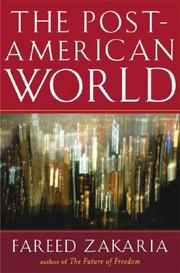
The Post-American World is a non-fiction book by American journalist Fareed Zakaria. It was published in hardcover and audiobook formats in early May 2008 and became available in paperback in early May 2009; the Updated and Expanded Release 2.0 followed in 2011. In the book, Zakaria argues that, thanks to the actions of the United States in spreading liberal democracy across the world, other countries are now competing with the US in terms of economic, industrial, and cultural power. While the US continues to dominate in terms of political-military power, other countries such as China and India are becoming global players in many fields.
The book peaked at #2 on The New York Times non-fiction hardcover best-seller list and at #47 on the USA Today Top 150 Best-Selling Books list. Reviewers commented that Zakaria's writing was intelligent and sharp, yet accessible to general audiences. A few reviewers also wrote that the book was similar to an extended essay with journalistic style writing.
Background
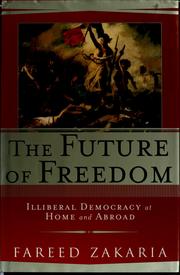
At the time of publication author Fareed Zakaria was a 48-year-old married man living in New York City and working as an editor for Newsweek International. Zakaria had immigrated to the United States from India during his university career. He graduated from Harvard University with a Ph.D. in political science in 1993 after earning a B.A. from Yale University. He worked as the managing editor of Foreign Affairs magazine before accepting the editor position at Newsweek. Labeled a liberal hawk, Zakaria's political views have shifted from supporting Reagan's pro-democracy agenda to Clinton's pro-market stances and to the point where Zakaria felt that the US was "unstoppable". In subsequent years, he watched as other countries set records for the world's tallest building, largest factory, largest refinery, and richest person. Meanwhile, he watched the US get bogged down in war in Iraq. In 2003, his book The Future of Freedom: Illiberal Democracy at Home and Abroad, in which he examines the necessary conditions for liberal democracy to survive, was published. While he initially supported US intervention in Iraq, Zakaria criticized the Bush Administration's methods of nation-building and for trying to force Iraq into a liberal democracy without the preconditions of economic liberalisation and rule-of-law. Over the next few years, Zakaria developed his theory on shifting global power as he contributed or wrote articles profiling emerging national powers and participating in economic forums and organizations.
Synopsis
The content is divided into seven chapters. The first chapter introduces the thesis of the book: that a 'post-American' world order is emerging in which the United States will continue to be the most powerful nation but its relative power will be diminished. He believes that there have been three power shifts in the last 500 years: a shift of power to the West during the Renaissance, a shift of power to the US making it a superpower, and now a shift to several surging countries, especially China and India, and to non-governmental organizations. Zakaria believes that international organizations are not adapting well to emerging challenges and that there is too much focus on problems arising from potential market failures or general crises (e.g. terrorism) at the expense of focus on problems stemming from success (e.g. development causing environmental degradation, or rising demand creating high commodity prices).
The second and third chapters examine factors that led to the current power balance. Power shifted to the West because it fostered trade with foreign peoples and developed superior labor productivity per capita. Power shifted to the US because of its strong democracy and capitalist market. Zakaria argues that the success of the US in promoting free market capitalism and globalization has led to power being dispersed to several other countries. Economies have been surging for decades, in part due to large new players entering the global market place. He compares this era's economic growth to the economic surges of the 1890s and the 1950s which also saw new players become global powers. At the same time, Zakaria sees attitudes in the US becoming insular and distrustful of foreigners.
The fourth chapter focuses on China. Its strategy of small, gradual reforms has allowed it to quietly modernize. It has become the second most powerful nation, but still unlikely to match the US for decades to come. China's strengths include a philosophy that reflects Confucian ideals of practicality, ethics and rationalism. Its non-combative foreign policy is more appealing, most notably in Africa, over interventionist Western-style policy that demands reforms in other countries. China's weakness, though, is a fear of social unrest.
The fifth chapter focuses on India. Contrasted to China, India has a bottom-up democratic political system constantly subject to social unrest with only a few politicians losing elections. Its political system is characterized by strong regionalism — often placing high priority on regional interests rather than national. Zakaria lists India's advantages: independent courts that enforce contracts, private property rights, rule of law, an established private sector, and many business savvy English-speaking people.
以上文字摘自英文维基百科「The Post-American World」(有删节,去掉了参考文献等尾部小节),按 CC BY-SA 4.0 使用,作者为维基百科的各位编者。
资料卡
- 原题
- The Post-American World
- 原作语言
- 英语
- 首次出版
- 2008 年 5 月
- 体裁
- 非虚构作品
- 首版出版社
- 威廉·沃德尔·诺顿公司
资料卡来自 Wikidata Q1326268(CC0),众包数据,个别字段可能不全。