书单
百科
这个词条暂时没有中文维基百科条目,下面是英文维基百科的内容(英文原文):
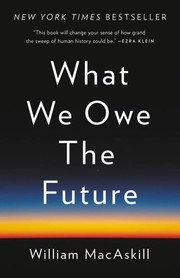
What We Owe the Future is a 2022 book by the Scottish philosopher and ethicist William MacAskill, an associate professor in philosophy at the University of Oxford. It advocates for effective altruism and the philosophy of longtermism, which MacAskill defines as "the idea that positively influencing the long-term future is a key moral priority of our time." His argument is based on the premises that future people count, there could be many of them, and we can make their lives better.
Summary
Part one: The long view
MacAskill makes the case for longtermism—an ethical stance which gives priority to improving the long-term future—and proposes that we can make the future better in two ways: "by averting permanent catastrophes, thereby ensuring civilisation's survival; or by changing civilisation's trajectory to make it better while it lasts ... Broadly, ensuring survival increases the quantity of future life; trajectory changes increase its quality". According to MacAskill, the present era is a critical juncture: "Few people who ever live will have as much power to positively influence the future as we do. Such rapid technological, social, and environmental change means that we have more opportunity to affect when and how the most important of these changes occur".
His argument for longtermism has three premises: first, future people count morally as much as the people alive today; second, the future is immensely big since humanity may survive for a very long time, and there may be many more people alive at any given time; and third, the future could be very good or very bad, and our actions may affect what it will be.
Part two: Trajectory changes
To improve the future, MacAskill investigates how moral change and value lock-in may constitute long-run trajectory changes for civilisation. He suggests that moral and cultural values are malleable, contingent, and potentially long-lived—if history were to be rerun, the dominant global values may be very different from those in our world; for example, the abolition of slavery may not have been morally or economically inevitable. MacAskill warns of a potential value lock-in—"an event that causes a single value system ... to persist for an extremely long time"—which he believes may result from technological advances, particularly the development of artificial general intelligence.
Part three: Safeguarding civilisation
Next, MacAskill explores how to protect humanity from risks of extinction, unrecoverable civilisational collapse, and long-run technological stagnation. He argues that the most severe threats of human extinction are posed by engineered pathogens and misaligned artificial general intelligence. He also discusses several potential causes of civilisational collapse—including extreme climate change, fossil fuel depletion, and nuclear winter caused by nuclear war—concluding that civilisation appears very resilient, with recovery after a collapse being likely. MacAskill next turns to risks of long-lasting technological and economic stagnation. While he considers indefinite stagnation unlikely, "it seems entirely plausible that we could stagnate for hundreds or thousands of years". From a longtermist perspective, this matters primarily because long-term stagnation makes extinction or collapse more likely, and because the society emerging after the period of stagnation may be guided by worse values than society today.
Part four: Assessing the end of the world
The book also discusses how bad the end of humanity would be, which depends on whether the future will be good or bad in expectation and on whether it is morally good for happy people to be born—a key question in population ethics. He concludes optimistically that the future will likely be positive on balance, in part because future people are asymmetrically motivated to bring about good things rather than bad things. He also claims that preventing future people from coming into existence is a moral loss if their lives would be sufficiently good, leading him to conclude that "the early extinction of the human race would be a truly enormous tragedy".
Part five: Taking action
The book's final part details how to choose which problems to focus on, along with what people can do to take action. In areas such as climate change, fossil fuel depletion, biosecurity, pandemic preparedness, and disaster preparedness, people can take "robustly good actions" like research and advocacy to help. Meanwhile, for issues with more unknowns, such as reducing AGI risk and preventing great-power wars, building up options and learning should be prioritized.
For the individual, MacAskill emphasises the significance of professional work, writing that "by far the most important decision you will make, in terms of your lifetime impact, is your choice of career". He mentions 80,000 Hours, a nonprofit he helped co-found, which conducts research and provides advice on which careers have the largest positive impact, especially from a longtermist perspective. He also argues that donations to effective longtermist causes and organisations are much more impactful than changing our personal consumption.
Critical reception
What We Owe the Future has received coverage in The New Yorker, NPR, The Ezra Klein Show, The Bookseller, and New York Magazine. Adaptations of the book's central thesis have been published by MacAskill in Foreign Affairs, The New York Times, and the BBC.
以上文字摘自英文维基百科「What We Owe the Future」(有删节,去掉了参考文献等尾部小节),按 CC BY-SA 4.0 使用,作者为维基百科的各位编者。
资料卡
- 原题
- What we owe the future
- 原作语言
- 英语
- 首次出版
- 2022 年
- 主题
- 有效利他主义、长期主义
资料卡来自 Wikidata Q113536662(CC0),众包数据,个别字段可能不全。