书单
百科
这个词条暂时没有中文维基百科条目,下面是英文维基百科的内容(英文原文):
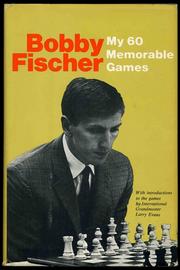
My 60 Memorable Games is a chess book by Bobby Fischer, first published in 1969. It is a collection of his games dating from the 1957 New Jersey Open to the 1967 Sousse Interzonal. Unlike many players' anthologies, which are often titled My Best Games and include only wins or draws, My 60 Memorable Games includes nine draws and three losses. It has been described as a "classic of objective and painstaking analysis" and is regarded as one of the great pieces of chess literature.
The book was originally published in descriptive notation. An algebraic notation version in 1995 caused some controversy in the chess world because of the many other changes made to the text, with Fischer himself denouncing the edition. In 2008, a reissue of Fischer's original text was published, the only changes being the updating to algebraic notation and the correcting of typographical errors, notation mistakes, and the erroneous last few moves of game 17.
Writing
The book had been planned for some time to be published by Simon & Schuster. Its first title was to be Bobby Fischer's Best Games of Chess. Fischer first announced it would appear "after my match with Botvinnik" (then World Champion), an event first suggested for 1962 and again in the mid 1960s, but which never took place. Fischer then added more games, and retitled it My Memorable Games – 52 Tournament Games. (At one time it was also titled My Life in Chess: 52 Memorable Games.) At that point the collection ended at the Piatigorsky Cup in 1966; however, Fischer then had an abrupt change of heart and decided not to publish the book at all, and asked to be released from his contract. It was suggested that he did not want to reveal all his secrets, as the book has lengthy annotations and analysis of different possible variations of his games.
In 1968, he changed his mind and decided to go ahead with publication. His friend and colleague Grandmaster (GM) Larry Evans, who helped in an editorial capacity and also wrote introductions to all the games, has said this was because Fischer felt philosophically that "the world was coming to an end anyway" (he thought that the Rapture was coming soon) and he might as well make some money. Fischer continued to revise the manuscript and added eight more games, also changing the title to My Memorable Games – 60 Tournament Struggles before settling on the final name.
Games
The collection begins in 1957, omitting the famous "Game of the Century" against Donald Byrne in 1956 (this game had been included in a small, lightly annotated work called Bobby Fischer's Games of Chess, published in 1959). The three losses are to Tal at the Candidates Tournament 1959, Spassky at Mar del Plata 1960, and Geller at Skopje 1967. Among the draws is his only encounter with World Champion Mikhail Botvinnik, at the 1962 Varna Olympiad. This game contains the longest piece of analysis in the book, with Fischer concluding that he missed a win in the endgame. Botvinnik later disputed this, with a refutation from one of his chess school pupils, 13-year-old Garry Kasparov. Among the wins are his first defeat of a Soviet grandmaster, Paul Keres at Zurich 1959, and his 21-move victory as Black over Robert Byrne at the 1963/64 US Championship. There are seven games from his first Candidates tournament in 1959, but only two from his second at Curaçao 1962. All the games were played under tournament conditions except for a friendly game at the home of Reuben Fine in 1963 and a win from Fischer's 1964 simultaneous exhibition tour of the US.
Fischer makes several atmospheric observations about his opponents' habits and reactions to his moves. In game 1, he writes that "Sherwin slid the Rook here with his pinky, as if to emphasize the cunning of this mysterious move." In game 12 versus Gligorić he recalls that "Petrosian and Tal both happened to stroll by the board at this instant. Petrosian made a wry face which looked to me like 'Can Black do this and live?'." From game 37: "Poker-faced, as always, Keres made this move as though it were the most natural one on the board." From the game versus Botvinnik: "I could see by the glint in his eye that he had come well armed for my King's Indian."
He frequently gives his very opinionated views on the opening, mentioning that he had "never opened with the QP [1.d4]—on principle" and that 1.e4 is "Best by test."
Reception
My 60 Memorable Games was enthusiastically received by the chess community and was an immediate success. A review in British Chess Magazine in December 1969 called it "a great book without a doubt, and [it] can go straight on the shelf alongside Alekhine and Tarrasch and fear no comparisons." Upon its reissue in 1995, the same magazine suggested that it could be the best chess book ever written. Fischer was praised for his honesty and the depth and accuracy of his annotations. The book has had a great influence on today's top players. Peter Biyiasas became an International Master by studying only two books: Rook Endings by Levenfish and Smyslov (see Chess endgame literature § Rook endings), and My 60 Memorable Games. It was also GM Bu Xiangzhi's first chess book: he described the games as "fantastic".
以上文字摘自英文维基百科「My 60 Memorable Games」(有删节,去掉了参考文献等尾部小节),按 CC BY-SA 4.0 使用,作者为维基百科的各位编者。
资料卡
- 原题
- My 60 Memorable Games
- 原作语言
- 英语
- 主题
- 国际象棋
资料卡来自 Wikidata Q1126789(CC0),众包数据,个别字段可能不全。