书单
百科
这个词条暂时没有中文维基百科条目,下面是英文维基百科的内容(英文原文):
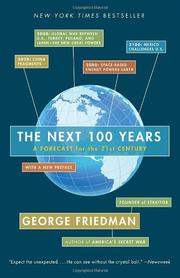
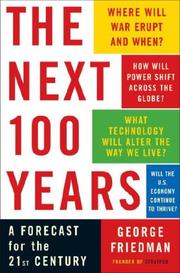
The Next 100 Years is a 2009 speculative nonfiction book by George Friedman. In the book, Friedman attempts to predict the major geopolitical events and trends of the 21st century. Friedman also speculates in the book on changes in technology and culture that may take place during this period.
Overview
Friedman predicts that the United States will remain the dominant global superpower throughout the 21st century and that the history of the 21st century will consist mainly of attempts by other world powers to challenge US dominance. Although mainly about the geopolitics and wars of the century, the book also makes some economic, social, and technological predictions for the 21st century.
Second Cold War
In the 2010s and early 2020s, the conflict between the US and Islamic fundamentalists will die down, and a second Cold War, less extensive and shorter than the first, will take place between the United States and Russia. It will be characterized by Russian attempts to expand its sphere of influence into Central and Eastern Europe, coupled with a buildup of Russian military capabilities. During this period, Russia's military will pose a regional challenge to the United States. The United States will become a close ally to some Central and Eastern European countries, all of whom will be dedicated to resisting Russian geopolitical threats during this period. Friedman speculates in the book that the United States will probably become a close ally of some Central and Eastern European countries: Poland, the Czech Republic, Slovakia, Hungary, and Romania. Around 2015, a Polish-led military alliance of countries in Central and Eastern Europe will begin to form, which is referred to in the book as the "Polish Bloc."
Russian and Chinese fragmentation
In the early 2020s, the New Cold War will end when the economic strain and political pressure on Russia, coupled with high military spending, Russia's declining population, and poor infrastructure, cause the federal government of Russia to completely collapse, much like the dissolution of the Soviet Union. Other former Soviet countries will fragment as well.
Around this time, China will politically and culturally fragment as well. The book asserts that the rapid economic development of China since 1980 will cause internal pressures and inequalities in Chinese society. Regional tension in mainland China will grow between the prosperous coastal regions and the impoverished interior regions. Friedman gives two possible scenarios: that the Chinese central government will expel outside interests and rule with an iron fist to keep the country together, or that China will fragment, with the central government gradually losing much of its real power and the provinces becoming increasingly autonomous. He works on the assumption that fragmentation is the most likely scenario.
In the 2020s, the collapse of the Russian government and the fragmentation of mainland China will leave Eurasia in general chaos. Other powers will then move in to annex or establish spheres of influence in the area, and in many cases, regional leaders will secede. In Russia, North Caucasus and other Muslim regions, as well as the Pacific Far East will become independent, Finland will annex Karelia, Romania will annex Moldova, Tibet will gain independence with help from India, Taiwan will extend its influence into mainland China, while the United States, European powers, and Japan will re-create regional spheres of influence in mainland China.
New Great Powers Arise
In the 2020s and 2030s, three great powers will emerge in Eurasia: Turkey, Poland, and Japan. Initially supported by the United States, Turkey will expand its sphere of influence and become a great power, much as it was during the time of the Ottoman Empire. The Turkish sphere of influence will extend into the Arab world, which will have increasingly fragmented by then, and north into Russia and other former Soviet countries. Israel will continue to be a powerful nation and will be the only country in the immediate region to remain outside the Turkish sphere of influence. However, Israel will be forced to come to an accommodation with Turkey due to Turkey's military and economic power.
Meanwhile, Japan will expand its economic influence to regions of coastal China, the Russian Far East, and many Pacific Islands. Friedman predicts that Japan will change its foreign policy during this time period, becoming more geopolitically aggressive, beginning a major military buildup. Friedman predicts that Japan will build military strength capable of regionally projecting power across East Asia during this time.
Finally, Poland will continue to lead its military alliance, the "Polish Bloc." Poland and its allies will be a major power, much like the time of the Polish–Lithuanian Commonwealth. Now possessing substantial military strength, Poland will expand its economic influence into what was formerly European Russia, and will begin to compete with Turkey for influence in the important economic region of the Volga River Valley. Around this time, space programs for military use will begin to emerge, and Japan and Turkey will increasingly begin to develop military capabilities in space.
Tensions build
At the beginning of this period, the United States will be allied with all three powers. By 2020, the United States will have been allied with Turkey and Japan for over 75 years. However, in the years after the end of the Second Cold War and collapse of Russia, the United States will gradually become uneasy as Turkey and Japan expand their military power and economic influence. Establishing regional spheres of influence, Turkey and Japan will begin to threaten US interests. The growth of Turkish and Japanese naval power, and their military activities in space will be particularly disturbing to the United States.
以上文字摘自英文维基百科「The Next 100 Years: A Forecast for the 21st Century」(有删节,去掉了参考文献等尾部小节),按 CC BY-SA 4.0 使用,作者为维基百科的各位编者。
资料卡
- 原题
- The Next 100 Years
- 原作语言
- 英语
- 首次出版
- 2009 年
资料卡来自 Wikidata Q7753948(CC0),众包数据,个别字段可能不全。