书单
百科
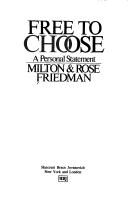
《自由选择》(英语:Free to Choose)是米尔顿·弗里德曼和罗斯·弗里德曼著作的一本书籍,以及在公共电视上播出的一部十集电视片。于1980年1月出版。这本书宣传了自由市场的思想。全书共297页,包含了10个章节。于1980年1月出版。这本书在上市之后,有5个礼拜都排在美国畅销书排行榜之列。这本书籍在世界其他国家也有发行。
以上文字摘自维基百科「自由選擇」(去掉了参考文献等尾部小节),按 CC BY-SA 4.0 使用,作者为维基百科的各位编者。
中文维基百科的条目比较短,下面附上英文维基百科的内容(英文原文):
Free to Choose: A Personal Statement is a 1980 book by economists Milton and Rose Friedman that advocates free market principles. It was primarily a response to an earlier landmark book and television series The Age of Uncertainty, by the noted economist John Kenneth Galbraith. Free To Choose has been translated into two dozen languages and a companion book.
The Friedmans maintain that the free market works best for all members of a society, provides examples of how the free market engenders prosperity, and maintains that it can solve problems where other approaches have failed. Published in January 1980, the 297-page book contains ten chapters. It was atop the The New York Times Best Seller list for six weeks. The book was accompanied by a ten-part television series of the same name broadcast by PBS in 1980 and updated in 1990.
Positions advocated
The Friedmans advocate laissez-faire economic policies, often criticizing interventionist government policies and their cost in personal freedoms and economic efficiency in the United States and abroad. They argue that international free trade has been restricted through tariffs and protectionism while domestic free trade and freedom have been limited through high taxation and regulation. They cite the 19th-century United Kingdom, the United States before the Great Depression, and modern Hong Kong as ideal examples of a minimalist economic policy. They contrast the economic growth of Japan after the Meiji Restoration and the economic stagnation of India after its independence from the British Empire, and argue that India has performed worse despite its superior economic potential due to its centralized planning. They argue that even countries with command economies, including the Soviet Union and Yugoslavia, have been forced to adopt limited market mechanisms in order to operate.
The authors argue against government taxation on gas and tobacco and government regulation of the public school systems. The Friedmans claim that the Federal Reserve exacerbated the Great Depression by neglecting to prevent the decline of the money supply in the years leading up to it. They further argue that the American public falsely perceived the Depression to be a result of a failure of capitalism rather than the government, and that the Depression allowed the Federal Reserve Board to centralize its control of the monetary system despite its responsibility for it.
On the subject of welfare, the Friedmans argue that the United States has maintained a higher degree of freedom and productivity by avoiding the nationalizations and extensive welfare systems of Western European countries such as the United Kingdom and Sweden. However, they also argue that welfare practices since the New Deal under "the HEW empire" have been harmful. They argue that public assistance programs have become larger than originally envisioned and are creating "wards of the state" as opposed to "self-reliant individuals." They also argue that the Social Security System is fundamentally flawed, that urban renewal and public housing programs have contributed to racial inequality and diminished quality of low-income housing, and that Medicare and Medicaid are responsible for rising healthcare prices in the United States. They suggest completely replacing the welfare state with a negative income tax as a less harmful alternative.
以上文字摘自英文维基百科「Free to Choose (book)」(有删节,去掉了参考文献等尾部小节),按 CC BY-SA 4.0 使用,作者为维基百科的各位编者。
资料卡
- 原题
- Free to Choose
- 原作语言
- 英语
- 首次出版
- 1980 年
- 体裁
- 非虚构作品
- 首版出版社
- 哈科特
- 页数
- 338
- 主题
- 货币主义
资料卡来自 Wikidata Q581535(CC0),众包数据,个别字段可能不全。