书单
百科
这个词条暂时没有中文维基百科条目,下面是英文维基百科的内容(英文原文):
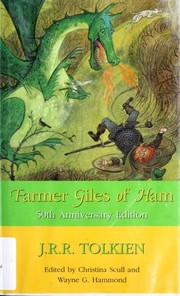
Farmer Giles of Ham is a comic medieval fable written by J. R. R. Tolkien in 1937 and published in 1949. The story describes the encounters between Farmer Giles and a wily dragon named Chrysophylax, and how Giles manages to use these to rise from humble beginnings to rival the king of the land. It is cheerfully anachronistic and light-hearted, set in Britain in an imaginary period of the Dark Ages. It features mythical creatures, medieval knights, and primitive firearms.
Scholars have noted that despite the story's light-hearted nature, reflected in Tolkien's playful use of his professional discipline, philology, it embodies several serious concerns. The setting is quasi-realistic, being the area around Oxford where Tolkien lived and worked. The story parodies multiple aspects of traditional dragon-slaying tales, and has roots in modern and medieval literature, from Norse myth to Spenser's The Faerie Queene. Its concern for the "Little Kingdom" embodies Tolkien's environmentalism, in particular his well-founded fears for the loss of the countryside of Oxfordshire and surrounding areas.
Pseudo-translation from Latin
According to Tolkien's Foreword, Farmer Giles is not an original tale but a translation, from 'very insular Latin', of a compilation of old legends of the Little Kingdom. In token of this, the full subtitle is given as
Aegidii Ahenobarbi Julii Agricole de Hammo, Domini de Domito, Aule Draconarie Comitis, Regni Minimi Regis et Basilei mira facinora et mirabilis exortus, or in the vulgar tongue, The Rise and Wonderful Adventures of Farmer Giles, Lord of Tame, Count of Worminghall and King of the Little Kingdom
This presages the great number of Latin-based jokes throughout the story.
Plot summary
Farmer Giles (Ægidius Ahenobarbus Julius Agricola de Hammo, "Giles Redbeard Julius, Farmer of Ham") is fat and red-bearded and enjoys a slow, comfortable life. A rather deaf and short-sighted giant blunders on to his land, and Giles manages to send him away with a blunderbuss shot. The people of the village cheer: Farmer Giles has become a hero. His reputation spreads across the kingdom, and he is rewarded by the King with an unfashionable old sword.
The giant, on returning home, relates to his friends that there are no more knights in the Middle Kingdom, just stinging flies—actually the scrap metal shot from the blunderbuss—and this entices a dragon from Venedotia, Chrysophylax Dives, to investigate the area. The terrified neighbours all expect the accidental hero Farmer Giles to deal with him.
The knights sent by the King to pursue the dragon turn out to be full of excuses not to do their duty. The villagers look to Giles to do something. The local priest finds that the old sword is Caudimordax ("Tailbiter"), meant specifically for killing dragons.
Giles sets out and meets Chrysophylax. The sword turns out to be able to fight almost on its own; Giles hits the dragon with the sword, damaging its wing so it cannot fly, and leads it through the town. It is made to promise to bring its treasure to the villagers, but it does not keep its word.
The king sends Giles and the knights to deal with Chrysophylax. The knights have never seen any dragon apart from their Christmas "Dragon Tail" cake made of marzipan. Chrysophylax kills them. Giles survives, and with his sword he masters the dragon and obtains part of the treasure. On his way home, he acquires the servants of the dead knights. Back at home, with servants and treasure, Giles becomes a powerful lord.
Publication history
Farmer Giles of Ham was originally illustrated by Pauline Baynes. The story has appeared with other works by Tolkien in omnibus editions, including The Tolkien Reader and Tales from the Perilous Realm.
Tolkien dedicated Farmer Giles of Ham to Cyril Hackett Wilkinson (1888–1960), a don (lecturer) he knew at Oxford University; Wilkinson had encouraged Tolkien to go ahead with writing the story for the Lovelace Society at Worcester College.
Analysis
Quasi-realistic geographical setting
Tolkien, a philologist, sprinkled philological jokes into the tale, including intentionally false etymologies. The place-names are of places close to Ox[en]ford including Oakley, Otmoor and the Rollright Stones. At the end of the story, Giles is made Lord of Tame, and Count of Worminghall. The Tolkien scholar John Garth comments that the tale is "an elaborate false explanation for the name of the Buckinghamshire village of Worminghall".
Quasi-realistic historical setting
The philologist and Tolkien scholar Tom Shippey suggests that the Middle Kingdom is based on early Mercia, since the Middle Kingdom's capital, "some twenty miles distant from Ham", could well be Tamworth, once Mercia's capital. Giles's break-away realm (the Little Kingdom) is based on Frithuwald's Surrey.
The tale's Foreword states that the tale is "a translation" from "insular Latin" of events taking place "after the days of King Coel maybe, but before Arthur or the Seven Kingdoms of the English".
Blunderbuss philology
Another joke puts a question concerning the definition of blunderbuss to "the four wise clerks of Oxenford": "A short gun with a large bore firing many balls or slugs, and capable of doing execution [killing people] within a limited range without exact aim. (Now superseded, in civilised countries, by other firearms.)" Tolkien had worked on the Oxford English Dictionary, and the "four wise clerks" are "undoubtedly" the four Oxford English Dictionary lexicographers Henry Bradley, William Craigie, James Murray, and Charles Talbut Onions. Tolkien then satirises the dictionary definition by applying it to Farmer Giles's weapon:
However, Farmer Giles's blunderbuss had a wide mouth that opened like a horn, and it did not fire balls or slugs, but anything that he could spare to stuff in. And it did not do execution, because he seldom loaded it, and never let it off. The sight of it was usually enough for his purpose. And this country was not yet civilised, for the blunderbuss was not superseded: it was indeed the only kind of gun that there was, and rare at that.
以上文字摘自英文维基百科「Farmer Giles of Ham」(有删节,去掉了参考文献等尾部小节),按 CC BY-SA 4.0 使用,作者为维基百科的各位编者。
资料卡
- 原题
- Farmer Giles of Ham
- 原作语言
- 英语
- 首次出版
- 1949 年
- 作品形式
- 中篇小说
- 体裁
- 童话、奇幻
- 首发于
- 托尔金奇幻小说集、Poems and Stories
- 前作
- 论童话故事
- 续作
- 比欧特诺斯·比欧特尔姆之子的归来
- 故事发生地
- 不列颠
资料卡来自 Wikidata Q471398(CC0),众包数据,个别字段可能不全。