 书单
百科
这个词条暂时没有中文维基百科条目,下面是英文维基百科的内容(英文原文):
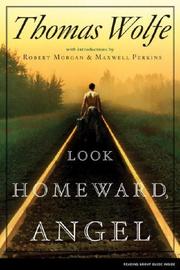
Look Homeward, Angel: A Story of the Buried Life is a 1929 novel by Thomas Wolfe. It is Wolfe's first novel, and is considered a highly autobiographical American coming-of-age story. The character of Eugene Gant is generally believed to be a depiction of Wolfe himself. The novel briefly recounts Eugene's father's early life, but primarily covers the span of time from Eugene's birth in 1900 to his definitive departure from home at the age of 19. The setting is a fictionalization of his home town of Asheville, North Carolina, called Altamont in the novel.
A restored version of the original manuscript of Look Homeward, Angel, titled O Lost, was published in 2000.
Genesis and publication history
Thomas Wolfe's father, William Oliver Wolfe, ordered an angel statue from New York and it was used for years as a porch advertisement at the family monument shop on Patton Avenue (now the site of the Jackson Building). W. O. Wolfe sold the statue to a family in Hendersonville, North Carolina in 1906. The angel was then moved to that town's Oakdale Cemetery. The boarding house run by Eugene Gant's mother, based on one run by Wolfe's mother, has been called "the most famous boardinghouse in American fiction."
The title of Thomas Wolfe's novel comes from the John Milton poem "Lycidas":
"Look homeward Angel now, and melt with ruth:And, O ye Dolphins, waft the hapless youth."(163–164)
Wolfe's original title was The Building of a Wall, which he later changed to O Lost. On the novel's completion, Wolfe gave the vast manuscript to Scribner editor Maxwell Perkins. Perkins was impressed with the young author's talent, but requested that Wolfe rewrite the novel to a more publishable size. The two worked through it together, and after being trimmed by 60,000 words, the novel was published in September, 1929. Wolfe became insecure about the editing process after receiving criticism that the novel was Perkins's almost as much as his own. This led to an estrangement between the two, and Wolfe eventually left Scribner. Prior to his death in 1938, Wolfe made amends with Perkins. Writing in 1947, Perkins stated that he took the book "substantially as it was," and that "in truth, the extent of cutting ... has somehow come to be greatly exaggerated. Really, it was more a matter of reorganization."
Descriptions of Altamont are based on Wolfe's home town of Asheville, North Carolina, and the descriptions of people and family led to estrangement from many in his hometown. Though often regarded as a "sentimental tale of growing up," the novel is characterized by a "dark and troubling" depiction of the times, "full of loneliness, death, insanity, alcoholism, family dysfunction, racial segregation and a profoundly cynical view of World War I." Rarely named but frequently alluded to, the infectious disease tuberculosis (consumption) casts a "death’s-head shadow" over the novel. Wolfe later died of the disease.
O Lost, the original "author's cut" of Look Homeward, Angel, was reconstructed by scholars Arlyn and Matthew Bruccoli and published in 2000 on the centennial of Wolfe's birth. Matthew Bruccoli said that while Perkins was a talented editor, Look Homeward, Angel is inferior to the complete work of O Lost and that the publication of the complete novel "marks nothing less than the restoration of a masterpiece to the literary canon."
Plot
Part One
The first marriage of Oliver Gant, father of the protagonist, Eugene, ends in tragedy, after which Oliver becomes an alcoholic; the battle with alcoholism remains the major struggle of his life. He eventually remarries, builds a new house, and starts a family. The couple have a total of six surviving children.
Eugene's birth follows a difficult labor during which his father, Oliver, is drunk downstairs. Oliver forms a special bond with his son from early on. He begins to get his drinking under control, although his marriage becomes strained as Eliza's patience with him grows thinner.
Despite his flaws, Oliver Gant is the family's keystone; he reads Shakespeare, has his daughter Helen read poetry, and keeps great fires burning in the house as symbols of warmth for the family. Eugene's early education includes several clashes with teachers but he has a love of books and is bright, much to the pride of both his parents. His mother continues to baby him, unwilling to see him grow up.
Part Two
Eugene wins a writing contest and is chosen to attend Altamont Fitting School and later, the University of North Carolina.
At UNC, he is taken up by the new school principal, John Dorsey Leonard and wife, Margaret. They form a college prep academy and add Eugene to the student population at the cost of $100 per year, grudgingly provided by Eliza. He learns the basics from them both, but is prompted by Margaret to immerse himself in poetry and ancient drama. He becomes like a son to them both.
Oldest Gant son, Stevie, is a braggart and an enterprising entrepreneur, albeit with rotting, painful teeth. Younger son, Luke, minus the dental ailment, seems to be following in his footsteps, both hustlers and conmen. Kind, gentle, brooding brother, Ben, grows close to Eugene and looks out for him.
Part Three
After his freshman year, Eugene's summer back in Altamont is marked by him falling in love with a 21-year-old tenant—Laura James—at his mother's boarding house. Eugene becomes obsessed with Laura and at the end of the summer, she tells him that she is engaged to be married to a man in Norfolk, Virginia. Eugene falls into a funk which haunts him for another two years.
Oliver Gant undergoes radiation treatments for his cancer at Johns Hopkins University Hospital in Baltimore.
以上文字摘自英文维基百科「Look Homeward, Angel」(有删节,去掉了参考文献等尾部小节),按 CC BY-SA 4.0 使用,作者为维基百科的各位编者。
资料卡
- 原题
- Look Homeward, Angel
- 原作语言
- 英语
- 首次出版
- 1929 年
- 作品形式
- 长篇小说
- 体裁
- 教育小说
- 首版出版社
- 斯克里布纳之子公司
- 获奖
- 20世纪百大英文小说
资料卡来自 Wikidata Q6675006(CC0),众包数据,个别字段可能不全。
改编作品
取材于它的书1
- 《宝贝,望乡》Look Homeward, Angel
名单来自 Wikidata(CC0):只列条目里写明「改编自 / 取材于」这本书的作品,不按名字猜;众包数据,可能不全。