书单
百科
这个词条暂时没有中文维基百科条目,下面是英文维基百科的内容(英文原文):
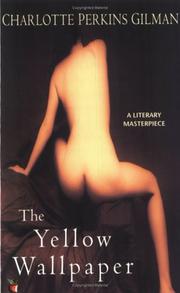
"The Yellow Wallpaper" (original title: "The Yellow Wall-paper. A Story") is a short story by American writer Charlotte Perkins Gilman, first published in January 1892 in The New England Magazine. It is regarded as an important early work of American feminist literature for its illustration of the attitudes towards the mental and physical health of women in the 19th century. It is also lauded as an excellent work of horror fiction.
The story is written as a collection of journal entries narrated in the first person. The journal was written by a woman whose physician husband has rented an old mansion for the summer. Forgoing other rooms in the house, the husband confines the woman to an upstairs nursery. As a form of treatment, the husband forbids the journal writer from working or writing, and encourages her to eat well and get plenty of air so that she can recuperate from what he calls a "temporary nervous depression – a slight hysterical tendency", a common diagnosis in women at the time. As the reader continues through the journal entries, they experience the writer's gradual descent into madness with nothing better to do than observe the peeling yellow wallpaper in her room.
The story has been the subject of extensive feminist and psychoanalytic criticism and is often compared to Sylvia Plath's The Bell Jar for its depiction of mental illness, gendered expectations, and the search for agency. More recent interpretations have also explored the story through an ecogothic lens, emphasizing the unsettling role of the natural and domestic environment in shaping the protagonist's psychological breakdown.
Plot summary
The story describes a young woman and her husband. He imposes a rest cure on her when she suffers "temporary nervous depression" after the birth of their baby. They spend the summer at a colonial mansion, where the narrator is largely confined to an upstairs nursery. The story makes striking use of an unreliable narrator in order to gradually reveal the degree to which her husband has "imprisoned" her due to her physical and mental condition. She describes torn wallpaper, barred windows, metal rings in the walls, a floor "scratched and gouged and splintered", a bed bolted to the floor, and a gate at the top of the stairs, but blames all these on children who must have resided there.
The narrator devotes many journal entries to describing the wallpaper in the room – its "sickly" color, its "yellow" smell, its bizarre and disturbing pattern like "an interminable string of toadstools, budding and sprouting in endless convolutions," its missing patches, and the way it leaves yellow smears on the skin and clothing of anyone who touches it. She describes how the longer one stays in the bedroom, the more the wallpaper appears to mutate, especially in the moonlight. With no stimulus other than the wallpaper, the pattern and designs become increasingly intriguing to the narrator. She soon begins to see a figure in the design. Eventually, she comes to believe that a woman is creeping on all fours behind the pattern. Believing she must free the woman in the wallpaper, she begins to strip the remaining paper off the wall.
When her husband arrives home, the narrator refuses to unlock her door. When he returns with the key, he finds her creeping around the room, rubbing against the wallpaper, and exclaiming, "I've got out at last… in spite of you." He faints, but she continues to circle the room, creeping over his inert body each time she passes it, believing herself to have become the woman trapped behind the yellow wallpaper.
Author
Charlotte Perkins Gilman used her writing to explore the role of women in America around 1900. She expounded upon many issues, such as the lack of a life outside the home and the oppressive forces of a patriarchal society. Through her work, Gilman paved the way for writers such as Alice Walker and Sylvia Plath.In "The Yellow Wallpaper," she portrays the narrator's insanity as a way to protest the professional and societal oppression against women. While under the impression that husbands and male doctors were acting with their best interests in mind, women were depicted as mentally fragile. Women's rights advocates of the era believed that the "outbreak" of this mental instability was the manifestation of their setbacks regarding the roles they were allowed to play in a male-dominated society. Quawas argues that women were even discouraged from writing because it would ultimately create an identity and become a form of defiance. Gilman realized that writing became one of the only forms of expression for women at a time when they had very few rights.
After the birth of her first daughter, Gilman suffered postnatal depression and was treated by Dr. Silas Weir Mitchell, the leading expert on women's mental health at the time. He suggested a strict 'rest cure' regimen involving much of bed rest and a blanket ban on working, including reading, writing, and painting. After three months and almost desperate, Gilman decided to contravene her diagnosis, along with the treatment methods, and started to work again. Aware of how close she had come to a complete mental breakdown, the author wrote "The Yellow Wallpaper" with additions and exaggerations to illustrate her criticism of the medical field. Gilman sent a copy to Mitchell but never received a response. Gilman was ultimately proven right in her disdain for the "rest cure" when she sought a second opinion from Mary Putnam Jacobi, one of the first female doctors and a strong opponent of this theory, who prescribed a regimen of physical and mental activity that proved a much more successful treatment.
以上文字摘自英文维基百科「The Yellow Wallpaper」(有删节,去掉了参考文献等尾部小节),按 CC BY-SA 4.0 使用,作者为维基百科的各位编者。
资料卡
- 原题
- The Yellow Wall Paper
- 原作语言
- 英语
- 首次出版
- 1892 年
- 作品形式
- 短篇小说
- 体裁
- 虚构作品
- 主题
- 精神健康
- 故事发生地
- 美国
资料卡来自 Wikidata Q462373(CC0),众包数据,个别字段可能不全。