书单
百科
这个词条暂时没有中文维基百科条目,下面是英文维基百科的内容(英文原文):
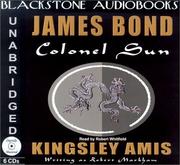
Colonel Sun is a novel by Kingsley Amis published by Jonathan Cape on 28 March 1968 under the pseudonym "Robert Markham". It is the first James Bond continuation novel published after Ian Fleming died in 1964. The novel centres on the fictional British Secret Service operative James Bond and his mission to track down the kidnappers of M, his superior at the Secret Service. During the mission he discovers a communist Chinese plot to cause an international incident that would implicate Britain. Bond, assisted by Ariadne Alexandrou, a Greek spy working for the Russians, finds M on a small Aegean island, rescues him and kills the two main plotters: Colonel Sun Liang-tan and a former Nazi commander, Von Richter.
To create a realistic setting and characters Amis drew upon a holiday he had taken in the Greek Islands. He emphasised political intrigue in the plot more than Fleming had done in the canonical Bond novels, also adding revenge to Bond's motivations by including M's kidnapping. Despite keeping a format and structure similar to Fleming's Bond novels, Colonel Sun had a mixed reception, many reviewers commenting that Amis lacked Fleming's style in writing.
Colonel Sun was serialised in the Daily Express in March 1968 and adapted as a comic strip in the same newspaper between 1969 and 1970. Elements from the story have been used in the Eon Productions Bond series: the 1999 film The World Is Not Enough used M's kidnapping; the name of the antagonist in the 2002 film Die Another Day, Colonel Tan-Sun Moon, comes from Colonel Sun Liang-tan; and one scene inspired an element of the 2015 film Spectre.
Plot
Kidnappers violently take the Secret Service chief M from his house and almost capture James Bond, who is visiting his superior. Intent on rescuing him, Bond follows the clues to Vrakonisi, one of the Aegean Islands. In the process, he discovers the complex military-political plans of Colonel Sun of the Chinese People's Liberation Army. Sun has been sent to sabotage a Middle East détente conference which the Soviet Union is hosting. He intends to attack the conference venue and use M and Bond's bodies to blame Britain for the disaster, leading to a world war. Bond meets Soviet agents in Athens, led by Major Piotr Gordienko, and they realise that not only is a third country behind the kidnap, but that there is a traitor in Gordienko's organisation. An attack on the Soviet headquarters kills all the agents except Ariadne Alexandrou, a Greek Communist. As Gordienko is dying he encourages Bond and Ariadne to work together to prevent an international incident.
Ariadne persuades Niko Litsas, a former Second World War resistance fighter and friend of her late father, to help them by telling him about the involvement in the plot of a former Nazi war criminal, Von Richter. Trying to find M and Colonel Sun, Bond is nearly captured by the Russians, but is saved by Litsas. Finally, Bond finds Sun's headquarters, where he is knocked out by one of Sun's men; Bond learns that Von Richter will use a mortar to destroy the conference venue and that Bond will be tortured by Sun, before his inevitable demise. Sun tortures him brutally, until one of the girls at the house is ordered by Sun to caress Bond. In the process she cuts one of Bond's hands free and provides him with a knife. She tells Sun that Bond is dead: when examined Bond stabs Sun. He then frees other captives who help Bond stop Von Richter. Sun, however, survives the stab wound and kills several of the other escapees; Bond tracks down Sun and kills him. The Soviets thank Bond for saving their conference, offering him the Order of the Red Banner, which he politely declines.
Background and writing history
Ian Fleming, the creator of James Bond, died on 12 August 1964, eight months before the publication of his twelfth and final novel, The Man with the Golden Gun. After his death the Fleming-family-owned Glidrose Productions (now Ian Fleming Publications) held the rights to his works and decided to publish the short story collection Octopussy and The Living Daylights on 23 June 1966.
Glidrose took legal advice and found the Bond character could not be copyrighted. They decided that to avoid the possibility of other people publishing works about Bond, they would commission a sequel to retain their rights in the Bond product. Initially Glidrose approached the author James Leasor to write a continuation novel, but he declined. They then commissioned the writer Kingsley Amis. Fleming's widow, Ann, did not endorse any further Bond works, which she saw as cashing in on his work. She disliked Amis and said:
Since the exploiters hope Colonel Sun will be the first of a new and successful series, they may find themselves exploited. Amis will slip 'Lucky Jim' into Bond's clothing, we shall have a petit bourgeois red brick Bond, he will resent the authority of M, then the discipline of the Secret Service, and end as Philby Bond selling his country to Spectre.
The Sunday Telegraph asked her to review the novel, but her resulting criticism was so acerbic that it was never published as it was thought it could have been libelous.
以上文字摘自英文维基百科「Colonel Sun」(有删节,去掉了参考文献等尾部小节),按 CC BY-SA 4.0 使用,作者为维基百科的各位编者。
资料卡
- 原题
- Colonel Sun
- 原作语言
- 英语
- 首次出版
- 1968 年
- 作品形式
- 长篇小说
- 体裁
- 谍报小说、犯罪作品
- 首版出版社
- 乔纳森·凯普
- 所属系列
- 詹姆斯·邦德
- 主要人物
- 詹姆斯·邦德
资料卡来自 Wikidata Q2448628(CC0),众包数据,个别字段可能不全。