书单
百科
这个词条暂时没有中文维基百科条目,下面是英文维基百科的内容(英文原文):
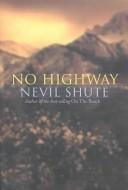
No Highway is a 1948 novel by Nevil Shute. It formed the basis of the 1951 film No Highway in the Sky.
A scientist has been claiming that certain parts of a new aircraft called a Reindeer will develop metal fatigue sooner than officially estimated, but nobody takes him seriously. While flying to the site of an air crash that killed a Soviet ambassador, he discovers that his own plane is a Reindeer which has already flown twice its permitted number of hours. He uses his technical knowledge to sabotage it as soon as it lands, putting his credibility further in doubt.
The plot weaves together many themes, such as attitudes to safety, conflicts of interest between management and professionals, Cold War diplomacy, single parenthood and clairvoyance, before the scientist's theory is finally vindicated. As the novel appears to presage some later real-life disasters and is based on just-emerging knowledge of metal fatigue, it is said to be one of few novels to reveal a new engineering truth.
Shute was a pioneer aircraft designer and co-founder of the aircraft construction company Airspeed Ltd.
Characters
Theodore Honey: A middle-aged widower and experienced scientist at the Royal Aircraft Establishment Farnborough, Hampshire (RAE), working on safety;
Dr Dennis Scott: Younger, dynamic aeronauticist and recently appointed head of the structural department at the RAE, brought in to 'downsize' the department;
Marjorie Corder: Airline stewardess, in her mid-20s and tiring of the "glamorous life" with the fictional C.A.T.O.;
Monica Teasdale, an older, middle-echelon Hollywood actress, facing a lonely retirement;
Captain Samuelson: veteran pilot of the Reindeer, highly respected;
Elspeth: Honey's twelve-year-old daughter;
Shirley Scott: Dr Scott's wife, a local schoolteacher.
Plot
The narrator is Dr Scott, brought in to downsize his department, and the plot concerns his consideration of Theodore Honey, who initially comes across as an unlikely hero. Mr Honey, a widower, does not live a conventional British life, and is bringing up his young daughter, Elspeth, alone. He is engaged in research on the fatigue of aluminium airframes. He is currently investigating possible failure in the high aspect ratio tailplane of a new airliner, the fictional "Rutland Reindeer".
Honey is nervous and distrusting of the 'new broom', is unimpressive in appearance and is so intensely focused on his work that his relations with the outside world – never that good to begin with – suffer badly. Throughout the story, people judge him by that appearance, or by his varied and unconventional outside interests, such as pyramidology, the study of possible esoteric interpretations of the Pyramids.
Honey has predicted, by a (fictional) theory supposedly related to quantum mechanics, that it is possible for an aluminium alloy structure to fail long before the design lifetime predicted by the usual design standards. He is using a spare tailplane from a Reindeer aircraft in a fatigue test. Honey's theory predicts that the metal at the root of the tailplane will suffer from metal fatigue and fail with a crystalline fracture.
Before Dr Scott's arrival, despite Honey's concerns, the aircraft had recently been allowed into service. Honey's work is regarded as likely to refute his far-fetched theory, rather than raising a significant safety issue. But the newly arrived Mr Scott links it with the recent crash of a Reindeer carrying the Soviet ambassador, which had total flying hours close to Honey's estimate, and which crashed in northeastern Quebec. The crash report, including photographs, is inconclusive, and Scott feels that the remains of the aircraft must be physically examined.
Honey is sent to Canada to examine the debris of the crash, travelling on board a Reindeer aircraft on which he meets the two heroines of the novel, Corder and Teasdale. During the flight, Honey discovers from the cockpit crew that the flying hours of this aircraft are twice those of any other Reindeer in service, and are close to his predicted failure time. He becomes increasingly anxious for its safety. He confides in Teasdale, whose films he admires, and goes on to give her some advice on the safest place to go in the aircraft in the event of a crash. Despite his alarm, he remains persuasive and sincere, and impresses Corder and Teasdale. He also impresses the pilot, Samuelson, who knew the captain of the recently crashed Reindeer and had rejected with scorn the official inquiry's conclusion that the crash was the result of pilot error.
During a heated discussion during a stopover at Gander International Airport, Honey realises that he has failed to persuade anyone to declare the Reindeer unfit for service, and in desperation, he disables it by raising its undercarriage while it is standing on the tarmac, leaving the aircraft damaged and unable to move.
Honey is recalled to Farnborough after this sabotage, but he is delayed because C.A.T.O., the fictional operator of the damaged aircraft, refuses to carry him. While he is away, trouble arises on a second front. For the duration of his trip, he has left Elspeth in their shabby, neglected home in Farnham, with only the supervision of the unreliable cleaning woman.
Shirley Scott finds Elspeth unconscious, confirming her misgivings about the state of Honey's home life, and nurses her. Elspeth displays a touching mix of precocity and serious intelligence, but betrays Honey's hobbies of spiritualism and prophecy. That notwithstanding, Elspeth's outlook is tempered with serious thought and childhood happiness in simple things.
Teasdale visits Dr Scott at Farnborough and relates her story of events to the Director of the RAE before offering Elspeth some feminine care and affection. Her affection for Honey is obvious, but she realises it is not to be – she cannot give him children or sustain him in his work. She is rapidly followed by Corder, who bears Honey's letter of resignation to Scott and her own account of the events in Gander.
以上文字摘自英文维基百科「No Highway」(有删节,去掉了参考文献等尾部小节),按 CC BY-SA 4.0 使用,作者为维基百科的各位编者。
资料卡
- 原作语言
- 英语
- 首次出版
- 1948 年
- 作品形式
- 长篇小说
- 首版出版社
- 海尼曼出版社
资料卡来自 Wikidata Q7044287(CC0),众包数据,个别字段可能不全。