书单
百科
这个词条暂时没有中文维基百科条目,下面是英文维基百科的内容(英文原文):
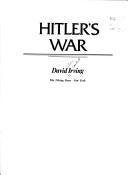
Hitler's War is a biographical book by the British author and Holocaust denier David Irving. It describes the Second World War from the point of view of Adolf Hitler, the dictator of Nazi Germany.
It was first published in April 1977 by Hodder & Stoughton and Viking Press. Avon Books reissued it in 1990. In 2002 Focal Point Publications published a revised illustrated edition, combined with Irving's The War Path, as a 1024-page hardcover.
Critical reception was mostly negative, with academics largely criticizing the book for historical negationism around Hitler's involvement in the Holocaust. Despite (or perhaps because of) the controversy Hitler's War generated, it was a best-seller in 1977. In particular, Hitler's War was a best-seller in Germany.
Primary theses
Irving's book Hitler's War, the first published installment of his two-part biography of Adolf Hitler (the prequel The War Path was published in 1978), had originally been published in German as Hitler und seine Feldherren (Hitler and his Generals) in 1975. Irving's intention in Hitler's War was to clean away the "years of grime and discolouration from the facade of a silent and forbidding monument" to reveal the “real Hitler”, whose reputation Irving claimed had been slandered by historians. In Hitler's War Irving tries to "view the situation as far as possible through Hitler's eyes, from behind his desk". He portrays Hitler as a rational and intelligent politician whose only goal was to increase Germany's prosperity and influence on the continent, and who was constantly let down by incompetent and/or treasonous subordinates. Irving's book faults the Allied leaders, most notably Winston Churchill, for the eventual escalation of war, and claims that the German invasion of the Soviet Union in 1941 was a "preventive war" forced on Hitler to avert an alleged impending Soviet attack. Irving comments that in light of the "preventive war" that he feels Hitler was forced to wage, the Kommissarbefehl was merely something that Stalin forced on Hitler. He also claims that Hitler had no knowledge of the Holocaust; while not outright denying its occurrence, Irving claims that Heinrich Himmler and his deputy, Reinhard Heydrich, were its originators and architects. Irving makes much of the lack of any written order from Hitler concerning the Holocaust (and for decades after the book's publication has offered to pay £1,000 to anyone who could find such an order). In addition, citing the work of such historians as Harry Elmer Barnes, David Hoggan, and Frederick J. P. Veale, Irving argues that Britain was primarily responsible for the outbreak of war in 1939.
Irving in his first edition of Hitler's War in 1977 argues that Hitler was against the mass killing of Jews. He claims that Hitler even ordered a stop to the extermination of Jews in November 1941 (the British historian Hugh Trevor-Roper stated that this admission contradicts Irving's other claim that Hitler was ignorant about the mass killing of Jews). On 30 November 1941 Heinrich Himmler went to the Wolf's Lair for a private conference with Hitler and during it the fate of some Berlin Jews was mentioned. At 1.30 pm Himmler was instructed to tell Reinhard Heydrich that the Jews were not to be liquidated. Himmler telephoned SS General Oswald Pohl, the overall chief of the concentration camp system, with the order: "Jews are to stay where they are." Irving argued that "No liquidation" (Keine Liquidierung) was "incontrovertible evidence" that Hitler ordered that no Jews were to be killed. However, although the telephone log is genuine, it provides no evidence that Hitler was involved at all, only that Himmler contacted Heydrich and there is no evidence that Hitler and Himmler were in contact before the phone call. This is an example of Irving's manipulation of documents since there was no general order to stop the killing of Jews. The German historian Eberhard Jäckel wrote that Irving "only ever sees and collects what fits his story, and even now he will not let himself be dissuaded from understanding what he wants to by the phrase postponement of the Jewish question’."
In a footnote in Hitler's War, Irving first introduced the thesis later popularised in the 1980s by Ernst Nolte that a letter written by Chaim Weizmann to Neville Chamberlain on 3 September 1939, pledging the support of the Jewish Agency to the Allied war effort, constituted a "Jewish declaration of war" against Germany, thus justifying German "internment" of European Jews. In 1975, when without Irving's permission the firm Ullstein-Verlag removed the passages claiming Hitler had no knowledge of the Holocaust from the German edition of Hitler's War, Irving sued Ullstein-Verlag. Despite his much-vaunted disdain for professional historians (most of whom Irving accused of slandering Hitler), Irving attended a historians' conference in Aschaffenburg in July 1978 to discuss "Hitler Today – Problems and Aspects of Hitler Research". Irving spent his time at the conference attacking all of the historians present for alleged sloppy research on Hitler, and promoting Hitler's War as the only good book ever written on the Führer.
Irving in his 1991 revised edition of Hitler's War removed all mentions of "gas chambers" and the word "Holocaust". He defended the revisions by stating, "You won't find the Holocaust mentioned in one line, not even in a footnote, why should [you]. If something didn't happen, then you don't even dignify it with a footnote."
以上文字摘自英文维基百科「Hitler's War」(有删节,去掉了参考文献等尾部小节),按 CC BY-SA 4.0 使用,作者为维基百科的各位编者。
资料卡
- 原题
- Hitler's War
- 原作语言
- 英语
- 首次出版
- 1977 年
- 首版出版社
- 维京出版社
- 主题
- 第二次世界大战、阿道夫·希特勒
资料卡来自 Wikidata Q5871993(CC0),众包数据,个别字段可能不全。