书单
百科
这个词条暂时没有中文维基百科条目,下面是英文维基百科的内容(英文原文):
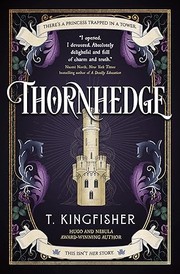
Thornhedge is a 2023 novella by Ursula Vernon, writing under the pen name T. Kingfisher. The novella is a reimagining of the story of Sleeping Beauty. It won the 2024 Hugo Award for Best Novella and 2024 Locus Award for Best Novella.
Plot
Toadling guards a wall of thorns which conceal a sleeping princess in a tower. She hopes that humans will eventually forget the existence of the tower and its occupant.
Hundreds of years later, a knight approaches the hidden tower. Toadling tries to tie elf-knots into his hair to scare him away, but he awakens and discovers her. The knight tells her that his name is Halim and claims to be looking for the lost princess.
Toadling narrates her story to Halim. She was born a human princess and switched with a changeling at birth. She was raised in Faerie by frog-like creatures called greenteeth. Because time passes differently in Faerie, she was able to return to the human world and stand as the fairy godmother for the christening of the changeling, Fayette. The Faerie hare goddess instructed Toadling to give Fayette a gift: "she will do no harm to those around her." Toadling messed up the words of the spell, rendering it ineffective. As Fayette grew, she became increasingly violent and unpredictable. At first she tortured animals. Later, her nurse fell down the stairs and died; Fayette puppeted the corpse around the palace. Toadling could not bring herself to kill Fayette and so decided to place her in an enchanted sleep. She grew the hedge of thorns around the keep for the protection of the outside world.
Halim and Toadling enter the tower and accidentally wake Fayette. Fayette tries to strangle Toadling; Halim pushes her out of the tower and kills her. The hare goddess returns to Toadling and reveals that the initial gift of "doing no harm" would have killed Fayette anyway, as the dead cannot harm anyone. The goddess brings Toadling back to Faerie, where she reunites with her family of greenteeth. She returns to the mortal world to journey with Halim, but plans to return home to Faerie someday.
Major themes
Gary K. Wolfe writes that the novella exists in "that liminal space ... between fairytale lore and actual medieval history". The opening chapter "serves as a remarkable evocation of loneliness" as Toadling watches the centuries pass around her. Later, Halim's "references to the Pope, the Byzantine-Seljuk wars, and his own Muslim background" place the story more firmly in a historical context.
Good and Evil
In the traditional tale of Sleeping Beauty, the princess symbolizes good and the fairy symbolizes evil. However, not all versions of Sleeping Beauty have an evil character. Perceforest is a 14th century epic containing a version of Sleeping Beauty. This version tells the story of princess Zellandine, who was cursed to eternal sleep by one of the three goddesses (Themis) who were invited to celebrate her birth. In Giambattista Basile's 17th century work Sun, Moon, and Talia the princess Talia's father consults astrologers who prophesy that Talia will be in danger, referencing her slumber caused by a splinter of flax. There are no evil fairies, or the mention of fairies, until Charles Perrault's version, The Sleeping Beauty in the Wood and the Brothers Grimm fairytale, Little Briar Rose. In the 1959 Disney film Sleeping Beauty, the word "evil" is used to refer to Maleficent, and her name also means evil-doer.
According to the author from the book review in the blog Plain-Spoken Pen (2023), in Thornhedge, the theme of evil and good is reversed; the princess Fayette represents evil and the fairy Toadling represents good. Moreover, in the review the author states that, "Toadling was supposed to be the princess, but she was stolen by the fae and a changeling was left in her place. She was raised by the greenteeth, trained in the ways of their magic". From this it can be interpreted that the princess and fairy roles in this novella merge, as Toadling is the true princess, and then changes into a fairy when she enters the fairy realm.
Friendship and Family
Thornhedge, unlike other tales of Sleeping Beauty, emphasizes the theme of friendship and familial bonds. Toadling's relationship with the greenteeth is similar to that of mothers and daughters, and she cared for them dearly and vice-versa. "Surrounded by child-eating swamp spirits, Toadling felt intensely loved " (Kingfisher, 2023). However, Toadling wasn't able to find the same love form her real parents, The King and The Queen. Additionally, Toadling had other friends from the swamp, the Kelpies.
Halim and Toadling's relationship is similar to that of platonic friends. Their interactions are polite and respectful and both understand each other's perspectives or views. According to the review in Publishers Weekly, Halim doesn't judge Toadling after she narrates her story to him, and helps her defeat Fayette. Moreover, Halim isn't disgusted by Toadling's toad form and befriends her. This aspect isn't present in the other versions of Sleeping Beauty, such as Little Briar Rose, or Sleeping Beauty in the Wood.
Beauty
In the novella, T. Kingfisher, emphasizes "beauty" not by the typical beauty standards. In the novella, Toadling is described as being hideous, and her mothers, the greenteeth, are also described as hideous. "No. I have many mothers. If I am hideous, then we are hideous together. And that made it easier, because in her heart of hearts, she could not believe that her mothers were anything but beautiful" (Kingfisher, 2023). Beauty is not limited to a particular standard or personality. However, in original Sleeping Beauty and its versions, the princess is interpreted to be beautiful, not hideous. "A legend of a fort with a magnificently beautiful princess sleeping within".
以上文字摘自英文维基百科「Thornhedge」(有删节,去掉了参考文献等尾部小节),按 CC BY-SA 4.0 使用,作者为维基百科的各位编者。
资料卡
- 原题
- Thornhedge
- 原作语言
- 英语
- 首次出版
- 2023 年 8 月 15 日
- 作品形式
- 中篇小说
- 体裁
- 推想虚构作品、奇幻
- 获奖
- 雨果奖最佳中短篇小说奖(2024)、轨迹奖最佳中篇小说(2024)
资料卡来自 Wikidata Q124381961(CC0),众包数据,个别字段可能不全。