 书单
百科
这个词条暂时没有中文维基百科条目,下面是英文维基百科的内容(英文原文):
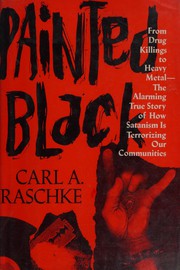
Painted Black: From Drug Killings to Heavy Metal — The Alarming True Story of How Satanism Is Terrorizing Our Communities is a book about Satanism by American academic Carl Raschke, then a religious studies professor at the University of Denver. It was published in 1990 by Harper & Row. The book attempts to link Satanism to the drug trade, several murders, heavy metal music, neo-Nazism and Dungeons & Dragons. He describes most other researchers of Satanism, including the FBI, scholars, and police, as "cult apologists".
The reception to the book from scholars and the media was highly critical. Specific criticism was given over the book's factual accuracy, hysterical nature, sourcing, and for contributing to the Satanic panic. Scholar Arthur Versluis wrote of Painted Black that "it is scarcely possible to exaggerate the hysterical nature of this book, nor the number of errors in it". Shawn Carlson called the book a "firm clout on the jaw of reason", and "the Exxon Valdez of rational journalism".
Background and publication history
Carl Raschke is an American scholar of religion and was at the time of the book's publication a religious studies professor at the University of Denver. Raschke was the director of the Institute for the Humanities at the college. He was a self described expert on the Satanic, and had previously been an expert witness in court on two trials that involved Satanism.
The book came at a time where several high-profile crimes had been linked or blamed on Satanism and the occult. In writing the book, Raschke drew much of his material from the work of Dale Griffis, a scholar whose work is not accepted by most other scholars and whose diploma was received from a diploma mill. The book was published in 1990 by Harper & Row. Its first edition was 276 pages long.
The Satanist Michael A. Aquino, covered in the book, sued as a result of its publication, alongside another book that mentioned him, The New Satanists by Linda Blood. Both Raschke and Blood implied that Aquino was guilty of a past accusation of child molestation. The case was settled out of court.
Contents
The book traces the historical roots and genealogy of Satanism, which Raschke says has its origins in the occultism of the Knights Templar. He traces the advancement of Satanism to Aleister Crowley.
He argues that Satanism's appeal to the American youth is brought on by a "culture of despair", and contributed to by the drug culture. Drug abuse, teen suicide, and instances of child abuse are all blamed on Satanism. Raschke attempts to link Satanism to many crimes and other activities, including the drug trade, several murders, heavy metal and rock music. He also connects Satanism to neo-Nazism and Dungeons & Dragons. He describes Satanism as an "ideological conspiracy to overthrow the world", that has practices that invoke animal and child abuse and murder. Raschke writes of Satanism that:
Satanism is a sophisticated and highly effective motivational system for the spread of violence and cultural terrorism all the while hiding behind the cloak of the First Amendment. It is an ideology has that found a strategic application in the criminal underworld, even it was not invented there.
Raschke says America is facing an epidemic of Satanic crime, which he says are ignored by the experts, FBI and media that paint instances like the murder of Mark Kilroy as "freak accidents". The Kilroy murder is focused on especially. He describes most other researchers of Satanism, including the FBI, scholars, police, and the National Child Safety Council, as "cult apologists", and that individuals such as an FBI special agent are friendly to the Satanic criminals.
Reception
Contemporary reception
Upon release, the book was widely ridiculed by the press. A review from John G. Taylor of McClatchy described it as "launched with promise and scuttled by problems". Taylor said there was "little serious thought be found among the deluge of oftentimes meandering details about criminals". Similarly, a reviewer for The Charlotte Observer called the book conspiratorial and said that this "catalogue of crimes fails to convince us that these are anything more than isolated and unrelated incidents, as the FBI concludes". A review from the Houston Chronicle was more positive, though noted his conclusions were "not shared by every expert".
A review in the magazine The Humanist from Shawn Carlson called the book a "firm clout on the jaw of reason", "the Exxon Valdez of rational journalism" and "a masterpiece of the new 'satanic' McCarthyism". Carlson criticized the book for not putting any of the information in context, like not mentioning that "of the 100,000 murders committed in the United States over the last five years, fewer than 100 had occult or satanic overtones; moreover, most of these were committed by mentally disturbed adolescents". Reviewing Painted Black in 1991, scholar Jonathon S. Epstein wrote: "Painted Black adds additional fuel to the flames of hysteria surrounding satanism in America", that "what the book lacks is scholarship, it makes up for it in sweeping and unsupportable generalizations", and that "Painted Black cannot be taken seriously". Epstein singled out Raschke's history of Western Satanism and its origins as largely accurate and "excellent", but said that the rest of the book was very poor, especially the chapter on heavy metal music.
以上文字摘自英文维基百科「Painted Black (book)」(有删节,去掉了参考文献等尾部小节),按 CC BY-SA 4.0 使用,作者为维基百科的各位编者。
资料卡
- 原题
- Painted Black
- 原作语言
- 英语
- 首次出版
- 1990 年
- 主题
- 撒旦教
资料卡来自 Wikidata Q136481641(CC0),众包数据,个别字段可能不全。