书单
百科
这个词条暂时没有中文维基百科条目,下面是英文维基百科的内容(英文原文):
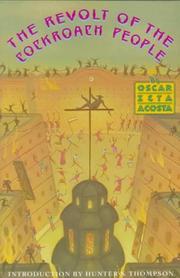
The Revolt of the Cockroach People is a novel by Oscar Zeta Acosta. It tells the story of a Chicano lawyer, "Buffalo Zeta Brown", fictionalizing events from Oscar Acosta's own life, including the East L.A. walkouts at Garfield High School, the founding of the Brown Berets, the Christmas protests at St. Basil's church, the Castro v. Superior Court decision of 1970, Acosta's run for sheriff of Los Angeles County later that year, the Chicano National Moratorium, and the death of Ruben Salazar, who is referred to as "Roland Zanzibar" in the novel. The novel is written in the style of Gonzo journalism, the conventions of which he helped codify with American journalist and friend Hunter S. Thompson. The story of Buffalo Z. Brown, a persona of the author, satirizes the East L.A. Chicano movement through the eyes of a participant observer. Acosta uses the historical events of the late 1960s and early 1970s "as the context for the construction of a Chicano identity and the realization of a revolutionary class consciousness."
Acosta frames Brown as a lawyer who understands the United States's legal system as both arbitrary and differential, and therefore comes to the realization that an "objective truth" can never materialize "either in the courtroom or elsewhere." Through the character of Brown, Acosta acknowledges that what is understood as "truth" is a social construct or cultural convention. This realization is destabilizing yet invigorating for Brown, who understands that law can function both "as a tool of repression but it may also be used to project a radically new form of legality that cannot be achieved within present institutions," as described by Mexican-American scholar Ramón Saldívar. Saldívar characterizes this as an important moment for Brown (and Acosta), as he understands that "ideological commitment to a cause" is not a matter of identifying "truth" or "falsehood" but an "issue of taking sides in a struggle between embattled groups."
Plot Summary
Chapters 1-5
Continuing the events of the previous novel, Brown has moved to Los Angeles to participate in the Chicano Movement. The novel starts in medias res, during the 1969 Christmas protest at St. Basil Catholic Church. The demonstrators, many associated with the Chicano Militants, protest against the Church's perceived wealth and neglect of the poor, and specifically against the Cardinal McIntyre. The protestors carry religious objects and candles, and demand admission during the Christmas Mass. Brown accompanies other activists approaching the building, where they encounter ushers who refuse to allow them in.
One of the activists, Gilbert Rodriguez, attempts to persuade the ushers to open the doors, but the dispute turns violent when an usher strikes him. Other demonstrators get involved, and the police show up and attempt to force the activists from the church. The protestors attempt to appeal to the congregation and gain their support, while Brown identifies himself as the group's lawyer and confronts Sergeant Armas, a Mexican-American police officer in charge of the responding force. After witnessing the police use force on the protestors, Brown returns to this apartment to prepare statements for the press. He then gets a phone call from a journalist named Jesus, who explains that he had been following Brown's travels. Brown then recaps the situation, during which the narrative shifts back to 1968.
When Brown first arrives in Los Angeles in January 1968, he intends to go back to practicing law while writing a book about his experiences. After several years of travel, he is financially unstable and uncertain about the future. He stays with his sister in the San Fernando Valley and begins searching for work. Brown reflects on his unsuccessful attempts to establish himself after law school, including a brief stint at a legal aid office in East Oakland. He considers his own feelings of estrangement from both conventional American society and from his own identity as a Mexican-American. During this period, he reconnected with Manuel, an old friend from his hometown of Riverbank, California.
Manuel, a former athlete who failed to qualify for the Olympics, had become a teacher and a coach. The two meet at a restaurant in East Los Angeles and discuss professional ambition, and the status of Chicanos in society. Manuel criticizes Brown's unconventional lifestyle, and Brown questions Manuel's attachment to individual success. Their conversation leads Brown to remember his childhood in Riverbank, where he and several Chicano classmates considered organizing a protest against the discriminatory policies of their grammar school. Brown recalled how the students were initially on board with the protest, then abandoned the plan due to pressure from school authorities and their families. This connection reinforced Brown's frustration with discrimination in greater society and with organizing in general.
Three months after his initial arrival in L.A, Brown meets Gilbert Rodriguez, Risco, and Ruth at the headquarters of the Chicano Militants. The organization operates from the basement of an Episcopal church, in which members distribute political literature and plan demonstrations. Brown initially approaches the activists to gather material for an article he had hoped to write, with Gilbert and Risco expressing doubt about his intentions and background as both a writer and lawyer. Brown responded with his experience in defending criminal cases and expressed intrigue into the organization itself. The activists then invite Brown to join them at a student walkout at a local high school.
以上文字摘自英文维基百科「The Revolt of the Cockroach People」(有删节,去掉了参考文献等尾部小节),按 CC BY-SA 4.0 使用,作者为维基百科的各位编者。
资料卡
- 原题
- The Revolt of the Cockroach People
- 原作语言
- 英语
- 首次出版
- 1973 年
- 作品形式
- 长篇小说
- 前作
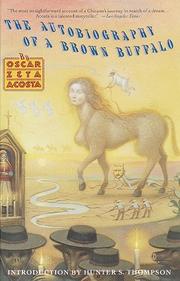
- Autobiography of a Brown Buffalo
- 故事发生地
- 洛杉矶
资料卡来自 Wikidata Q7760566(CC0),众包数据,个别字段可能不全。