书单
百科
这个词条暂时没有中文维基百科条目,下面是英文维基百科的内容(英文原文):
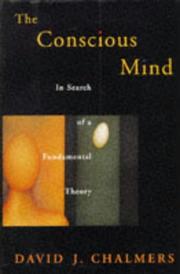
The Conscious Mind: In Search of a Fundamental Theory was published in 1996, and is the first book written by David Chalmers, an Australian philosopher specialising in philosophy of mind. Although the book has been greatly influential, Chalmers maintains that it is "far from perfect", as most of it was written as part of his PhD dissertation after "studying philosophy for only four years".
Summary
Thesis
In The Conscious Mind, Chalmers argues that (1) the physical does not exhaust the actual, so materialism is false; (2) consciousness is a fundamental fact of nature; (3) science and philosophy should strive towards discovering a fundamental law of consciousness.
Definitions
Psychological consciousness: publicly accessible descriptions of consciousness, such as its neurochemical correlates or role in influencing behaviour.
Phenomenal consciousness: experience; something is phenomenologically conscious if it feels like something to be it.
Every mental state can be described in psychological terms, phenomenological terms, or both.
Further clarification
Psychological and phenomenal consciousness are often conflated. Thinkers may purport to have solved consciousness (in the phenomenological sense) when really all they have solved are certain aspects of psychological consciousness. To use Chalmers words: they claim to have solved the "hard problem of consciousness", when really all they have solved are certain "easy problems of consciousness".
Chalmers believes that an adequate theory of consciousness can only come by solving both the hard and easy problems. On top of discovering brain states associated with conscious experience, science must also discover why and how certain brain states are accompanied by experience. This is what Chalmers attempts to do in The Conscious Mind.
Arguments against reductionism
The hard problem is hard, by Chalmers' account, because conscious experience is irreducible to lower-order physical facts. He supports this conclusion with three main lines of argument, which are summarised below.
Appeals to conceivability: Chalmers argues that conscious experience can always be "abstracted away" from reductive explanations. This is evidenced by the conceivability and, by extension, logical possibility of philosophical zombies (exact replicas of a person that lack conscious experience). Alternatively, it is conceivable that a "partial zombie" could have been "physically identical", but not "phenomenological identical" to their nonzombie twin (they could have an inverted visible spectrum, for instance).
Appeals to epistemology: Unlike other forms of knowledge, knowledge of consciousness can only ever be gained through first-hand experience. The problem of other minds is evidence of this. Frank Jackson's famous thought experiment Mary's Room demonstrates a similar point. Upon seeing red, Mary gains new information was not entailed by the physical facts alone.
Appeals to analysis: There are no satisfying reductive accounts of consciousness, and it is not even clear what such a theory would look like. All such accounts suffer from the same core sin: the inability to explain why certain brain states are accompanied by conscious experience.
The conclusion of all these arguments is the same: consciousness is irreducible to physical facts alone.
Against materialism
The only things that are irreducible to lower-level facts are fundamental laws of nature (e.g., space and time). Since consciousness is irreducible, Chalmers believes that it, too, is fundamental.
Chalmers accepts that people may be reluctant to accept this conclusion, but notes that people were initially reluctant to accept the fundamental nature of electromagnetism as well. He also accepts that his conclusion sounds jarring, but notes that the brute nature of consciousness poses no more of a mystery than the brute nature of electromagnetism, gravity, or any other fundamental law.
Constraints
So, just as scientists of the past have sought fundamental laws of gravity and electromagnetism, so too should scientists of the present seek fundamental laws of consciousness. So, after providing the disclaimer that he is "most likely to be entirely wrong", Chalmers puts forward possible ways in which the search for a theory may be constrained:
Phenomenal judgements: A theory of consciousness should be able to dispel epiphenominalism without resorting to interactionism (a view which Chalmers rejects).
The double-aspect principle: Some information must be realised both physically and phenomenologically (i.e., realised both in the mind and brain).
Structural coherence: the internal structure of consciousness (structural relations between qualia, such as the red/green blue/yellow axis of colour vision) must be accounted for.
The principle of organisational invariance: Through the thought experiments of Fading Qualia and Dancing Qualia.[see: Further reading] Chalmers concludes that consciousness and its contents are substrate independent; structurally isomorphic computations must create qualitatively identical experiences regardless of how they are realised.
Similarly, Chalmers puts forward a number of "open questions" that a fundamental theory must answer:
Why does certain information correspond to certain qualia rather than functionally equivalent qualia?
What are the relations between spatial representations in the mind and the structure of space itself?
How do the structures of our sensory and neurological apparatus influence the structure of consciousness?
What causes the unification of consciousness?
Why are some bits of information realised in experience while others are not?
Good contenders for a fundamental theory of consciousness would be one that (a) fits the above criteria; (b) is compatible with the data; (c) has predicative power; and (c) is elegant. Though, of course, there will likely be further considerations that arise as science progresses.
以上文字摘自英文维基百科「The Conscious Mind」(有删节,去掉了参考文献等尾部小节),按 CC BY-SA 4.0 使用,作者为维基百科的各位编者。
资料卡
- 原题
- The Conscious Mind
- 原作语言
- 英语
- 首次出版
- 1996 年
- 体裁
- 哲学
- 首版出版社
- 牛津大学出版社
- 主题
- 意识、知觉难题
资料卡来自 Wikidata Q7727400(CC0),众包数据,个别字段可能不全。