 书单
百科
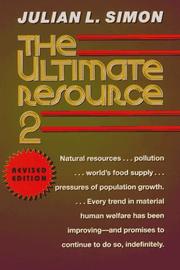
没有极限的增长(英语:The Ultimate Resource)是一本朱利安·林肯·西蒙创作的关于自然资源经济学的书籍,1981年出版,1996年出版第二版(The Ultimate Resource 2)。
以上文字摘自维基百科「没有极限的增长」(去掉了参考文献等尾部小节),按 CC BY-SA 4.0 使用,作者为维基百科的各位编者。
中文维基百科的条目比较短,下面附上英文维基百科的内容(英文原文):
The Ultimate Resource is a 1981 book written by Julian Lincoln Simon challenging the notion that humanity was running out of natural resources. It was updated in 1996 as The Ultimate Resource 2.
Overview
The overarching thesis on why there is no resource crisis is that as a particular resource becomes more scarce, its price rises. This price rise creates an incentive for people to discover more of the resource, ration and recycle it, and eventually, develop substitutes. The "ultimate resource" is not any particular physical object but the capacity for humans to invent and adapt.
Scarcity
The work opens with an explanation of scarcity, noting its relation to price; high prices denote relative scarcity and low prices indicate abundance. Simon usually measures prices in wage-adjusted terms, since this is a measure of how much labor is required to purchase a fixed amount of a particular resource. Since prices for most raw materials (e.g., copper) have fallen between 1800 and 1990 (adjusting for wages and adjusting for inflation), Simon argues that this indicates that those materials have become less scarce.
Forecasting
Simon makes a distinction between "engineering” and "economic" forecasting. Engineering forecasting consists of estimating the amount of known physical amount of resources, extrapolates the rate of use from current use and subtracts one from the other. Simon argues that these simple analyses are often wrong. While focusing only on proven resources is helpful in a business context, it is not appropriate for economy-wide forecasting. There exist undiscovered sources, sources not yet economically feasible to extract, sources not yet technologically feasible to extract, and ignored resources that could prove useful but are not yet worth trying to discover.
To counter the problems of engineering forecasting, Simon proposes economic forecasting, which proceeds in three steps in order to capture, in part, the unknowns the engineering method leaves out (p 27):
# Ask whether there is any convincing reason to think that the period for which you are forecasting will be different from the past, going back as far as the data will allow
If there is no good reason to reject the past trend as representative of the future as well, ask whether there is a reasonable explanation for the observed trend
If there is no reason to believe that the future will be different from the past, and if you have solid explanation for the trend—or even if you lack a solid theory, but the data are overwhelming—project the trend into the future
Infinite resources
Perhaps the most controversial claim in the book is that natural resources are infinite. Simon argues not that there is an infinite physical amount of, say, copper, but for human purposes that amount should be treated as infinite because it is not bounded or limited in any economic sense, because:
known reserves are of uncertain quantity new reserves may become available, either through discovery or via the development of new extraction techniques recycling more efficient utilization of existing reserves (e.g., "It takes much less copper now to pass a given message than a hundred years ago." [The Ultimate Resource 2, 1996, footnote, page 62])
development of economic equivalents, e.g., optic fibre in the case of copper for telecommunications
The ever-decreasing prices, in wage-adjusted terms, indicate decreasing scarcity, in that it takes less time for the average worker to earn the money required to purchase a set amount of some commodity. This suggests, Simon claims, an enduring trend of increased availability that will not cease in the foreseeable future, despite continued population growth.
Evidence
A plurality of the book consists of chapters showcasing the economics of one resource or another and proposing why this resource is, for human purposes, infinite.
以上文字摘自英文维基百科「The Ultimate Resource」(有删节,去掉了参考文献等尾部小节),按 CC BY-SA 4.0 使用,作者为维基百科的各位编者。
资料卡
- 原题
- The Ultimate Resource
- 原作语言
- 英语
- 首次出版
- 1981 年
- 体裁
- 非虚构作品
- 首版出版社
- 普林斯顿大学出版社
- 主题
- 自然资源
资料卡来自 Wikidata Q7771211(CC0),众包数据,个别字段可能不全。