书单

百科
这个词条暂时没有中文维基百科条目,下面是英文维基百科的内容(英文原文):
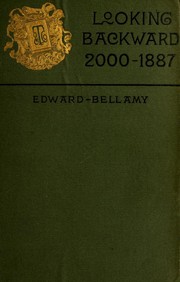
Looking Backward: 2000–1887 is a utopian time travel science fiction novel by the American journalist and writer Edward Bellamy first published in 1888.
The book was translated into several languages, and in short order "sold a million copies." According to historian Daniel Immerwahr, "In the 19th-century United States, only Uncle Tom's Cabin sold more copies in its first years" than Bellamy's book.
The novel inspired several utopian communities. In the United States alone, over 162 "Bellamy Clubs" sprang up to discuss and propagate the book's ideas. According to Erich Fromm, "It is one of the few books ever published that created almost immediately on its appearance a political mass movement."
Looking Backward influenced many intellectuals, and appears by title in many socialist writings of the day. Owing to its commitment to the nationalization of private property and the desire to avoid use of the term "socialism," this political movement came to be known as Nationalism (not to be confused with the political ideology of nationalism).
Synopsis
Bellamy's novel is set in Boston, Massachusetts, and tells the story of a young American man named Julian West who, in 1887, falls into a deep, hypnosis-induced sleep and wakes up 113 years later. He finds himself at the same location but in a totally changed world: It is the year 2000, and while he was sleeping, the United States has been transformed into a socialist utopia. The remainder of the book outlines Bellamy's thoughts about improving the future. The major themes include problems associated with capitalism, a proposed socialist solution of a nationalization of all industry, and the use of an "industrial army" to organize production and distribution, as well as how to ensure free cultural production under such conditions.
The young man is awoken to a guide, Doctor Leete, who shows him around and explains all the advances of this new age, including drastically reduced working hours for people performing menial jobs and almost instantaneous, internet-like delivery of goods. Everyone retires with full benefits at age 45, and may eat in any of the public kitchens (realized as factory-kitchens in the 1920s–30s in the USSR). The productive capacity of the United States is nationally owned, and the goods of society are equally distributed to its citizens. A considerable portion of the book is dialogue between Leete and West wherein West expresses his confusion about how the future society works and Leete explains the answers using various methods, such as metaphors or direct comparisons with 19th-century society.
Although Bellamy's novel did not discuss technology or the economy in detail, commentators frequently compare Looking Backward with actual economic and technological developments. For example, Julian West is taken to a store which (with its descriptions of cutting out the middleman to cut down on waste in a similar way to the consumers' cooperatives of his own day based on the Rochdale Principles of 1844) somewhat resembles a modern warehouse club like BJ's, Costco, or Sam's Club. He additionally introduces a concept of credit cards in chapters 9, 10, 11, 13, 25, and 26, but these actually function like modern debit cards. All citizens receive an equal amount of "credit." Those with more difficult, specialized, dangerous, or unpleasant jobs work fewer hours. Bellamy also predicts both sermons and music being available in the home through cable "telephone" (already demonstrated but commercialized only in 1890 as Théâtrophone in France).
Bellamy's ideas somewhat reflect classical Marxism. In chapter 19, for example, he has the new legal system explained. Most civil suits have ended in socialism, while crime has become a medical issue. The idea of atavism, then current, is employed to explain crimes not related to inequality (which Bellamy thinks will vanish with socialism). Remaining criminals are medically treated. One professional judge presides, appointing two colleagues to state the prosecution and defense cases. If all do not agree on the verdict, then it must be tried again. Chapters 15 and 16 have an explanation of how free, independent public art and news outlets could be provided in a more libertarian socialist system. In one case, Bellamy even writes, "the nation is the sole employer and capitalist."
Publication history
The decades of the 1870s and the 1880s were marked by economic and social turmoil, including the Long Depression of 1873–1879, a series of recessions during the 1880s, the rise of organized labor and strikes, and the 1886 Haymarket affair and its controversial aftermath. Moreover, American capitalism's tendency towards concentration into ever larger and less competitive forms—monopolies, oligopolies, and trusts—began to make itself evident, while emigration from Europe expanded the labor pool and caused wages to stagnate. The time was ripe for new ideas about economic development which might ameliorate the current social disorder.
Edward Bellamy (1850–1898), a relatively unknown New England-born novelist with a history of concern with social issues, began to conceive of writing an impactful work of visionary fiction shaping the outlines of a utopian future, in which production and society were ordered for the smooth production and distribution of commodities to a regimented labor force. In this he was not alone—between 1860 and 1887, no fewer than 11 such works of fiction were produced in the United States by various authors dealing fundamentally with the questions of economic and social organization.
Bellamy's book, gradually planned throughout the 1880s, was completed in 1887 and taken to Boston publisher Benjamin Ticknor, who published a first edition of the novel in January 1888. Initial sales of the book were modest and uninspiring, but the book did find a readership in the Boston area, including enthusiastic reviews by future Bellamyites Cyrus Field Willard of the Boston Globe and Sylvester Baxter of the Boston Herald.
以上文字摘自英文维基百科「Looking Backward」(有删节,去掉了参考文献等尾部小节),按 CC BY-SA 4.0 使用,作者为维基百科的各位编者。
资料卡
- 原题
- Looking Backward
- 原作语言
- 英语
- 首次出版
- 1888 年
- 作品形式
- 长篇小说
- 体裁
- 政治小说
- 首版出版社
- 蒂克诺与菲尔德
- 续作
- Equality
- 主题
- 乌托邦
- 故事发生地
- 波士顿
- 故事年代
- 2000年9月10日
资料卡来自 Wikidata Q1305106(CC0),众包数据,个别字段可能不全。