书单
百科
这个词条暂时没有中文维基百科条目,下面是英文维基百科的内容(英文原文):
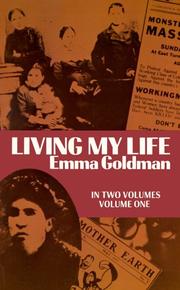
Living My Life is the autobiography of Lithuanian-born anarchist Emma Goldman, who became internationally renowned as an activist based in the United States. It was published in two volumes in 1931 (Alfred A. Knopf) and 1934 (Garden City Publishing Company). Goldman wrote it while living in Saint-Tropez, France, following her disillusionment with the Bolshevik role in the Russian Revolution.
The text thoroughly covers her personal and political life from early childhood through to 1927. The book has constantly remained in print since, in original and abridged editions. Since the autobiography was published nine years before Goldman died in 1940, it does not record her role in the Spanish Civil War.
Background
Emma Goldman was born in 1869 in Kovno, Lithuania (then Russian Empire). Her parents Abraham and Taube owned a modest inn but were generally impoverished. Throughout her childhood and early adolescence, Goldman traveled between her parents' home in Lithuania and her grandmother's home in Königsberg, Prussia before the family relocated to St. Petersburg. Though much of her childhood was unhappy, as her father was often abusive, Goldman was close with her older half-sister Helena and valued the modest schooling she received.
In 1885, Goldman immigrated with Helena to Rochester, New York to join their sister Lena and escape the influence of her father; he wanted to make an arranged marriage for her. Despite finding work in a clothing factory, Goldman did not stay in Rochester long. Enraged by the execution of the Haymarket bombers in 1887, she moved to New York and became one of the nation's most renowned anarchists.
Summary
Goldman begins Living My Life with her arrival in New York City on August 8, 1889—the day she said she began her life as an anarchist. She does not express her autobiography chronologically, as she considered her first twenty years to be something of a previous life. As Goldman recalls, "All that had happened in my life until that time was now left behind me, cast off like a worn-out garment." Living My Life reflects upon Goldman's time prior to New York as a means of explaining her principles and conversion to anarchy. For instance, she describes her employment in a Rochester clothing factory as an introduction to her antagonism toward industrial labor. Goldman claimed to work ten and a half hours a day and earned $2.50 a week, not unusual for the time. After she asked the owner for a raise, she was rebuffed; she left to find work elsewhere. Feeling alone in America, in 1887 Goldman "consented" to marry Jacob Kershner, a fellow Jewish immigrant. This marriage, however, would not survive long. While Goldman attributes her husband's disinterest in books and his growing interest in gambling toward their antagonism, the realization of his impotence was the breaking point for Goldman. She recalled being left in "utter bewilderment" on her wedding night. Goldman recalls being "saved from utter despair" in Rochester only by her fascination with the events at Haymarket and her subsequent move to New York City.
Goldman's memoir describes her first months in New York City fondly. The book vividly describes her efforts to meet Johann Most, the notorious German anarchist and editor of the newspaper Die Freiheit. Most, after the first meeting, became her mentor. Goldman's recollections heavily imply that Most was determined to craft her into a "great speaker," one that could take his place as a leader for "the Cause." It was during her unofficial tutelage that Goldman began public speaking. Beginning first by stumping in New York City, Goldman expanded her skills and departed shortly thereafter on a lecture tour of Cleveland, Buffalo, and her family's home of Rochester.
One of the key moments of Living my Life was Goldman's fateful encounter with a young Jewish anarchist named Alexander "Sasha" Berkman. The two met on Goldman's first day in New York and quickly became close friends and lovers. While Goldman credits both Most and Berkman with influencing her belief in anarchism, Living My Life positions Berkman and Most as rivals for Goldman's personal affections. Goldman recalls being courted by both men and being drawn to both in different ways:
"The charm of Most was upon me. His eagerness for life, for friendship, moved me deeply. And Berkman, too, appealed to me profoundly. His earnestness, his self-confidence, his youth—everything about him drew me with irresistible force."
These thoughts were indicative of Goldman's ruminations regarding "free love--" a persistent theme throughout the memoir. Maintaining that "binding people for life was wrong," Goldman carried on romantic affairs with Berkman, but rejected the advances of Most. In reflection, Goldman determines that Most "cared for women only as females" and ultimately "broke" with her because he wanted women "who have no other interest in life but the man they love and the children they bear him."
以上文字摘自英文维基百科「Living My Life」(有删节,去掉了参考文献等尾部小节),按 CC BY-SA 4.0 使用,作者为维基百科的各位编者。
资料卡
- 原题
- Living My Life
- 原作语言
- 英语
- 首次出版
- 1931 年
- 体裁
- 自传
- 主题
- 无政府主义运动
- 故事发生地
- 美国
资料卡来自 Wikidata Q3290152(CC0),众包数据,个别字段可能不全。